Tuesday, 5 April 2016

A week at Mamta’s

I have been in India for two months now. Two months already! I can’t believe it… There is much to say, many stories I would like tell. It took a long time for me to decide what I really wanted to talk about. I finally decided to tell you about my first week here and, more precisely, where I spend this very first week.

As every new interns, I had to start my internship with EduCARE in Gajner, Rajasthan to do my Induction. They told me I would spend the week in a homestay. What an exciting perspective! A bit scary too. I mean, spending my first week in India with a family I don’t know, with a completely different culture and who probably doesn’t speak English… it sounds challenging! I was afraid to not be able to understand them or to do something inappropriate or awkward. Well it finally turned out to be one of the coolest experiences I had so far in India.


I arrived at night in Gajner and the COM team directly brought me and two other interns, Costanza and Kelly at the homestay to spend the night. There I met Mamta, 17 years old, her younger brother, Anand, her mother and her father. She also had an older sister and older brother but they did not live in the house anymore.

Well, for sure the first moments were a bit… awkward. It was the first time they hosted foreigners and they seemed at least as uncomfortable as us. We spent our dinner basically looking at each other, smiling, and practicing the famous Indian head-wiggling (a right-left nodding that can mean ‘yes’, ‘I got it’, ‘thank you’ and ‘you’re very welcome’ all at the same time). Thankfully, the kids spoke some English and we tried to have some pretty limited conversations.

The day after, we learned some Hindi words, from other interns and from the kids around. At night, I was ready, my notebook in hand, to try out my first Hindi words! After having said ‘Aap kaise ho?’ (How are you?) and ‘Khanaa barut achcha hai’ (the food is very good), I was done… Still limited but it was a first step!


Kelly and me with Mamta's family

And day by day, by playing games, watching Punjabi video clips together, speaking some words of English and some words of Hindi, doing a lot of mimes, and having a lot of fun, we created a very nice relationship with the family. We showed them pictures of our family members and they proudly showed us the wedding book of the older sister. Mamta taught us how to make chapattis (I still have some work to do in this matter…) and Kelly taught her how to do pushups (I learned at the same time).

But what I will not forget is the last day we spent at Mamta’s. We came back for lunch and at home were only Mamta and her Mum. I don’t really remember how it started but Mamta’s mum ended up making us try her most beautiful saris and bangles. So much fun! After the picture session, Mamta even sacrificed her hands for my first try of henna. It turned up by being a complete disaster but she smiled and said that it was not so bad for a beginner… Hum… Sweet girl!

Drawing with henna

My first disaster with henna

Saying goodbye was pretty hard, much harder than I expected, to be honest. It was definitely a great experience.

I have been working in Harike, Punjab for two month now. My henna skills have improved a lot and now my chapattis are (almost) round. I am still in contact with the family via WhatsApp. I haven’t had the opportunity to see them again but when I come back to Gajner, I definitely know who I will take my first chai with.

Big up to Mamta and her family, the sweetest ever! I will not forget!

Trying on some beautiful saris 

Sacha Belle-Clot; France
Finance Coordinator and Microfinance Project Manager in Harike

Saturday, 2 April 2016

A weekend in India

Before coming to India, I was assigned to work in Rait, Himachal Pradesh. As excited I was to get to know this community, I also wondered how much I would travel and see the areas outside of this village. I read all the blogs on this website to obtain as much information as I could about what my weekends would look like (in addition to information about the projects in Rait, of course). Regardless of how much I read, nothing could have prepared me for the adventures that were to come. 

Now that I have been in India for more than two months, I, alongside my fellow Rait-ians, have travelled every weekend to villages and cities near and far. Included in the growing list is Shimla, Kashol, Manali, Dalhousie, Chandigarh, McLeod Ganj, and Udaipur. 

Shimla will never be forgotten (not that any of these weekend adventures would be) because It was riddled with both the good and the bad.


During one of my first weekends in Rait, I went to Shimla with Sylvja and a friend from the Harike centre, Sacha. It was a perfect opportunity to un-wind and seek some adventure outside of the Rait. So at 6:00 p.m. on a Wednesday (the last day of the work-week), Sylvia asked, "So are we going somewhere?" We looked at each other with that "oh-what-the-the-hell" look, and we quickly packed small backpacks not really considering logistics or considering; we were our the door by 630pm. Let me tell you, travelling by local bus during the night is not exactly fun. To all the future interns reading this, just know that local overnight buses will become your norm. Sylvia and I must have taken the world's worst bus driven by the world's worst driver (all of the buses in india will seem like this but, seriously, this bus was bad). With foreign smells and broken windows, we spent the next eight hours of our lives holding on to our seats for dear life. We literally could not rest our grip for fear of flying to the opposite side of the bus or inadvertently elbowing some cute, unsuspecting child. Sylvia and I also did not anticipate just how cold it would be in Shimla and on the way there. By the end of those grueling eight hours, we ended up wearing literally every single piece of clothing we had brought.

Arriving at 4:00 am with no reservations, Sylvia and I proceeded to walk the hills toward the main area. For two hours, we knocked on guesthouses door to door inquiring about availability. What made it worse was the snow. Yes, it was snowing. The two pants, two shirts, and two sweaters I was wearing could not keep out the cold. We finally found a guesthouse and slept for a few hours. With tired still in our eyes, we met Sacha mid-day. The first destination was the monkey temple. As you can guess, there were monkeys everywhere, but these were no ordinary monkeys; these monkeys were monkey thieves. Slowly creeping towards us with a nonchalant and calm demeanor, one monkey was just asking for trouble. He suddenly leaped toward my head and stole the sunglasses of my face. I wish I could say that my wonderful friends, Sylvia and Sacha, jumped to my aid, but no. They shouted and stared at me. I have to admit that my reaction would have been no better! 


Over the next 18 hours, the three of us unexpectedly went on a hike; visited some interesting and not-so-interesting temples and monuments; and nibbled on everything imaginable from coconut and peanut brittle to Chana Baturi to pizza. Finally, on Friday evening, Sylvia and I said our goodbyes to Sacha and we parted ways. We got on yet another gruesome overnight local bus back to Rait. We returned to our centre at 5:00 am with zombie eyes and strained backs (as we always do after a weekend of travel). After sleeping for a few hours, Sylvia and I went to the main market for the weekly house grocery shopping. As I was buying vegetables, several locals gathered around Sylvia and asked if she had been in Shimla the previous day. In a state of confusion, Sylvia and I pondered how they could have known that. A man came running to us presented us with the Himachal Pradesh newspaper.


Low and behold, a picture of Sylvia and I was on the front page. In Hindi, the caption read, "Tourists are enjoying the snow in Shimla" (or so we were told - I won't pretend I'm cool enough to read Hindi). Sylvia and I had no idea that we were being photographed! Being that Sacha is not in the photograph, I assume it was taken before her arrival. On one hand, I suppose it's kind of cool to be in the state newspaper, but on the other hand, it is somewhat disconcerting... We were 8 hours away from Rait yet everyone in Rait knew exactly where we were!

All in all, my weekend in Shimla was, like all the other weekend travels, unforgettable. For any future interns coming to India, don't do what I did and try to obtain as much information about as much as possible. Much of that information still won't really prepare you for this great adventure. Just know - You will be cold; you will be hot; you will be happy, you will be sad; and you will be sick. 

Just take it as it comes and have fun :)


Kelly Strautins - USA
Women's Empowerment Project Manager in Rait

Wednesday, 30 March 2016

Living in India

Before coming to India, I was warned by my relatives about how careful I should be and was told about so many clichés here. I am not saying that they were wrong but after staying 6 months here, I have seen so many things to say that India is incredibly amazing.

Beside my stay in Himachal, I have also been able to travel for holidays and I have seen things that I would have never expected. Travelling here can either be exhausting or incredible; all depends on how you place yourself in the situation. I understand why people call it Incredible India. From north to south, west to east India, everything changes so much: language, people, food, habits, weather and nature. And I have not even seen 1/3 of this country.


Here, all your senses are awakened and you will feel yourself alive and awarded.

Your eyes will be amazed by so many things - The colors of clothes; the crazy cows, donkeys, horses, monkeys and goats that will chill in the street; the Sikhs, Hindus, Muslims, and Christians that will follow their religion next each other; the Himalayan mountains in the north; the incredible forts almost everywhere; the crazy Taj Mahal; the beautiful beaches in the south; the nature of Hampi; the spirituality of Rishikesh and Varanasi; the star gazing in the desert, in the mountains and at the beach.

But the paradox between rich and poor living close by each other is also part of this experience, as the lack of waste management system that is a real question and the craaaazy traffic of big cities.

All the smells will stop you. From the food smells to the street smells, that is what will make you stay in a place for more than few minutes or make you go away. Curry, masala, turmeric, ginger, but also less appetizing smells from the street and pollution. If you love spices like I do, you will have to make sure to try every single food. There are so much tasty food and different tastes from north to south. It’s maybe not always the healthiest food but what is good is not always healthy!

Travelling is crazy and so is the available transportation: car, bike, tuktuk, local bus, public bus, roof of a bus, train (with proper ticket and general ticket), camels, jeeps, truck, and an ambulance. I might repeat myself but once again, India is incredible. So many noises, from the horns, bus conductor, street sellers and music. But in all the mess, you always have a peaceful place, for me it’s Himachal.

I have been lucky to be placed in the beautiful state of Himachal. Among the mountains, sometimes very cold, sometimes super-hot, there are so many to see and so many people to meet. My stay in Rait went through ups and downs, as I have already mentioned in the other blogpost. I am very thankful to EduCARE to have given to me this incredible opportunity. I have been lucky to spend 6 months with people from this developing village. If you ask me about my daily activities, it would never be the same but here are some of them that I won’t forget. Waking up and taking your breakfast in front of the mountains; going to fun club and having fun with the cool kids in town; going to girls club and discussing relevant subjects to girls’ development; going to the migrant camp and having fun with the kids; teaching the woman how to use the stitching machine; visiting the woman in Rait that are willing to work with us on microfinance projects and planning it with them; finding out new projects and visiting different people that can help; organizing workshop in schools; working in the garden; going back home and preparing the food all together. I have learned many things here that make my stay a life changing experience. Among many things, my relatives will be surprised to see me cook Indian foods, stitch with the stitching machine, growing mushrooms, tend to a garden, etc.! I will miss all the people in Rait that were always smiling at me; that would fill my tummy with chai and sweets every day; that would converse with me through smiles, laughs and sign language as I believe that the language should never be a barrier.


View of Himachal Mountains

Besides them, I will miss all the interns that I have been working with in Rait. I have seen fifteen different interns coming and leaving the house and my time has now come. I wanna give a big shout out to all the people that cross my way on this beautiful journey!


Anyway, here is how you should see life: Never stress your mind with little things when you can just make it easy by looking at it through another perspective.


Sylvia Rajaonah - France
Rait Centre Coordinator and Microfinance Project Manager

Saturday, 26 March 2016

Eco-Building in EduCARE India

When I arrived to EduCARE in October, there were no Ecobuilding interns nor previous coordinator. Some projects were done in the past and a few more were already spotted, so it was time to start working. I was expecting to stay in Naddi but I was sent to the new centre where community engagement was the most important part of the first months in Harike. Through all these house visits and walks around the village, I was able to observe the habitability conditions of most of the families. Five factors define a slum - lack of potable water or sanitation, overcrowded houses with no durability and insecurity of tenure - and you can easily identify some of them in the communities where we work in EduCARE. Although it's a small scale, with between 40 and 120 families, reaching awareness and improving their skills to finally help them building the needed infrastructure are the right steps to make a difference.

The number of Ecobuilding interns increased in the last months what allow us to develop new ideas and projects. In December we received Niall from Ireland, who has previous experience in bamboo and earthquake construction. He came right before Christmas holidays with lots of enthusiasm and willing to start building!

In January two more interns joined our team, Faik from Cyprus and Alexis from France. They are now working hard in Rait and Naddi respectively and we'll see the results very soon! The last Ecobuilding addition was Lamia from Madagascar, who joined EduCARE a couple of weeks ago and will be starting the new centre in Rang Mahal.

Currently, we have ongoing projects in the three main areas we work on: interns' houses, furniture and community projects.

Indra´s homestay with bamboo structure and mud walls
In Harike, we are improving our centre by building a fence that will keep strangers away during work hours - they are welcome the rest of the time!, making new furniture for our common area and designing the future ReStore that will open soon. The garden keeps busy our interns in Rait, where they are planning a greenhouse and experimental vertical farming to extend to families who don't have enough space for an horizontal orchard. Faik is also making new furniture now that the centre is full. Alexis will show soon the result of the greenhouse he's been planning in Naddi, next to the nursery where the forestry team work. Finally, all the interns in Gajner are finalizing details for the ReStore launch, including furniture and a canopy made by Niall. He's also working on the ECRC design and a new homestay in Indra's colony. Two weeks ago, he delivered a three days' on site workshop for interns and community about bamboo and mud techniques, and the outcome is that the homestay is almost ready to use!

Indra's Homestay

They all are small projects that will improve the interns' stay or the communities' conditions. Hopefully we'll serve as an example to them, increase awareness and family incomes, transfer our knowledge, eliminate the stigma to some materials, adopt a more sustainable way of life for, at the end, improve their habitability conditions and dignify their lifes.


María Reyes - Spain
Ecobuilding coordinator in Harike

Friday, 18 March 2016

THE 5 STAGES OF BOOKING A TRAIN IN INDIA

Let me preface this by saying that I am an experienced traveler, especially in the developing world, and yet even I face these 5 stages almost every time I try to book a train. These are really only applicable to when you are booking a ticket that is available, because when you’re booking yourself straight to the waitlist, you generally skip these stages and go straight to defeat and angst, where you remain until the moment your status is changed to confirmed. 

NB: If you don’t have an Indian credit card or bank account, the only website you can book trains on is ClearTrip. In order to do so, you still have to have an account with IRCTC, the Indian rail company. In order to make an account, you need an Indian phone number. So if you have to book before you get to India, which most interns do since we need to get from Delhi to induction somehow, ClearTrip helpfully lets you use a dummy number and then you can email IRCTC to get your mobile one-time-password via email and make your account. 

Excitement. In which you’ve spent days, possibly weeks, planning and dreaming about your next Indian adventure, even if it’s just a weekend. You’ve spent hours on TripAdvisor.in and other blogs, figuring out the best and cheapest way to get where you want to go, where to stay there and what to see. All that remains between you and discovery is time and your train tickets. 

Denial/table flipping. In which one of two things happens. Either A, you reach the page where you put in all the information like passport numbers and then click “book” and it tells you that it cannot get current train information from IRCTC, please check back later and you have the sudden and overwhelming urge to flip the table you are sitting at, after lifting up your computer and chai, of course. And with every time this little red error message pops up when you click “book”, you fall deeper into this state of denial and disbelief until you abandon hope, fall back into your indoor-use plastic lawn chair and wave the proverbial white flag. 
Alternatively, you encounter situation B, in which IRCTC asks you a security question that you never made because you were never able to actually get into your account on the IRCTC website because you couldn’t receive the mobile code needed to make your real password because you made the account with a fake phone number, and you can’t change that fake number because in order to change your number you need to get into your account which you need a mobile code to do. So you find yourself being asked your pet’s name when in fact you don’t have a pet. So you send lots of emails and call numbers that either don’t exist or don’t have any humans on the other line until you give up and just make a new account using your real Indian phone number. 
At this point you start the whole process all over again and soon find yourself on the page where you are about to be finished, all you need to do is put in your IRCTC password and enter the “captcha”. It all seems so simple. You’ve made it, finally. So you enter the password and captcha and it tells you that your credentials are incorrect, or that the captcha was incorrect. So you try again, and again, until finally you lean back and close your eyes in quiet defeat. 

Quiet defeat. In which you sit staring at your computer, wondering why, why do bad things happen to good people? Why is this so hard? Why is it so hard to book a train in this country that the simple idea of doing so is used to cut diamonds? Your musings about this question quickly spiral into an existential crisis and you find yourself staring off into the middle distance wondering “why do you exist, IRCTC and ClearTrip, respectively, and why am I here, trying futilely to use you to accomplish what one might otherwise and naively presume a simple task? What is life, little box on the white screen asking me for a password that even Shiva does not and cannot hope to know? And most importantly, what reckless fool invented captcha?

Renewed hope. In which you’ve had some chai and moral support and are ready to try again, bolstered by the promise of another adventure awaiting you once you complete this process and the pressure of the fact that you likely have people relying on you to book their tickets as well. 

High blood pressure. In which you have your train booked and yet you feel no joy or satisfaction looking at the email from ClearTrip, the confirmation from IRCTC and the multitude of indecipherable text messages you receive from ClearTrip, IRCTC, perhaps your mobile provider, the train conductor, the Prime Minister of India and the ghost of Mahatma Gandhi. You instead feel the desire to drink 7-10 cups of chai and the need for some sort of sedative. Not for another 12 hours or so will you return to the pre-booking process euphoria and excitement of knowing you will soon be in another unique and colorful city seeing and doing and tasting and hearing things you will never forget and perhaps having your snacks stolen out of your unexpecting hands by a monkey or being offered a ride on a camel-drawn cart by some kind and curious locals who will likely want to take a selfie with you. And then it will all be worth it.

Naddi interns and myself at the Golden Temple in Amritsar, the previous weekend destination.

A staircase in Rishikesh, my most recent destination in my explore-north-India-in-my-weekends project 


PS: Ironically neither of these places were reached by train, but we've been booking extensively for upcoming trips - just trying to find our way :)


Kyla Korvne
Women's Empowerment Project Manager in Naddi

Saturday, 12 March 2016

Opening up a Girls Club in Harike!


What to say about my first few months here in Harike? 

When I first came to Harike, I thought my project was off to a slow start. The center was just opening and the three musketeers—Maria, Tommaso and I—along with our beloved Ethan, the center manager at the time, were in charge of establishing the centre within this new village. This meant that a great amount of time was to be spent engaging people, creating relationships and establishing trust with key individuals, while doing our best to always make a good impression. There was one thing we had not quite anticipated, however, and that was the extent of the language barrier in this village. Oh and being the only white people in the village, thus making us the object of constant scrutiny. 

Now, we all knew that community engagement was to be a part of the initial stages of our projects. I, for one, could not develop or implement my project without this crucial first step. Therefore, our first month consisted of what I felt was a series of failed attempts at verbally interacting with community members; we did not speak Punjabi and they did not speak English. Other than reading out a long list of Punjabi vegetables names just to get a laugh out of a group of school girls, there wasn’t much more I could say, and vice versa. How were we supposed to develop, let alone implement our respective projects?!

Then one day, it happened. As we were preparing to host quarterlies, Mr B took us on a visit to a neighbouring village called Makhu and introduced me to a timid, but very lovely girl—Harjwinder. We could not do much more than exchange smiles, head nods or hand gestures, and a few dance moves (my “go-to” place when we are so verbally limited). I, then, asked if she was interested in having English lessons and soon after, I had a list of names, ages and phone numbers of girls who were excited to learn English with me. I opened up a Girls’ Club only two weeks into the internship. This was going to be my baby, the center of my attention for the next months! Needless to say, I was equally excited. 

Playing Musical Chairs with our Girls’ Club in Makhu
In the meantime, as a center, we formed ties with a school that was happy to have us deliver sessions on various topics. I learned that the school had no Sex Ed programme and the kids were not taught about crucial life changes such as puberty. I saw this as a perfect opportunity to teach young girls about menstruation and give them the necessary knowledge and tools to cope with this new and natural process. As expected, the girls were shy but—thankfully—also very curious. To my surprise, the teacher that was translating for me said she had also learned some things. This was incredibly rewarding and I would do it a hundred times over. 

My first session on Puberty and Menstruation at Shri Guru Hargobind School. The students were aged between 13 and 16 and very keen on learning about this topic.  

Some time before the holidays, some changes happened and we received, Sabina—also a Women’s Empowerment project manager—who was transferring from Paro to Harike. We were now two interns working on Women’s Empowerment projects at the center and I knew we’d make a great team. Only two weeks after the holidays, things happened, again, so suddenly and in the span of a week, three Girls’ Clubs were up and running in three different communities—one in Makhu and two in Harike. 

Sabina and I with school staff, principal and some students after our session Puberty in Menstruation at Secondary Government School Harike Pattan


To this day, I am amazed at how this country works. It is so easy to get discouraged and be tempted to give up based on the impression that everything feels like a struggle. All you need is to have all the elements perfectly aligned for things to happen. And they do (happen). In other words, be patient…but stay focused and continue to work hard. Things will happen when you least expect it.

One of our most recent Girls’ Clubs—they are the most enthusiastic girls you will meet in Harike!  


Jessica Cialdella
Women’s Empowerment Project Manager, Harike (Punjab)


Saturday, 5 March 2016

Insanely incredible (and incredibly insane) India

Where do I start to describe my experience in India? The food?The colours and smells? Or perhaps countless number of cows roaming the streets? One thing is for sure, my time in India has been anything but dull!

During the EduCare Induction in Naddi, also referred to as “India light”, I got my first taste of this remarkable country. Beautifully located in the Himalayas, it was a great place to get to know India and meet all the other interns. I definitely experienced a bit of a culture shock in the beginning. Living with an Indian family in a mountain village with the dinner cooked over an open fire was amazing, but not something I had ever experienced before. However, as I was about to find out, I hadn’t seen nothing yet! A few days later I began my journey south to the state of Punjab. It was only a couple of hours away, yet the more south we got, Hinduism and Buddhism turned into Sikhism, mountains to green fields and peaceful Om-humming into vibrant Punjabi pop. I was sent to the centre of Paro, a tiny community with approximately ten shops selling more or less the same things (mostly Punjabi sweets) and with a bushorn so loud it could wake up the deaths. In this community, we worked primarily with a couple of migrant families living in a camp just outside the centre. It was incredible to get to know these people and their way of living. However, with the cultural differences, major language barriers and as most of the girls could not read and write, it was also immensely challenging. I came to learn though that the universal language of gestures and laugh will take you a long way (along with hours of badminton playing…).


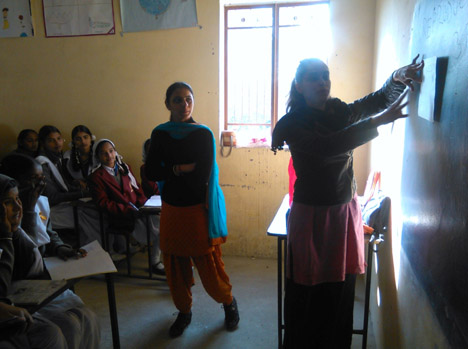
Girls Club
One of the hardest parts of the internship was witnessing the poverty the migrants and so many other people live in. I often felt somewhat helpless thinking about all the issues I would like to address in the community and in India as a whole. While I was not at all expecting myself to perform miracles, it also hit me how many people and animals suffer in this country and how many of them I am not able to help. With many of the girls we worked with being engaged already as well, some of them underage, it felt as if their futures were already sealed. When these thoughts hit me, I always thought of what the Women’s Empowerment Project Coordinator told me before I started my project. She said that while there are some aspects of these girls’ lives that you cannot change, you can always inspire them to dream. I have been carrying this last part with me throughout my internship and it has given me motivation at times when I felt like I was just wasting my and the girls’ time. 

The 2-week Christmas break provided an opportunity to get our minds off the projects for a while. Me and a number of other interns travelled south to Mumbai, Goa and Hampi. It was great to be able to travel and see another side of India, and also to get away from the freezing Punjabi winter! As the Paro centre closed after Christmas due to lack of manpower, I joined the other Punjab team and their vicious buffalos (they really hated us) in Harike; a place characterised by its wetlands, crazy traffic but most of all its awesome EduCare team! Here I helped starting two new Girls’ Club projects in different communities. It was truly great getting to know the girls. I’m sad that I won’t be able to stay and witness their progresses. I am confident however that we have managed to plant a seed for empowerment that has the potential to tangibly improve the lives of the women and girls in the area. 

Girls Club in Harike

So, to sum up, what was acha and what was achanahi?

First and foremost the girls from Girls’ Club! Their smiling faces and constant “didi”-callings made my day every time we went to see them. I will definitely miss my funny, crazy but above all else highly competent team members who provided great support (and entertainment!) throughout my internship. I will also miss the slightly awkward (due to language barriers) chai-gatherings with local families, Indian head-noddings (so contagious!),the delicious Punjabi sweets and the cheesy Indian soap operas. In a way I will also miss the unpredictability. Making plans in India was virtually impossible, and even if you did, you would very likely be forced to change them. Coming from a country where being 5 minutes late is almost a crime, this concept of elastic time was sort of refreshing.

Community of Harike
What I won’t miss as much is the crowdedness and constant stares. Random people asking for pictures of me is also something I can definitely live without, just like the piles of cow poo on the streets, the deafening noises of bus horns,power cuts and sneaky kitchen mice. 

And will I come back? As an intern once stated, you can spend five years travelling around in India and still only experience a fraction of what this country has to offer. So yes, I will be back, a couple of years older and a million experiences wiser! 


Sabina Bäckman
Women’s Empowerment Project Manager in Harike