Showing posts with label Portugal. Show all posts

Saturday, 16 July 2016

Women of Gajner

The first thing that strikes you when you come to a rural village in India is the people. People that look so different, that dress so different and whose habits are so far from yours. But then, you get to meet these people, to talk with these people in your broken Hindi and share moments with them. And you understand just how similar you actually are. And it is beautiful. 

As fervent believers of cross-cultural exchange and mutual learning, we wanted to know more about the stories of the people who constitute Gajner. Its people, its traditions, its soul. We wanted to give them a platform to share their stories and inspire each other the way they inspired us. So, we decided to create a project named Humans of Gajner. Similarlyto the famous Facebook page “Humans of New York”, we wanted to capture the soul of Gajner through pictures and stories of its people. 

We started to think about the stories we would like to showcase and really define the aim of this project. There, we realized that, from our personal point of view, the stories who needed to be told the most were the women’s. In Gajner, men are everywhere outside, they can talk, they can decide and they can share. The women, who are often kept in their houses, can be undermined and forgotten when you walk through the streets of Gajner. But, as you are welcomed inside their homes and their intimacy, you realize just how big a role they play in their household and therefore in the community. All the women and girls we met here, whatever their religion or age, have taught us something and have a unique role in making Gajner what it is. 

So there, Humans of Gajner became Women of Gajner (at least for now). We decided to start with the women of the community we know. The stories and pictures will be showcased in a safe, women-only space that we want them to make their own: our Vikas Center ECRC. As our center’s Girls Club is held there, these stories can inspire young girls and women to be proud of who they are and find their path to happiness and accomplishment in a society dominated by men. Also, as more women come into the ECRC, this will hopefully create links between them as it is a platform for them to share and discuss. 

We planned very carefully our schedule and stories/pictures to take. But, as everything as India, it did not go according to our plan. The first obstacle was how to explain these notions, very common in our Western world, in simple and down-to-earth words so that the women can understand. For this, we were lucky to have in our team Meera, our favorite Indian brilliant doctor intern. She perfectly understood where we wanted to go with this project and adapted it to words and notions that the women here will respond to. Also, she is our translator for our encounters with the women and our project greatly benefits from the relationship she easily establishes with the women.

We chose women that Educare has established relationships with. Obviously, we wanted every single woman and girl to tell us their story as there is so much to learn from them, but we needed to choose. We wanted women that are emancipated and have found a way to be powerful in the community, to be role models for younger girls. But, we also wanted to showcase women who may seem like regular “underpowered” housewives. Indeed, many girls will unavoidably get married and have to stay in their houses, and many will be restricted in their lives by their in-laws, so we wanted to give them examples for hope. To show them, at a very young age, that society will not get to decide how strong and powerful they are. That, even from home, they are central to their family life and that they are not weaker than men. That, whatever society tells them, they matter, deserve respect and can achieve great things. 

The second obstacle we faced is the paternalist family rules. Many women/girls needed the authorization from the men in their family. This was really tough because 2 key women we wanted to interview and photograph were not able to participate in this project. The most frustrating for us was to see how enthusiastic they were when we presented the project. And then, just because their husband/father did not want to have their picture in the ECRC, we could not showcase the great role they play in their family and community. And still, there is nothing you can do as you have to respect their authority. However, we expect that in the future, when the men will see that the picture will be seen by women only and how careful we will be with it, they will be less skeptical and hopefully there will be less restrictions from this. Also, a part from their authorization, we also needed to handle their presence during our interviews with the women. For one of our stories for example, the man was the one speaking the whole time, even if we were directing our questions to the woman. So again, you cannot say anything, smile and think how you can still make the woman the center of the story. 

This project has been full of ups and downs; coping with people’s personal schedules, running after women to take their picture when they are available, having men telling us that we cannot tell their wife or daughter’s stories even if the woman seemed very enthusiastic, the cultural and language barrier… But we can definitely say that every single step, obstacle, encounter has been worth it. The road to the 4 final stories we have has been bumpy and tough but it has given us so much more than we expected. These 4 stories, written solely from what they told us, give a glimpse of these women’s pride and individuality. 

In the future, we wish to continue with this project as it is a great platform for exchanging but also deeply understanding these women, their vision and their role. We don’t know the whole of Gajner, and are actually very far from it, so this project aims to discover even more these beautiful and strong women. And for us, this project represents exactly our role within the community: build platforms for the community to express their potential and take leadership on their own and village’s path.


Women of Gajner Making of


Costanza Burstin - Women's Empowerment Project Manager and CC in Gajner
Debora Cortez-Miranda - SWASH Project Coordinator, P. Manager and CC in Gajner
Meera Suresh - Rural Health Care Project Manager in Gajner

Wednesday, 25 May 2016

Something Special

There is something about Gajner. That’s what everyone says. And when they say that I don’t think they mean the beautiful Gajner Palace or the lake. Nor the mesmerizing sunsets and the amazing desert landscape. In my case, now that I am leaving after 6 months, I came to narrow it to three things: the people, the animals and the pani puri. I will start with the last.

Pani Puri
I truly believe Gajner has the best panni puri in the world. The only panni that not only tastes amazingly good but doesn’t give you diarrhea (at least not to me). And the special one, as I like to call it, the one without the water you get in the end, tastes like India to me. Sweet, sour, spicy and interesting enough to keep me coming back for more.

The man that creates the magic!

Animals
Delhi. Delhi was our house puppy we rescued from the streets, who sadly is no longer with us. He destroyed my favorite pair of gloves and pretty much every shoes I owned. I used to call him “Terrorista”. Manoj says he had an education. Indeed, he had an education, but he was a rebel at heart. 


Delhi's bright and dark side


Mico and Vather, our two beloved pet geckoes. Recently, they have been occupied doingsome horizontal (vertical?) dancing. Actually, I noticed a little bump in Vader’s belly which leads me to believe that the gecko family might be increasing anytime soon. When you don’t have television, this is the best you get. 

Lady, the nicest and smartest dog in Gajner. In fact, the only dog that acts like a dog around here. She wails her tail when she sees you, jumps at you asking for affection, and follows you around. She recently dig a hole just outside of our house where she retires during sleep. Summer doesn’t spare anyone and even the dogs can’t handle the suffocating heat during the night. 

The Cat who comes to our house at night when everyone is asleep to steal our food. He has literally the weirdest taste when it comes to food, and he eats anything from dog food, bread, and eggs, to toilet paper, tampons and sanitary pads. Disgusting I know, but true. Our cat is also a very needy cat and tries to cuddle with people if given the chance. He has found his way into our rooms a few times, and once Orane (an amazing French intern) woke up with him on top of her in bed.

Finally, the moody cows in front of Mr. Bero Singh vegetable shop. For future interns, especially female interns, keep your eyes wide open and prepare to run (and scream!) when crossing through this (dangerous) area, because these cows might attack you for no particular reason. It has happened in the past and it may happen again.

People
Our community has the kindest and friendliest people I met in my life. Living in a place where people actually remember your name and care enough to reach out to say Namaste whenever they see you gives you an immense joy and a true sense of belonging.

Ankita, is one of the many kids in town who runs to you whenever they spot you on the street. For six months our interactions have been always the same. She asks me my name, I reply and then we engage in fist punch with a boom in the end.

Then, there are all the shopkeepers in the main street who, in the beginning, looked at me with curiosity but, whom with time, I became very good friends with. Not surprisingly, my Hindihas evolved from knowing only casual greetings to knowing back and forth the Hindi words for all the vegetables and fruits and many other foods. And then there is the constant invitations for chai, and all the people that ask you to come to their house for dinner, try to teach how to make chapatti for the hundredth time, and reject your weird shaped chapatti as its form would alter the taste.

Vimla, who the moment you say you have to leave her house, gets you more food so you have stay a little longer. And Sorav, her son, who is one of the smartest kids I have ever met, and who at 13 is already thinking about university and studying abroad. Sorav, who is Hindu but spends almost two hours looking for eggs with you (when many others cringe even to the sound of the word) when you decide at the last moment you want to make a cake for dinner.

Me and the kids

Manoj, who not only helps you immensely with all of your projects, but also tries to teach you Hindi, cooks the best Indian food you will ever taste, and invites you to come to his house and celebrate Holi and Diwali with his family.

And Shushuma and her family,Anjuman and Mubarak Je, Dappu, Durga, Pria, Shreea, Kumkum, the Gajner team (you guys rock!), and all of these others amazing people who I would write things about if I had the space, but I am almost on 900 words now and this is obviously getting way to long.

The funny part about leaving is you are not gone yet and you are already thinking when you are coming back. I guess there is really something special about this place. 

So instead of saying goodbye I say phir milinge Gajner, phir milinge India!!

View of Gajner from our roof


Ana Silva - Portugal 

Rural Healthcare Project Manager in Gajner

Tuesday, 12 January 2016

Want subdji?


It all started with a simple request: “Can you show me the vegetables you have in your house?” Meera and Kursida, the two older daughters of Saira and Sadiq – a family we have a chicken coop project with in Modia Mansar- pointed to the phali (rajasthani beans) drying on the floor of their one room house and to three pieces of kakria (an Indian sweet cucumber) laying in a small basket. To me it didn’t seem like a lot of food for a family of 6 (they have two more children) so I asked “Or subdji? (More vegetables?) Aloo (potatoes), gobi (cabbage), tamatar (tomatoes), piaj (onions)?” The girls shook their head no. After some more questions, I came to realize that Modia Mansar only has a small variety shops that sell cookies, chips, and dhal, but no vegetables or fruits. They have to travel all the way to Gajner to get them.

Gajner is located 10 km away from Modia Mansar and although 10 km doesn’t seem that far, unfortunately not everyone owns a car or a bike, and not everyone can afford to use a tuk-tuk on a regular basis. Even if they can afford it, we know by experience that tuk-tuks are not always available, nor its drivers willing to do that specific journey, as there is a highway in between and the roads are in really bad shape. That’s when I realized the limitations this community face in terms of accessibility to food and how it to a certain extent affects their food choices and health. In conversation with one of my fellow co-workers this idea of a pop-up vegetable came up and now we are doing it every week.

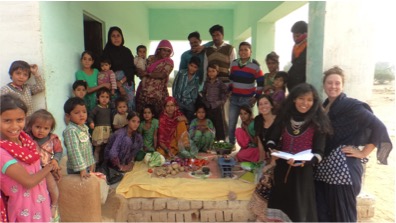
Our formula is very simple: every Monday, in the morning, we scavenge Gajner vegetables stands for the best prices; around 3 p.m. we pack our vegetables and fruits, a bed sheet to display our goods, a scale and off we go. Once in Modia Mansar, we display our things in the front porch of Sadiq’s house with the help of his children and then we wait. Usually it doesn’t take more than 10 minutes for our first customer to arrive. Saira is often present, and usually helps manage all the weighting in a not-so-easy manual scale and understanding the more complicated customers’ requests. All I can say is that so far the initiative has been a great success. We already have requests to bring more products, such as eggs, and a woman from the community has demonstrated interest in taking over the project.


Me selling a bag full of vegetables to one of our regular customers

In addition, last week we almost sold out all the vegetables we brought. Only the cauliflower didn’t find a home, as usual, and to this I must say something about. Our customers are really demanding when it comes to cauliflower. At first, the problem was the stalks. They didn’t want to buy cauliflower because they didn’t want to pay for the stalks, as they don’t eat them. In order to make our customers happy, I started bringing the cauliflower without the stalks. It was not enough. I came to realize that in addition of being stalk-free, the cauliflower needs to be a certain size (not too small but not to big), have the perfect beige color and be just firm enough, to have a chance of conquering a place in their kitchen. In the presence of a non-conformity, even dropping the price from the usual 20 rupees to 5 rupees is not enough to convince the cauliflower experts. 

Carrots are also neglected but surprisingly not for aesthetic reasons. The truth is people don’t know what to do with them. I believe part of the reason for this is that people are not used to having this vegetable around, as it is only available during the winter months. In the beginning of November, we started to hear “carrots are coming”. The possibility of having carrot soup or a simple raw carrot was something that made us all pretty excited, but unfortunately many Indian families don’t share the same enthusiasm, as carrots are not frequently used in a lot of typical dishes. Spinach faces similar popularity issues, which is something that I’ll work my best to change, as spinach is one of the few high sources of iron in a community where anemia is prevalent. On the other hand, green chilies, ginger and bananas sell effortlessly, and radishes are equally appreciated by humans and the goat population, as some of the goats walking around always try to get some when we are not looking.
A goat trying to steal some radishes
The vegetable stand in Modia Mansar is much more than a way to provide the community with a service that was not available before. It’s not only about making things easier. For me as the Health Project Manager in Gajner, it is ultimately about forging new relationships, deepening my understanding of the community’s eating habits and diversifying their vegetable and fruit intake. 

A successful vegetable stand in Modia Mansar with Saira's family and neighbors


Ana Silva - Portugal
Health Care Project Manager, Gajner (Rajasthan)

Tuesday, 22 December 2015

Chai and an EduCARE's experience manifesto

So I'll be talking about my overall experience with EduCARE. It has been quite a ride. Four months have passed but I feel, at least, one year older. It was fast yet so enriching.

Most western people come to India to find themselves. I came to India to find India and then, maybe, find myself. You see, how could I find myself if I don't even know where I am? If I can't even understand basic hindi or why people act like they act in here?

I'm glad I've found an organization like EduCARE, which gave me the opportunity to live so close to the Rait community and within Indian culture. Here I've met some of the kindest people in my life. Indeed I can use kind as a good description of Bhahari people. They will welcome you warmly to their homes and be genuinely curious/interested about you. Even without knowing you they will still feel responsible to take care of you. And let me tell you, they will take really good care of you. Obviously, they also come with their eccentricities. For example the difficulty to say no or that they don't know the direction to some place you are headed put me in messed up situations where patience couldn't really help me that much.

Anyways, I am also really grateful for the opportunity to share this experience with all the EduCARE team, particularly the (G)RAIT Team. Working next to you made me grow as one can only do among family. You'll be with me forever. (G)Rait brothers and sisters, I'll miss all the laughter, all the trips, all the messed up situations we put ourselves in and escape alive of and how we used to learn together. How we managed to live with each other having all different paces and make such a beautiful home out of the Rait house. It was amazing to work with all of you and getting to know what you are made of and what daily India can be.

There was times when I was very unsure about the work itself. I was wondering, is it just me? Am I really too ambitious while being too quiet while being too aggressive while being unlikable? Am I not funny enough? Am I not working hard enough? Do I belong?

Well, the adaptation can be a really hard process, which for me resulted in this kind of questioning. It took me a while to pick up on my work and get the hang of it; understand my duties, my rights and my limitations within this position. In the end, all the questions answered, I felt freer than ever as well as empowered: I learned that I'm more patient than I thought I was and that I can indeed overcome quite a few obstacles. The important thing is: Slowly, slowly but Rait is moving forward, gi. 

& Chai 4 life!


Inês Ramos - Portugal
Women's Empowerment Project Manager, Rait (Himachal Pradesh)

Tuesday, 15 December 2015

Whatever happened to my Womanhood (part I). Living in India: Expectations Vs. Reality


So I've said many times before coming to India that I knew about the cultural differences, particularly the ones concerning being a woman in India. In my specific case being a woman in rural Himachal Pradesh, India.

So about being a woman in Himachal Pradesh. I always felt really strong about my independence and autonomy. I was never good at being told what to do or what to say. Oké, even sometimes my temper is the boss of me. Anyways, I knew I would have to remain passive in more situations than I usually do. Ok. No issue! I thought: - if I live through this it will certainly improve my patient, my interpersonal/social skills, my understanding of what it can feel like being an Indian woman and my understanding of what my culture allows womanhood to be. So far I had a lot to gain.

And then it happened…the warnings started and I did not see them coming, specially since I was following the rules of conduct. The warnings about how dangerous it is for me to walk in my own neighborhood hit me hard. Specially coming from a friendly neighbor of ours. It happened three times in two months. Yeah, it was a bit past 7 p.m. So what it was already dark since 6p.m. because it's winter? I had just finished work and needed to buy some food. The worst was it came from a supposed friend. I mean, how could he not see how threatening and demeaning he was sounding. He gave me 2 of the 3 warnings. Both times I was with fellow male colleagues with whom he engaged in gleeful conversations and when the glee vanished he decided to address me to exclusively warn me about the danger I was running. It made me feel small, powerless, threatened and like I didn't own my own life. I didn't have the reaction of replying to him, but what to say?

I cannot help thinking that these warnings and rape culture are somehow intertwined, at least from where I see it. He did not warn the men that were with me. The warning was only for me, because I'm a woman. Despite our friendly neighbor naively yet truthfully warning me for my own good (I know this, cause today he told me about how I should buy a sweater (winter is coming) and beware of being overcharged) he was simultaneously contributing to carve the bars of the cage rape culture puts around all of us women in. He should not tell me to be aware of my steps on the way to buy groceries. Instead he should tell men to stop harassing people, women, girls whether it is day or night. However, how can I explain him all of this? He would not understand. Probably he would even get offended for me rejecting his good advice.

Oh well, I hope the demand for self-defense courses will soon rise among women in India. Women can and must defend themselves. It starts by rejecting a conformist position and stopping to accept this type of "advice" as justifiable. The warning can be based on true facts of existing violence. Nevertheless this violence will persist if we continue to emphasize the victim as the element that takes the blame instead of the aggressor.

When I mention learning self-defense I mean to learn how to defend yourself, not necessarily in a physical way, but in a way where you can recognize where you stand and what actually your position is about a particular matter. Learn about what in reality happens around you and what you can do to change and improve it.

Inês Ramos - Portugal
Women's Empowerment Project Manager, Rait (Himachal Pradesh)

Friday, 11 December 2015

The Making of a Journal: p.s. It's Personal


Before I've arrived in India I already knew I wanted to manage the project Girls' Club.

The first time I went to Girls' Club (just as an observer) I encountered this group of energetic teenage girls who mostly kept to themselves or traded secrets or inside jokes amongst each other. It was noticeable how self-aware they were while verbally participating in group activities. It's natural to act this way, specially throughout adolescence, while one's building their self-confidence and self-esteem. However if you add the natural cultural and linguistic barriers you have quite a few obstacles to good communication. Only with lots of time, dedication and patience can you slowly overcome these. I had almost 4 months with them. Ah, and it took me at least 2 months to feel comfortable in India.

One of the main goals of Girls' Club is to create a platform where the girls can freely express themselves, their interests, joys, concerns and fears. It is supposed to be a place to share experiences, learn and understand what it is like to be a girl in India.

I developed the idea of making a personal journal since it can work as such a platform. It can be used freely and the girls can dare express anything they want. Importantly, it gives them the confirmation that they have the right to their privacy and to their secrets. That they should invest in listening to their own voices. Besides, I had never done a (note)book from scratch. I was sighted to learn about it.

In one of my trips to Dharamshala I've notice this printer/stationary shop and went right in. After introducing myself and my intention of learning how to bind and make a notebook, I've agreed with the shop owner I would buy the raw materials for at least 10 notebooks if he agreed to teach me how to make them. That closed the deal.

On my first day I went alone and was received by a very peaceful and relaxed team. I had to wait until they were ready to bind books which took a couple of hours. Throughout that morning they were just performing other tasks. They let me help them in some of them - e.g. organize the pages of some books. Simultaneously I did a lot of waiting and learned about how patient I can be. I also grew respect for the work of these men. It is beautiful and so fulfilling to make something yourself…and not just buy it done by some machine.

The girls were so happy when they learned we would be doing the journals. We divided the making of the 13 journals through 3 weeks. It was an activity difficult to coordinate specially due to the barriers mention above but it was totally worth it. The girls turned out to be really creative and put a lot of effort personalizing their diaries. Despite the raw materials being equal to everyone, in the end all diaries where different from one another.

Me and Hellen learning how to bind journals 


Inês Ramos - Portugal
Women's Empowerment Project Manager, Rait (Himachal Pradesh)