Showing posts with label Canada. Show all posts

Sunday, 13 November 2016

An internship with EduCARE India

It’s quite hard to summarize a travel experience; so how complex it is to make the point about an internship in India. Finding the right words to express such a rich and multifaceted adventure is complicated; it’s hard to talk about it but there is also so much to say.The first time I asked myself what I’ve learned from my experience in India was in a cab, coming back from a fourth or fifth visit at the hospital after an ankle injury. That day, I questioned my experience there because things turned out to be not as I expected them they would be, and I had taken the decision to go back to my country before the end of my internship, for a medical purpose. 


It’s very common to hear warnings and recommendations before traveling, such as how mentally and physically prepared for a cultural shock you have to be. If you travel for a professional purpose, you are often told that you have to be very patient and flexible, as well as open-minded. So after hearing that for a while, you think you’ve got enough and that you detain all the tools needed to succeed your journey, and then it starts. With EduCARE India, you have an Induction; you begin your insertion in your new environment; you get involved with the community; you think about some goals and objectives you want to achieve… You take a step back to analyse the situation and create a project related to the needs of the local population and the outcomes you want to attain… 

And then, you realize how big are certain barriers that keep you from doing your project the way you want to do it. You are destabilized and it’s sometimes hard to apply what you’ve been told: to adapt yourself to every situation. In my case, to be a Project Manager for Women Empowerment in Gajner was a huge opportunity to learn to work on the field and to acquire the skills related to the project management and the social development. It pushed myself to find the tools and the motivation to pursue my project even if the conditions didn’t help, such as the extreme heat, the language barrier and the lack of resources. I thought a few times that it was difficult to work with those conditions, and then other inconvenience happened, and everything became more complicated. In the most difficult moments, the professional pressure pushed myself to continue my work and find some alternative ways to conduct my project, as well as the pressure I myself put on my shoulders. I didn’t want to fail that professional and personal quest. 


At the critical moment I questioned my experience, I realized the outcomes of my internship. I truly understood that you can’t control everything, and failure brings lessons. From there,you learn how to improve yourself. And fortunately, EduCARE India allows you to make some mistakes and encourages you to move forward and think about yourself. This experience has been amazing for me because it brought me a lot on both the professional and personal sides. An internship with this NGO not only gives you the chance to work on the field with a local approach and to immerge into the culture, but also to learn more about yourself. You are not going to change the whole world with your work there and you might be sometimes discouraged and overwhelmed, but you are going to make some steps and participate for a bigger change. And you should do it for yourself; it might totally change your vision, and self-development is important to lead to a better world, in my opinion.

It took me some time to realize how important are the benefits I got from this experience. I was first not able to express them with words; I just had this feeling of emptyness and plenitude, as well as weakness and strength. I was prepared for India and didn’t really have a cultural shock. But things out of my control happened, and I felt more vulnerable than ever, without passport, identification cards, money, and with a cast and crutches. It’s at that moment that I really understood the meaning of being patient and flexible. Having to deal with that many issues while having to work at the same time was hard. But at that moment I also felt thatI was stronger than ever, because I experienced that everything depends on your mindset and that you have the control of your mind. You are the only one who can decide for yourself and your experience thus depends on you. And you can work on your self-development to improve your work.

It’s normal that such a multidimensional experience generates mixed feelings and that some things get out of your control. But it is what makes an experience more enriching and thrilling, and pushes yourself to grow and evolve. So for future interns I would say; you’ll become more independent, stronger and fearless. But at the same time just “go with the flow”, learn to let things go, to take things easy, to be vulnerable, to recognize your fears and weaknesses, to accept help… It doesn’t make you weaker; it helps you to open yourself and gain another perspective. Let down your mental and physical barriers. You will achieve a lot this way, and you might achieve more than you notice, professionally and personally speaking.


Laurence Patenaude - Canada 
Women's Empowerment Project Manager in Gajner

Wednesday, 4 May 2016

Leaving India

I always knew that this internship would give me a chance to learn and have new and unique experiences, but I was surprised at what I became to know about the most. The thing I learned about the most while working for EduCARE was in fact, myself. 

Of course, the internship is about community engagement, practicing sustainable development and sharing knowledge with others-but for most of us, it becomes much more than that along the way.


I got to know more about myself than I ever expected. The frustrations, the challenges, the constant nausea and diarrhea brings out parts of you that you don’t like or try to avoid. But in India, when there is no power or water or horrible and unavoidable weather, you sometimes can’t escape these parts of yourself. When this happens, you begin to learn how to adapt or how to react in situations. Then, after time, you begin to realize some parts of yourself that are really great. You realize you are an innovator, most certainly a problem solver and have more ideas, knowledge and definitely patience, than you ever thought you were capable of. 

On a more narrow point, I got to learn specifically about microfinance in the field. Traditional microloans and microsavings is not the only way to conduct microfinance in developing countries. I understood quite quickly that sometimes the most effective ways of doing a project are not the most efficient or traditional ways of approaching ideas and projects. It could not be truer that flexibility is essential and the key to succeeding in any projects attempts. Even while keeping this in mind, you will almost definitely fail at some stage. Of course we are constantly told failure is good and it takes time to accept this but its true. The constantly failing and mistakes is often what gives you inspiration for better ideas or alternative solutions. So what I’d really like to say is thank you. 

Thank you EduCARE for giving me so many opportunities to fail :)


Breanne Jury - Canada
Microfinance Project Manager / REstore Project Coordinator in Paro and Naddi

Saturday, 12 March 2016

Opening up a Girls Club in Harike!


What to say about my first few months here in Harike? 

When I first came to Harike, I thought my project was off to a slow start. The center was just opening and the three musketeers—Maria, Tommaso and I—along with our beloved Ethan, the center manager at the time, were in charge of establishing the centre within this new village. This meant that a great amount of time was to be spent engaging people, creating relationships and establishing trust with key individuals, while doing our best to always make a good impression. There was one thing we had not quite anticipated, however, and that was the extent of the language barrier in this village. Oh and being the only white people in the village, thus making us the object of constant scrutiny. 

Now, we all knew that community engagement was to be a part of the initial stages of our projects. I, for one, could not develop or implement my project without this crucial first step. Therefore, our first month consisted of what I felt was a series of failed attempts at verbally interacting with community members; we did not speak Punjabi and they did not speak English. Other than reading out a long list of Punjabi vegetables names just to get a laugh out of a group of school girls, there wasn’t much more I could say, and vice versa. How were we supposed to develop, let alone implement our respective projects?!

Then one day, it happened. As we were preparing to host quarterlies, Mr B took us on a visit to a neighbouring village called Makhu and introduced me to a timid, but very lovely girl—Harjwinder. We could not do much more than exchange smiles, head nods or hand gestures, and a few dance moves (my “go-to” place when we are so verbally limited). I, then, asked if she was interested in having English lessons and soon after, I had a list of names, ages and phone numbers of girls who were excited to learn English with me. I opened up a Girls’ Club only two weeks into the internship. This was going to be my baby, the center of my attention for the next months! Needless to say, I was equally excited. 

Playing Musical Chairs with our Girls’ Club in Makhu
In the meantime, as a center, we formed ties with a school that was happy to have us deliver sessions on various topics. I learned that the school had no Sex Ed programme and the kids were not taught about crucial life changes such as puberty. I saw this as a perfect opportunity to teach young girls about menstruation and give them the necessary knowledge and tools to cope with this new and natural process. As expected, the girls were shy but—thankfully—also very curious. To my surprise, the teacher that was translating for me said she had also learned some things. This was incredibly rewarding and I would do it a hundred times over. 

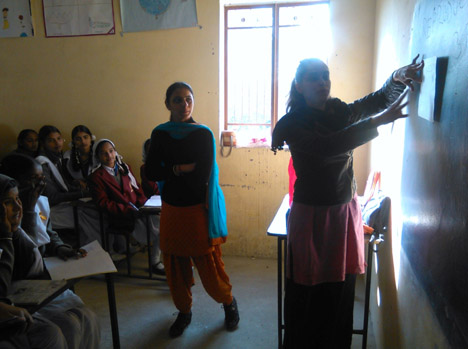
My first session on Puberty and Menstruation at Shri Guru Hargobind School. The students were aged between 13 and 16 and very keen on learning about this topic.  

Some time before the holidays, some changes happened and we received, Sabina—also a Women’s Empowerment project manager—who was transferring from Paro to Harike. We were now two interns working on Women’s Empowerment projects at the center and I knew we’d make a great team. Only two weeks after the holidays, things happened, again, so suddenly and in the span of a week, three Girls’ Clubs were up and running in three different communities—one in Makhu and two in Harike. 

Sabina and I with school staff, principal and some students after our session Puberty in Menstruation at Secondary Government School Harike Pattan


To this day, I am amazed at how this country works. It is so easy to get discouraged and be tempted to give up based on the impression that everything feels like a struggle. All you need is to have all the elements perfectly aligned for things to happen. And they do (happen). In other words, be patient…but stay focused and continue to work hard. Things will happen when you least expect it.

One of our most recent Girls’ Clubs—they are the most enthusiastic girls you will meet in Harike!  


Jessica Cialdella
Women’s Empowerment Project Manager, Harike (Punjab)


Tuesday, 1 March 2016

Hard Questions

Alright, I’ll say it. I don’t know what I’m doing here.

Don’t get me wrong…I love EduCARE. I love the interns (my family-away-from-family), the community, the organisation. I love the opportunity we are given here, the chance to explore whatever draws our interest. I love the crazy Indian traffic, the wandering cows, and (somehow) even the bucket showers. What I love just a little bit less is all the damn thinking required!

With the COM Team and Project Director hanging around Gajner, we have had a (large!) number of meetings and discussions. For me, the common theme behind all of these discussions: asking hard questions.

Why are you here? What are you hoping to accomplish? Should we even be here in the first place? What is your personal/centre/organisational/community vision? How does your project contribute to these visions?Why, why, why?! All of these bloody questions really made me stop and think…

Back home, with the fast pace of life, competing deadlines and priorities, I found it very easy to get sucked into it all. At times I felt as though I was following a script; progressing through life’s checkpoints without much critical thought.Highschool grad? – Check. University? – Check. ‘Real’ job?... Marriage?... House?...

Here at EduCARE, that script is removed. The structure I was used to, relied on (?), is nowhere to be seen. What is left in that space? What exists without that structure? After four months of work here and a lot of learning, my short answer would be: a lot of hard questions, as well as personal opportunity and growth.

Following our discussions with COM, the centre has started thinking about what all of these questions mean for us. Specifically, what is our vision for the centre? Although at first glance answering this question may seem easy, we have learned that it is much more difficult to express when you start putting your mind into it.


Gajner crew thinking hard...

Our centre visioning process has only just begun, but so far it has brought out some interesting insights. At the end of our first meeting, there may have even been some mediocre-enthusiastic applause (thanks for the prompting Shama!). Our hope is that by exploring these tough questions, we can bring all of our projects and personal directions together to push the centre work forward.

With all of this blabbering about hard questions and the future, what about the present?As cliché as it may sound, I will say this: always take the time to stop, think, and truly take in the moment. As easy as it can be to forget, we here in EduCARE are living a one-in-a-million experience. We are young people given big responsibility, are part something bigger than ourselves, where our only real limitation is our own creativity and imagination. Never lose sight of this, and enjoy every moment of your internship - the good and the bad.

So where does this leave me? What am I doing here in EduCARE India? Although I haven’t quite found the answer, I’ve asked the question - I think that is a good start.


P.S. For those who were wondering, question mark count: 15


Tom Zadorsky - Canada
Alternative Energy Coordinator - Gajner (Rajasthan)

Monday, 8 February 2016

Learning to Drive in India

Having Rahul, the little old red car, has made our travels to projects a lot easier as we can get there faster and not worry about leaving before it is dark. The only thing is that I cannot drive the car because I don’t know how to drive standard. Coming from Canada where everyone has an automatic vehicle, I never learned how to drive stick. Having this car has given me the opportunity to learn.


The community was very surprised at seeing the women interns driving. The mobility of women in Gajner is quite low. They mostly stay in the house. When women have to leave the house they will bring their husbands, fathers, children or brothers with them. This subjects them to stares, gossip, sexual harassment and rape, in serious cases. We decided that teaching women to drive could improve their mobility, independence and safety.

Many different women wanted to learn to drive but we decided to start with Manoj’s little sister, Durga, and Sunita, their neighbour. I was very excited to learn to drive with Ana and Ilaria as our teachers and my fellow students.


Claire trying to get through the traffic jam


Our first lesson was scary, fun and impressive all at the same time. I was first up. I was able to get the car in first and second gear after a couple of stalls. Through our broken Hindi and Durga and Sunita’s broken English, we explained how to shift and use the clutch. Durga stalled a couple of times but finally got the car into first gear. Sunita had a little more trouble but still got the car into first gear as well. We continued like this for a little while, switching up drivers. It was then Sunita’s turn. She started going fast so Ilaria and I were saying “Deera Deera”, “Slower” but she kept going. She turned the car to avoid a part of the road but we soon realized we were heading for the sand ditch. By the time she pressed the break we were stuck in the sand. Ilaria got into the driver’s seat and Durga, Sunita and I got in front of the car to push it out. We pushed and pushed, but it did not move and inch. We then realized that the back wheels were not touching the ground. Durga waved down a man walking by, who was one of Manoj’s close friends. He helps us dig the car out and push it out of the ditch. We thought ending the lesson here was a good idea.


Me teaching the girls how to drive

The next lesson, Sunita was at her cousin’s house so she didn’t join. Ana, Durga and I headed out. Durga practiced getting into first while I practiced getting into first and then second. This time, the car didn’t seem to be working well. We thought the car had only a little gas in it, as we never fill it up completely. Durga and I kept practicing even though the car did not sound great. Durga stalled the car and tried to turn it back on although it did not start. We thought it was probably out of gas. We called Manoj to bring gas, although he said he had filled the car with gas yesterday and there was no way it was out of gas. He came with gas anyways. When he arrived Manoj got into the car and said we had been driving the car with its lights on the entire lesson and turning the car off and on again killed the battery. Ana and I felt terrible because we thought we had killed the car. Manoj got us to push the car at running speed while turning the key. This restarted the car. Ana and I, relieved the car was okay, decided the car had enough hard work for the day and we ended the lesson.


Durga trying to turn on the engine 

In the most recent lessons, Durga had improved a lot, after a month of no driving. Durga can now get the car into first gear, drive to the end of the road, put the car in reverse and drive back without stalling. She also drove home after one lesson through deep sand with no stalling or getting stuck. We are only four lessons in, with a month break after the first two, and Durga impresses me every day with her confidence and perseverance.


The driving lessons are one of the most fun times of the week for me. I get to hang out with my friends, laughing and learning. This project is no longer just a project. It is a time for me to learn and spend time with the people that I have started to create long lasting friendships with.


Claire Mackie—Canada
Women’s Empowerment Coordinator, Gajner (Rajasthan) 

Monday, 18 January 2016

From Himachal to Harike


The coordinator role at EduCARE involves providing support and guidance to not only yours, but all projects that run under your department’s domain. As of now, EduCARE has official forestry projects in both our Naddi and Harike centres, however when I first arrived Naddi’s was the only one established. I gained a lot of valuable knowledge living and working in Naddi for 3 months – the Indian culture, the biodiversity of Himachal Pradesh and ‘torro torro’ Hindi. When the centre opened in Harike and the first forestry intern arrived to take a position there, I knew my time in Naddi would come to an end to fulfil my role of project coordinator. Within my time living in both states, I’ve come to understand three main differences between the two centres: the projects, the people and the pollution. 

When I first arrived in Naddi, there were many documents I needed to catch myself up on in order to get a grip on the existing and past projects. The green gift project, the plantation and the tree nursery were all great efforts from past interns, but unfortunately had been halted with the several month gap between forestry interns. My goal in Naddi was to revive each of these projects, starting with shifting the ownership of the plantation to the community and restarting the tree nursery to supply saplings to the plantations and community in the future. After Johnatan and Louise arrived, the projects made great headway and they each took their contributions to another level to lead our initiatives to sustainability and success. 


Johnatan, a forestry project manager, in the recently constructed tree nursery in Naddi. The main sowing season is in March, however Deodar and Kaintt, planted in the polybags pictured, should be sowed in December.


On the contrary, Alex and I made it to Harike with little to go off of other than the few research papers on the Harike Wetlands and the knowledge that the communities surrounding the protected area were depending on its products. Most of our work so far has been creating a network of local stakeholders and support, as well as engaging and learning about the communities that we will eventually be starting our projects with. Being the first forestry interns at the centre, we are committed to creating a thorough and organized database of our gathered research. 

Over the years, Naddi interns have made strong connections with the community and local shopkeepers; it’s not uncommon for Omi of Om’s café to slip you a free chai with your breakfast paratha or share a delicious dahl dinner with the village families. Naddi was so much like a second home to me, that when I arrived in Harike I almost forgot that I wasn’t native to India! We are still met with curious stares from every direction and have to barter in the markets to get local prices. Although we are becoming acquainted over chai with individual families in the villages, we still have a ways to go to establish a trusted bond that is parallel to those with Naddi’s communities. 

Flock of birds at Harike Wetlands, a Ramsar site. The invasive flora specie, Water Hyacinth, has posed many issues in the wetlands, including siltation.

The landscape between the two centres is vastly different; Naddi is in the foothills of the Himalayas, whereas Harike is located in the agricultural plains of Punjab. To the naked eye, Himachal’s environment seems pristine with its clean air and abundant resources. However, the area is severely littered with solid waste, its 5.1 million livestock population is degrading its productive land and its inhabitants and tourism sector are taking forest management into their own hands. 

Punjab’s pollution problems are much more obvious. A thick cloud of smog gives the sunset an apocalyptic hue and the natural landscape has been transformed into chemical ridden crop fields. The bird sanctuary in the wetlands is a beautiful escape from the bustle of the city, however effluents from industries upstream have threatened aquatic life and an invasive specie, Water Hyacinth, has taken up almost 50% of the wetland’s surface water. Both centres have pollution issues that would rouse the concerns and action of environmental enthusiasts everywhere. 

It’s important for interns to experience more than one region of India while they are here, coordinator or not. New perspectives and a heightened knowledge of the Indian culture will bring a lot to your projects and will send you home with stories. Although saying a temporary so long to my project and friends in Naddi was not easy, the comforts and challenges in Harike have welcomed me to a whole other world within India.


Sydney  Strelau - Canada
Forestry Project Coordinator,  Harike (Punjab)

Friday, 6 November 2015

Trekking to Triund


I have a tradition of sipping a freshly brewed coffee on the brisk mornings of a hike to take in the sun rising over the beautiful view in front of me. However, after a cold and unexpected trek to Indrahar pass with Mr. B, Rachael, Daikon, Jacob and fellow interns, all I needed to wake and warm me up in the morning was a hot, spicy chai.

It all started with a call from B early on a Thursday morning asking to join him on an overnight trip to Triund, a popular hike among travellers, to survey the trees at different elevations. I had already been to see the unobstructed view of the Dhauladhar mountain range, but going again with B offered a chance to learn more about the flora and government forest management initiatives. So I rounded up a crew- Louise as my forestry team mate as well as Daniela and Kevin and we were off.

We started through the Deodar predominant forest area in Upper Naddi. The morning sun shone through the dark green needles providing us with some serenity before our gruelling trek; it’s no wonder deodar forests are sacred place of meditation in Hinduism.

Ascending from there brought us to a dense Rhododendron forest on either side of the path, which was unchanging for the better half of the trek. Even without their flowers, which bloom in March/April, it made for a pretty sight. This area is also sprinkled with Himalayan Oak trees, which have been severely lopped by the locals. Lopping is the act of cutting off branches of the tree to provide fuel for families and fodder for livestock to the point where the tree’s shape resembles that of a toothpick. Lopping hinders the regeneration of the tree’s population in a region and has adverse effects on the tree’s overall health. Unfortunately, this practice is not uncommon- you would be hard-pressed to find a healthy Oak in the region.
Kevin, Sydney and Daniela on the way to Triund

The foliage gradually became less dense as we neared our destination and the thick Rhododendron forests transitioned into scattered Kriew trees, also known locally as Triund Oak, which are a type of Himalayan Oak. These trees can establish their roots in the steepest and rockiest of slopes. Unlike their sister species, these trees seemed to be in better shape, however they are largely exploited for cattle fodder (local people send their livestock up the mountain for prime grazing during the monsoon season, before winter).

And alas, we reached Triund for a lunch of Thali and a refill of water. Clouds were blocking our promised view of the mountains, but luckily this was not the end of our trip. We were to set up camp for the night in a cave about an hour and a half’s walk from Triund on the base of the mountain. We set out for our last lag of the journey, energy restored and excited to have made it up the toughest bit of the hike- so we thought.
View from Triund

We passed Snow Line café, the last café of the journey, and picked up an omelette dinner that we would save for the cave. The clouds finally broke and we were able to see the peak of the mountains for which we came. Suddenly something sparked in all of us- we needed to get to the top. Although it was a risky decision, each of our worries and queries were rationalized in one way or another and it was set- we were to hike up to the top of the mountain as soon as the sun rose.

Cold from the frigid cave floor, we set the pass the next morning with promising clear skies. Only a 3 hour ascent and we would reach the peak of the monstrous rock! We stopped every couple hundred meters to catch our breath and a glimpse of Naddi from afar. Snacking on whatever food we had in our backpacks and water from the adjacent glacier, we hiked slowly but surely on the faintly marked path.

The dream was dampened once fog surrounded us and the path to the top was no longer visible. It had been three hours since we started for the day; some of us found ourselves questioning our motives, while others were strictly determined to reach the pass. A group huddle resulted in a decision of completing the journey and off we went again without hesitation.

An hour and a half later of a steep, narrow path and we finally reached the peak! Satisfaction overcame us as we high fived and hugged each other with congratulations. The view of Chamba Valley was worth every heavy breath and finally the mystery of what was beyond the towering mountains we see from Naddi had been uncovered. We knew it was our queue to descend when a blizzard obstructed our view and covered the path, adding another degree of difficulty to the trek.


The blizzard, accompanied by thunder and lightning, followed us down the mountain, forcing us to seek refuge under overhanging rocks when it became too dangerous to continue. The sun made a short appearance, just enough to warm us up and gain feeling in our fingers and toes, however it quickly retreated back in to the clouds. With wet equipment and a dwindling food supply, there was no choice but to make it to Snow Line. We trekked through the blizzards for the rest of the day into dusk with the promise of a warm cafe to keep us going.

We reached Snow Line and sat down among other hikers who did not brave the trek we just completed. We recounted all that we had done over our hot Maggi and omelettes: you know you have a good crew when all the stories told are done so with giant smiles. We set up our tents once we could phathom stepping into the snow, ready to start the next day’s descent with a hot chai and our favourite view.
Reaching the top!

Sydney Strelau - Canada
Forestry Coordinator

Friday, 30 October 2015

Colourful and exciting India


If there is one thing to know about India, it’s that they love a good festival and celebrating in style. Luckily, we got to experience every first hand and on a quite a personal level. We started small and by the second day, it turned into one of the most intriguing events in my life so far…

We spent the first night (Saturday), at a small celebration in Janauri, there was some delicious free food, a makeshift temple near the bus stand, and some lovely traditional Punjabi music. It was a nice and low-key event to transition us into what was in store for us Sunday.

Earlier in the week, the councilor from a nearby (and much bigger) town came to invite us to his festival in Hariana. We happily accepted and went over in the afternoon for some more food and music. I think we underestimated our invitation but quite quickly it was brought to out attention we were “esteemed guests” and presented with a picture of some Hindu Gods, which we are planning to hang in the office. 

Aurelien, Amelie, Madeline and Breanne
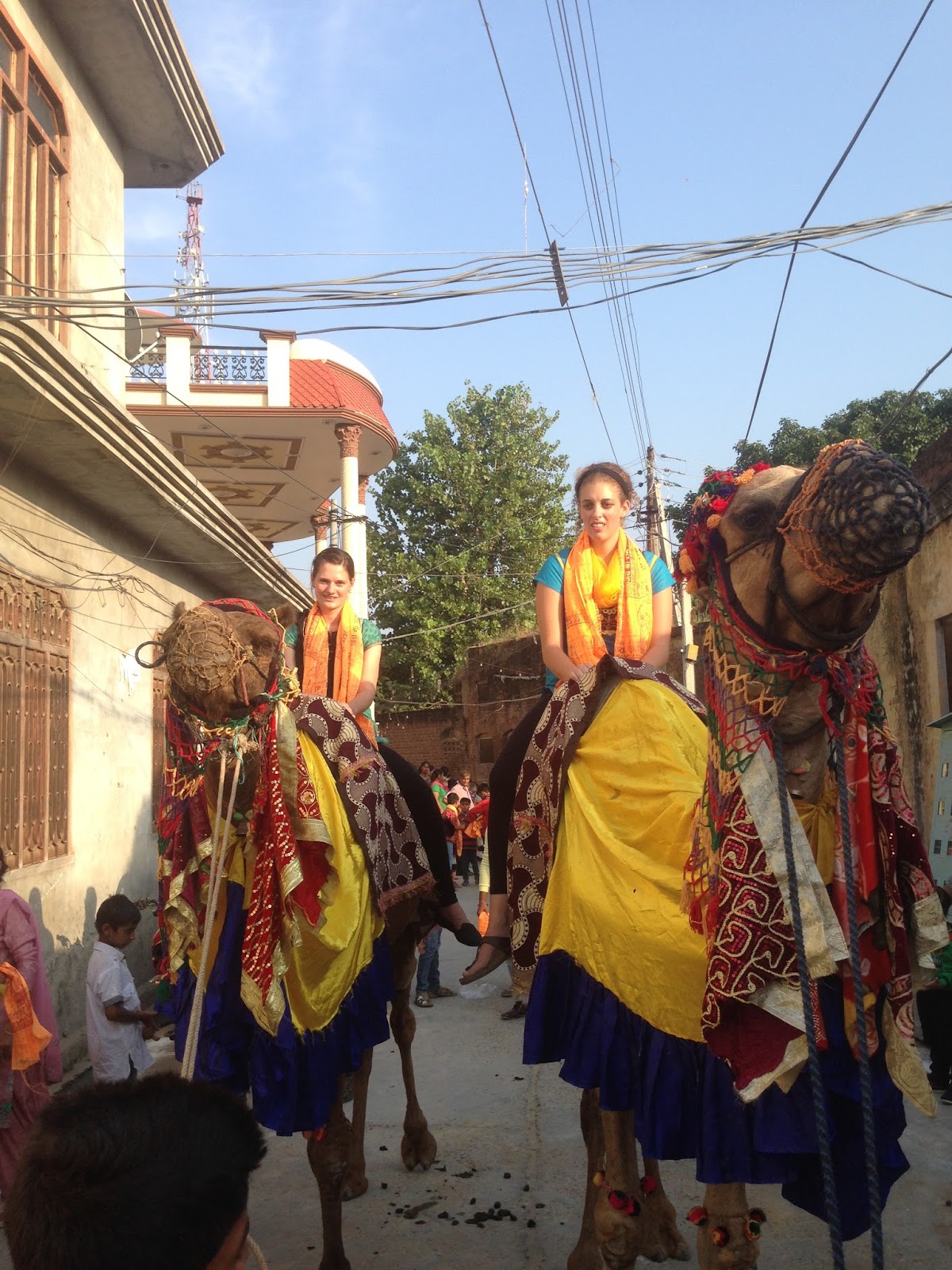
Immediately after that, everyone around us was preparing for the parade-men in costumes, drum players, cars with stereo systems surrounded us. Much to our surprise, Amelie and myself were asked to ride camels in the parade and wave to the crowds. There were firecrackers and elephants in front of us and the whole experience was loud, colourful and incredibly and uniquely, India. Three hours later we were finally off on camels and own our way home to get back to work until the Kabaddi games on Friday.

Amelie and Breanne riding camels in the streets of Hariana
The Councilor invited us to come to Hariana again to see a Kabaddi Game with him on 23rd of this month. Once we reached, he got us seats on the stage next to the other counselors from where we had a good view on the Kabaddi field. For most of us it was the first Kabaddi game so it was really interesting to see it live and from a stage as VIP guests. But what was even more interesting was the show inbetween the Kabaddi games. Once, three men tried to fit in a ring that, to us, already seemed too small for two men, and another time they let five men aged over 60 try to catch a chicken. As interesting it was to see all these bizarre shows and talents unfold in front of us, you can’t help fell uncomfortable as you realize these old men are chasing a chicken for a money prize and are quite poor members of the community. To everyone on the stage with us, they roared with laughter as the men tried and failed to catch the bird, falling face first in the sand along the way. It was a good example of the cultural shocks we sometime face in India and how we have to learn to adapt to the situation without being offensive. While watching the game, the counselor introduced us multiple times to the crowd and we got served several snacks throughout the afternoon. And again, we got a painting and orange scarves as a gift for the guests of honour, which will keep reminding us of this interesting part of Indian culture we could experience that day.

Kabaddi game in Hariana


 Amelie and Breanne - Germany/Canada
Microfinance Project Managers, Paro (Punjab)