Showing posts with label ReStore. Show all posts

Sunday, 24 June 2018

Developing micro-scale concentrator photovoltaics


Developing micro-scale concentrator photovoltaics
Concentration Factor
Renewable Energy

After completing my master’s degree in mechanical engineering in the UK, I came to intern at Naddi as part of the EduCARE team. I planned to only spend a month and a half interning, so I came with preconceived ideas of what I wanted to build and the components required. Hence, I set forth on designing a micro scale concentrator photovoltaic system (CPV), this technology generates electricity from sun light and uses lenses and curved mirrors to focus sunlight onto a solar panel. CPV technology has been used to improve the power output of a solar panel by 350 times, however on the budget and time constraints my aim was to double the power output.
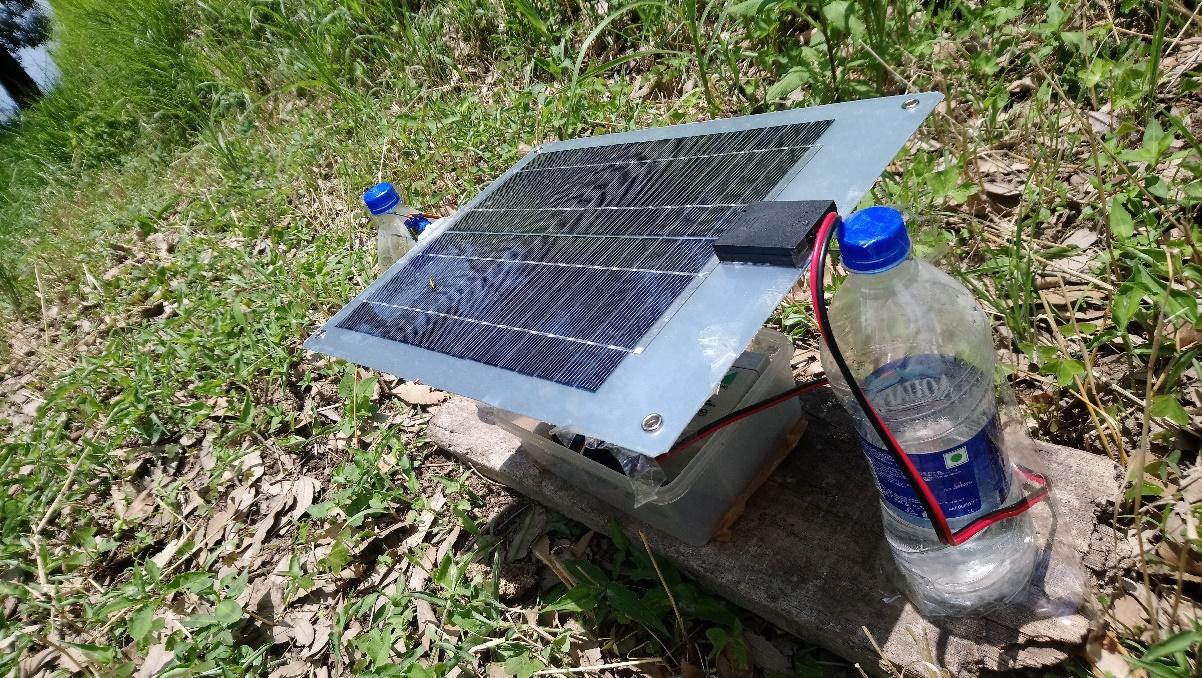

Within the first couple of days in Naddi, I discovered that solar power was currently being used by the majority of the street lights in Himachal Pradesh (HP). Every solar street light used a 40W solar panels and 40Ah battery, this ensured the lowest possible probability of loss of power supply and did not require to be connected to grid power. This was important in HP, as the street lights prevented accidents, so reliable constant lighting was key, and they were often deployed in remote locations. However, the cost of the solar lights, limited their deployment to more highly populated areas. I believed that a micro scale CPV system would be very applicable to these solar street lights, as it could reduce the cost of each light and improve its reliability.

I set about designing a CPV system, using the components I had brought with me, including a solar panel, solar charge controller, battery, Arduino and lenses. Surprisingly, the majority of the solar panel components were available in HP, however I was glad that I came prepared. The first step was to configure a solar panel set up, to test my components. Once that was completed, I designed a solar tracker, which rotated the solar panel to face the sun, so that lens remained focused on the solar panel. This was the most difficult part of the project, as it required me to design a frame for the panel to rotate about. Luxuries that I was used to, such as 3d printers and laser cutting was unavailable. Hence, I was forced to be more creative, I used recycled materials to design the frame including plastic bottles and scrap wood, making the design more environmentally friendly and cost effective. In the future of my project, I would aim to design a lens mounting system and make the product more robust.

The freedom of the project and the self-motivation has really helped me to enjoy my time here. I have had so much fun hanging out with the other interns, my favourite experience was going paragliding with them, in the quaint mountain village of Bir. This was a once in a life time opportunity and I am glad I took it.

Jack Parker (UK)
Project Manager, Micro-scale Concentrator Photovoltaics
Project Manager, Renewable Energy
Naddi
EduCARE India 

Tuesday, 19 July 2016

Photovoltaic Solar Panel System Project

With EduCARE, some interns already did few projects in alternative energy to have a way to produce clean energy, and without harmful effect on the environment and the people, like biogas station, solar heating water system, windmill system... Studying electrical engineering in France, I wanted to provide to Educare a new way to produce energy (and especially electricity), that Educare still didn’t have implemented. So I it’s all naturally that I proposed a small PV solar panel project, to provide electricity to the Naddi ReStore.

Why in ReStore?

The ReStore in Naddi had no way to have electricity power, and therefore, no way to have light during the night, or to run electrical cooking device. With the PV solar panel system, ReStore is now fully electrical autonomous, and able to run cooking device such as blender and so facilitated the work of the girls, to charge small device such as Smartphone or small speaker, and so make the job for girl more comfortable, and to run an LED light and so open lately in the day or also during the night. For the future we are also thinking to provide a free internet Wi-Fi to ReStore customer to attract more people. 

PV solar panel installed on the roof of the ReStore


For whom this project is it for?

One of the main goals of this project is to make the job more pleasant and more comfortable for the girls. But with this project, my objective was also to show and present this mean of electricity production to the people and the community, create an interest in people for solar electricity production. The last goal of this project is to provide a base of documentation for other intern who would do this type of project in other center for future project, and therefore not have to have strong knowledge in electricity to install a PV solar panel system. 

But how does it work?

About the technical part, the system is very simple, the solar panel transforms the solar energy in an electric energy, and the energy is store in a battery. To control the flux of energy between the PV solar panel and the battery we use a small controller/regulator. And then we can directly use the energy thought the battery to run light and small device, or use an inverter to use bigger device (220V).


Synoptic of PV solar panel system


Thomas Lecomte - France
Alternative Energy Project Manager in Naddi 

Tuesday, 21 June 2016

Home away from home

Beginning of June 2015: After 28+ exhausting hours of travelling I finally made it half way across the world! Standing in the scorching heat, I spotted my suited driver holding a ‘Ms. Sheth’ placard. Off I went to my ritzy hotel. When I arrived, the staff welcomed me with overzealous ‘Namaste’s’ and ‘How are you?’s’. Travel weary, I was in no mood to talk. As soon as I entered the suite, I drew a bubble bath and dimmed the lights to ‘relax setting.’ I thought ‘Well, this will be one hell of an easy adjustment.’

Flash forward 4 days, I’m now in the Himalayas in the middle of a place that has the address ‘Naddi, Near Bus Stand.’Ok, so not only do I have no idea where I am, neither do the residents of this village. Oh and there’s a cow pooping next to me. Cool. Great. Where’s my welcome drink? 

I was stranded in the middle of the Himalayas, hauling a large suitcase—the size of which could fit my body into—with the sun beating down on my back, and temperatures approaching 100 degrees Fahrenheit. I lugged my suitcase down the unpaved, rocky path ventured by moving animals and their feces. Every step I went down, my heart beat faster and faster. Soon, I was sufficiently disoriented, and my mental sanity was about to explode. ‘Sh** what did I get myself into. Holy hell Tulsi, you think you’re Mother Theresa? What’s your problem in life?’ I was just about ready to throw my suitcase off the mountain until I heard someoneyelling “Hi Tulsi!! Hi Tulsi!!” Confused as to where the voice was coming from, I continued to walk down the dubious path. 

My mind was frazzled, my bones fatigued, but my eyes finally saw the girl who was enthusiastically screaming my name—Savita Meen. Her long brown hair, radiant smile, and beautiful brown eyes were enchanting. Savita’s physical beauty was only overpowered by her charisma—quite the sight for my weary self. Unfortunately, my mind was still completely elsewhere to appreciate that at that moment. As Savita showed me her quaint home, my throat started to close and my eyes began to swell. We quickly made it to my room that also functioned as her sister’s, Sunita’s, sewing room. I held my tears back while seeking the right words to say, I choked ‘Thank you for showing me around, everything is great!’ 

Alone in my new room, hundreds of flies swarmed around my face—great. I burst out into tears. Again a series of rapid-fire thoughts zoomed through my mind, overwhelming me and causing me to sit. 4 days before I had breakfast made for a king: the choice of 100 dishes and an omelette bar, and now I’m with a family burning sticks to prepare a standard meal of rice and dal. 

I cried myself to sleep that night. I woke up in the morning not feeling much better. I told myself, ‘Either you can go home and end up regretting everything or you can suck it up and do what it is that you came here to do.’ I sucked it up. But by the end of my first week, there was no despair that I needed to ‘suck up.’Savita’s family became my family. Every aspect of them and every stick that was used to cook our food I fell in love with. I was happier than I was at that omelette bar. No hate to the omelette bar, but in retrospect I believe this was the beginning of my journey towards understanding happiness outside of materialistic possessions. I spent a few weekswith the Meen family before moving into our NGO’s house just up the street. My time and experiences in Naddi and with the Meen family were quite extraordinary, and deserve far more space than I can give them—however, that is for another time.

My perspective on life and India began to change drastically. I had only experienced a narrow version of India—my extended families’ secured, Bombay lifestyles and the swanky hotels we visited. It was quite perplexing, with a dash of irony, that despite being of Indian descent I was oblivious to all of India’s colors. Every week, I exceeded my emotional limit. I kept witnessing things that I thought would only happen in movies- young girls chasing their cows down the street and others carrying buckets of water on their heads. I thought that my efforts would lead to no avail, and even if I could do something I wouldn’t know where to start. I realized that I to take a step back and take in the whole picture, to understand how I could address the needs of the community and create measurable change within it. As I learned, it’s a picture easy to lose sight of. 

In many ways, I think the Naddi community gave me more than I gave them. I remember walking up the main road with a 3 lb. wooden board for ourlocal shop. But I was wheezing by the time I got to the main square. As I searched for my breath, I heard a mischievous giggle behind me. The giggle continued. I look behind and its Mamaji aka Savita and Sunita’s mom bearing the biggest smile. “Hi Tulsi!!” she lovingly says. Her right hand was holding the bottom of her headscarf that she was innocently chewing, and her left hand was effortlessly placed on the side of a 40 lb. haystack sitting on her head. ‘Well I’m a total loser. Panting while carrying a wimpy piece of wood, while a 50 year old is running around with a forest on her head.’ While humorous, this encounter helped showed me that no matter how much I improve and how much I learn, there is always something more I can do to be better than I was yesterday. The strength, love, and happiness that the community members taught me are true blessings. I’ll never forget them.

EduCare’s philosophy avoids the classic paradigm of imposing Western thought processes and value systems on groups receiving aid. Rather, it aims to provide a context-based understanding of people and their circumstances, leveraging them to foster individual empowerment. This organization has provided me with endless opportunities and challenged me in ways that I didn’t think were even possible. It helped me understand the boundless nature of human achievement. Bring any idea you have come to life! All you need is a cupful of humility, a spoonful of introspection, and a sprinkle of imagination. 

Hopefully I’ll be seeing you soon near a bus stand in the middle of nowhere.

Tulsi Sheth, USA
REstore Project Manager - Microfinance Project Coordinator


Wednesday, 10 February 2016

Surviving Without Gas!

I am currently working as the ReStore/Microfinance project manager in Rait, Himachal Pradesh, as well as the ReStore Supply Chain Coordinator for EduCare.

Being in India for almost a year now, I learned a lot about myself, about others, but also about how resourceful human beings can be! Sometimes, you have to deal with power cuts, sometimes there is no water running, and sometimes you run out of gas!  Not being able to shower and smell for a whole week is one thing that I can do! But, not being able to cook and taking away my body juice, ohh my god this is too much!

Just kidding!  Human beings are capable of always finding a solution to their problems, isn’t this amazing? Not that I didn’t know that before coming to India, but sometimes you truly realize things when you are facing them.

So, this is the story of when the Rait center ran out of gas!

It happened on a Saturday morning, we woke up and, as usual, we want to cook our breakfast. As Pooja turned the stove on, no gas was coming. No pressure, don’t panic! We tried to call Uncle, our landlord, but he was not answering. We, then, went to his house but he was not there. Can we panic now? No, of course not! We will just have to deal with it. So, how do we do that? Well, we go back to the basics!

Lunch was not such a problem because usually people go to the dabba in Rait to eat something but we had to be prepared for dinner.

Since we are eight in the house now, we divided people into cooking teams. That night, Pooja, Sylvia, Fayk and Andrea were cooking.

Cooking on the fire thanks to Pooja!
Led by Pooja, they scavenged some woods and paper in and around the house and used bricks to build a fire place. They set up everything on the roof of our house. They brought the utensils and had previously cut the vegetables. They managed to make a nice fire. Before cooking on fire like this, you need to dip the pans in soil and water so they do not get dark and ruined.

It was pretty awesome to look at how they managed to cook all the food like this. They made pakora and curry with rice and, I gotta say, it was really tasty. The hardest part during the cooking was the smoke because it was getting into their eyes. And let’s not forget that at this time of the year, it is really cold in Himachal Pradesh. Cooking in the dark with fire and the cold was a big challenge, but they did it! The taste was so different than when we cook on the stove. It did take a long time to be ready, of course, but the result was amazing!

Interns having a great time despite the inconveniences of cooking on the fire
The day after, it would be our team cooking (Kelly, Craig, Federica and I), so we got some good tips that night. We were already talking about what to cook the next night and when we should start cutting the vegetables to have the dinner ready by 8 o’clock.

On our way to the Fun Club on Sunday, we saw a truck delivering gas tanks in Rait. We did the exchange and we didn’t have to cook on fire that night. I was pretty disappointed because I was really looking forward to doing it. It was not the first time the Rait team had run out of gas and this won’t be the last time, I’m sure. When it happened, they had to cook outside for a whole week before getting a new gas tank. Fortunately, Pooja was there to save the day and she showed us everything.

So, if it happens to you, don’t panic! Team work and a little bit of imagination always makes it work.

Mathilde Buchet- France
REstore Supply Chain Coordinator, Rait (Himachal Pradesh)

Wednesday, 27 January 2016

Welcome to Harike

The first month in Harike has passed, and it has gone very fast. Many things have happened, and the team has been working hard to establish strong connections with the local communities. After the end of quarterlies, the team began strategizing on the future of the centre and planned the centre's activities for the following year. After some house decoration activities (led by our former centre manager Ethan), the real work began.

First Saturday Meeting complete
Until now, we established two weekly ASP’s with two different local communities. The wonderful  Jessica, our Women’s empowerment project manager, has initiated a Girls’ Club with the Makhu girls and has received a very positive response. Our Eco-building project manager, Maria, has been working hard at establishing relations with local women who will host the eco home stays in the future, as well as worked on the plan for eco-buildings in all of EduCARE’s centres. While our new centre manager Tommaso, in between cooking delicious meals for all the interns, has begun his business plan for Harike’s ReSTORE. In addition, we also began giving workshops to a local school on a range of subjects including SWASH, girls’ health, disaster management and environmental awareness. Maria and Jessica gave the first two workshops and received very positive feedback from both the children and the teachers. These workshops will be given twice a month for the next year and are aimed at raising awareness amongst local children about important issues.

Harike team members standing next to their caricature
With respect to the forestry project, Harike has a lot of potential particularly due to its proximity to Harike’s Wetland, a protected area which includes a bird sanctuary home to hundreds of birds migrating from places as far as Siberia. The forestry team, composed of Sydney and I, had a pretty successful month in terms of establishing contacts and planning future projects. During this month, we have managed to meet and interview a number of officers from Punjab’s Forest Department in both Harike and Firozpur, as well as visited Makhu’s tree nursery to learn about the local flora and fauna. After some brainstorming sessions and lengthy discussions with Mr B, we came up with a number of projects to implement in the future. These include:


·  Establishing a tree nursery at the local Sikh temple, planting bamboos and a number of other local trees, with the aim of engaging the local community in taking care of the trees and create, in this way, a social forestry project.

·  Work with some of the women from Makhu village to create organic vegetable gardens for self-consumption.
·         ·  Establish an income-diversification project aimed at the two local communities we work with in Harike. As these communities’ incomes rely on extraction of resources from the wetland (for example by fishing and cutting wood for fuel and fodder), our aim will be to create a number of organic vegetable gardens for the families to use for self-consumption. This will allow the families to reduce their expenditure on food, improve their levels of nutrition, as well as promote more sustainable agricultural practices.

Harike team at Quarterlies
For the moment, these are the forestry project priorities and steps have been taken to ensure we’re on the right track to achieve these in the next year. In addition to the main project, Sydney and I also created a new garden for the interns’ house which will be used to grow organic vegetables, as well as mosquito-repellent plants (which are very much needed for the summer months here).

All in all, our first month here went very fast, between some planning and strategizing, drinking many, many chais, film nights, perfecting our parantha recipe, running away from frisky buffalos, playing cricket with the children and experiencing our first Punjabi wedding, we have learnt a lot but still have a lot to achieve.
Our first Punjabi wedding


Alessandra Sciarra- Italy 
Forestry and Organic Farming Project Manager, Harike (Punjab)


Sunday, 10 January 2016

REstore in Naddi


The changes that have happened with Restore within the last 6 months have been incredible. Sometimes I can’t even contain my excitement and find myself jumping up and down in the shop while the girls look at me and call me a "4 year old girl".

For those of you who don’t know, Restore is a shop located in the main square of beautiful Naddi. One of the purposes of Restore is to empower women through teaching them the basic business and personal skills necessary to establish and maintain a successful business. 

It has been quite the ride so far, and I couldn’t be more proud of what we’ve accomplished. It’s most rewarding to see the changes in the girls’ attitudes. When I first came to Restore, 1 girl would come to ‘work.’ I say work in quotes because the interns would be doing mostly everything! Now the tables have finally turned and only 1 intern comes while 2-3 girls do all the work. Not only so, they come to the shop excited and engaged. 


Sunena, Shikha and Bindu, three of the girls that work at REstore
Sunena and Milan having some fun in the shop
We’ve expanded the horizon of products sold in Restore! From scarfs to bags to healthy, unique menu items, Restore can cater to all your needs!

Future happenings in Restore:


We plan to have our Multi-Purpose Bike fully finished by the first week of December. This is what our finished one our Punjab Restore looks like:


Multi-purpose bike

It will function as a blender, a charger, and a lantern, so if your phone is low on battery enjoy a hot cup of chai while getting it charged. 

We made our first laptop case a few weeks ago and plan on making more plus phone cases in the upcoming weeks. Who said your laptop can’t be covered in sass and class? 


The finished product!
Nisha making our first laptop case 

Recently, we’ve been reconstructing our Restore website. Soon Restore products from all our centers will be available online to buy! You’ll also be able to hear what the girls have to say with our Restore blog. This is basically an open journal for the girls who are working. 

Much more exciting things are coming our way in 2016…Stay Tuned!!!

Tulsi Sheth - USA
Microfinance Project Coordinator, Naddi (Himachal Pradesh)

Saturday, 22 August 2015

Juices, hot chocolate and scarves


When I first arrived in Naddi in February, I thought B didn’t want to open Restore. I was focused on making it look nice. No, think about the concept B said. What do we want Restore to be? Five months later and I feel at last the concept has been defined.

The journey started with the idea of a juice stall. We wanted to promote healthy living, and after seeing a juice press in action in Dharamsala, we realised that fresh juice was missing from Naddi Main Square. B liked the idea so much that the juice press was purchased in record time. It only took a few days from proposing the idea to B to a juice press and mixer arriving at the square.

The main aim of the juice stand is to help young girls from the community earn additional income and gain confidence in themselves by serving customers and interacting with new people. We decided the girls should work on a commission basis - they receive five rupees a drink for every drink sold. However, even with this financial incentive finding staff was not easy. Finding motivated and available staff has remained our main challenge for the last three months.

EduCARE Team preparing juices in Restore 
Sisters, Nisha and Bindu, now come consistently every Sunday. However, both go to college and school every day, apart from Sunday, as do many girls in the village. So at the moment Restore is only open every Sunday, with a big remaining challenge being finding staff for other days of the week.

The actual juice business has been surprisingly successful: daily sales have gradually increased since the opening of the stall, despite the worsening weather. The resulting profits have been reinvested into the shop. We have put down a new gravel floor, painted the shop and invested in a small gas stove. We plan to start offering coffee, hot chocolate and herbal teas, again drinks that are missing from what is offered on the square at the moment. The purchase of tables and chairs have also given the shop more of a cafe feel.

Elliot, SWASH manager, helping in Restore
The profits have also been invested in other microfinance projects. Many local women are very good knitters, and we have developed some scarf designs with them that we feel would appeal to the tourists from Punjab and Delhi. Some of these scarves are already being sold in the shop. We have also started initial investigations into pickle making which could also be sold in the store.

If the shop is a respected, successful business, the girls who work there will feel a pride in themselves and their work, and hopefully want to take on more of a leadership role in the running of the shop. This is the long-term goal and will probably take several years to fully implement. But at the moment, small steps continue to be made, profits are being reinvested into the shop and other microfinance projects, and the girls are smiling and taking home money and hopefully increased confidence each day that they work.


Eileen McDougall - UK 
Micro-finance project manager, Naddi 

Thursday, 16 July 2015

New Microfinance projects are on a roll in Paro, Punjab


The Punjab Microfinance project is undergoing an overhaul! The cluster went from zero microfinance interns to three, and thus the weeks since Educare’s quarterlies have been spent coming up with a shared vision for the microfinance initiatives we would like to see here. Assessing some of the past microfinance projects here we decided we wanted to go ahead and open a ReStore, and the best way to do this would be to start with a juice stand run out of the Paro office.

We believe this juice stand will be a good way to increase Educare’s visibility in Paro, and we can gradually encourage some of the girls in the Paro migrant camp to come help work the juice stand. We’re hoping this will teach the girls financial literacy skills (such as bookkeeping, addition, and subtraction), independence, and a desire to expand on new projects!
Rachel hopes to engage the women in Paro in a sewing project to make and sell re-usable bags either out of the ReStore or out of the local shops, Aurélien plans to expand on an organic farming project to sell fresh produce, and Madeline hopes to re-engage the chicken coop project out of the Paro camp to sell eggs in the ReStore.

We have a lot going on for Microfinance here in Punjab, stay tuned for some big changes!


Madeline Zdeblick - USA
Cluster Coordinator, Punjab

Thursday, 27 February 2014

The interns who make EduCARE

In mid-January, six new international interns joined EduCARE; Alex (from Ireland), Sigrunn (Norway), Emma (USA), Viktoria (Germany), Lucy (USA) and Mimi (Canada). There is always a sense of nervousness and anticipation when new personnel arrive, but after a month all six have adapted to life in Naddi extremely well. Many of the projects have been given a new lease of life, with the energy brought by the new interns motivating the whole organization.

February has been a difficult month in Naddi, with periodic intervals of snow, rain, sunshine and storms. Despite these meteorological challenges, work has progressed apace. A series of productive meetings of the microfinance team (Lucy, Mimi, Sigrunn and I) have resulted in a whole host of new ideas and plans to be implemented. The ReStore has been reopened by Mimi, and a new range of products is being created and tested. After surveying consumer demand and analysing which products are not currently available in the area, Mimi has developed a series of prototypes. I am in the process of developing links with shops and cafés in McLeod Ganj who have shown interest in stocking products made in a sustainable manner by the women of the community.

Lucy has begun work on several of the microfinance projects, and has worked hard and shown a great deal of initiative in developing them in new directions. Her editing skills for the homestays booklets, committed approach to the chicken coop project and focus on community engagement in JDM community will all reap dividends for EduCARE in the future. She has also taken over running Fun Club, and has developed a host of new ideas for stimulating activities for the younger children.

The proposed EcoStore in JDM community shows how several projects can fit together within a holistic framework. An existing local shop will transition towards stocking alternative products that are not available elsewhere in Naddi. It will also stock eggs produced by the chicken coop, and many other locally sourced items. Sigrunn is working hard to develop a range of items that can be produced locally, thereby creating business for the local community and ensuring economic and environmental stability in the future. While the project is in its development stage at the moment, Sigrunn’s attention to detail and positive engagement with the community to find out their needs should ensure that the project is a great success.

All of the projects that are being developed by the new interns reflect a model of development that focuses on the needs of people on the ground and allows them to develop their capabilities and achieve self-empowerment. Such an approach is, in my opinion, the only truly sustainable one.

Rick Parfett, UK.
MicroEmpowered Project Manager

Monday, 26 March 2012

Visit to CleanPlast

Harleen, Daisuke, and Ryusuke (the interns of EduCARE) visited “Clean Plast” on 12th of March in order to get some information about the local environmental issue. We achieved to get some valuable knowledge from Mr.B.S.Jassar, general manager of “Clean Plast”. So I’m going to share them now.

Overview
They`re recycling-facility in Hoshiarpur. They work for 24 hours. Their monthly production is 900t. They contract with Reliance Industries, that has a polymer production factory at Hoshiarpur.. Their raw material is empty bottle like Mineral water. They crash, wash and dry these bottles at their factory, and finally they make shape of flakes for clothes. They send their final products to other Reliance`s factories too.

Supply-Chain
First, migrants collect these bottles, trashed on the road, and they sell these bottles to local small shop. Other company, contracts with Clean Plast, collects bottles from these small shops and send to them. They recycle only clear bottles and send colored-bottles to other company. They collect bottles from 6 or 7 states, like Punjab and Delhi.

Their objective
・To be an environment friendly organization
・To use garbage and definitely create environmental system
・To make this organization sustainable one

Some questions to Mr.B.S.Jassar

What do you think of many garbage trashed?
India has lots of people, so we have lots of garbage. Currently, Indian government tries to reduce the population. Moreover, trashing garbage is a bad habit of Indian people. Government is now aiming to reduce the amount of garbage within 10years through recycling.

Please let us know about education system in India.
Currently, the literacy rate in India is 70%. The one in Punjab state is 76%, and the one in Hoshiarpur is 85%. In Punjab state, Boys are provided with education for free up to 15 or 16 years old. On the other hand, Girls are provided with education for free up to around 20 years old. Girls are also provided with bicycle for free. For long time, in India, only male went to school, and female didn`t. In order for girls to be more educated, government tries to give incentive to them.

Please let us know about garbage collection system around here.
Government made Pollution Control Division. They try to control the amount of garbage. At present, each state creates some regulation and check system. In Punjab state, if a factory brake some regulation, they`re fined. In Clean Plast, Officials come to check the water pollution level quarterly.

Do you know why any garbage collection car doesn`t come to Janauri?
They doesn`t have municipal committee, that`s why any garbage car doesn`t come. However, Punjab state tries to create garbage system in Janauri, this project is undergoing.

What do you think of NGOs like us?
He thinks NGOs have a really important role, and also said to us government wants to cooperate with NGO, because they want to know actual situation in each area.

Future Plan
・To increase production(but now depends on demands ) and to make this area free-of garbage

After this interview, they showed us inside of that facility and all the process. They also show us how to make the shape of flakes.

This visiting finished successfully. The information which we got from “Clean Plast” facility is very useful for our activities of SWASH and REstore.

REstore Dosarka Open


Hi, I’m Daisuke Yoshida, one of the EduCARE India’s interns from Japan. I’m student of WASEDA University in Japan and I’m working for this organization during my spring vacation. Today, I want to tell you about my project, REsotre Dosarka.

On 19th of March 2012, we finally achieved to open REstore Dosarka. Two Japanese interns (Daisuke and Naoki) held the opening event “Japan Day”. At first, we introduced the customers about Japanese cultures, where are famous Japanese places, what is poplar Japanese subculture and so on. And then, we made the presentation about REstore Dosarka, what is REstore, what we want to do. We got only 3 customers. But they looked very interested in our activities. So, regardless of the number of customers, we can say the event finished successfully. However, of course we must increase the number in the future. 

As the open of REstore Dosarka, I would like to inform you about REstore in details.

REstore Dosarka Goals/Objectives
The REstore Project will focus on two core objectives:
▼ Illuminating the local people and improving the environmental issue
→Through visiting to REstore, buying eco-friendly products and reading the posters which explain about environmental issue, the customers can get knowledge of global environmental issue and how to dispose waste.
▼ Producing local key-persons who are willing to make positive impact for the society
→Through mini library or interactive communication between interns and local people (especially local students) at the Restore, we want to create opportunities which make local people be interested in the development of their own areas, state, nation.

Thursday, 15 March 2012

Hello everyone!!
My name is Ryusuke, from Japan.
I`m one of the interns at EduCARE India and also
REstore manager in Janauri.


This time I`d like to introduce my project.
On March 9th, I held an event at migrant`s community Paro.

In Janauri and Paro, some migrants from Rajasthan live there and make communities. They pick some garbage up and sell for living. Migrant`s children also have to work because their income is very low. So our center is facilitating a MCE program. MCE stands for Marginalised Community Empowerment. In that program, we try to teach the children about nutrition, hygiene, English, Punjabi, and so on.

Through my internship, I found they have really dangerous problem. I found this burned toothpaste-tube in their community. They seem to burn these tubes, plastic-bags, and plastic-tray, and they breathe these smoke. That`s very dangerous for their health. So, I thought I have to teach them what is good or bad for burning. Moreover, I want them to use candles as cleaner energy.


This time, we went to their community and asked them some quiz questions: what is good or bad for burning. Besides, I told a story, showing their children some pictures. This story is about a boy`s life. The message is “always try to do your best” and “You can change your life for yourself”.
At first, only a few people took part in my program, but many people got interested in my project gradually. Children could easily understand the story due to local people`s help with translation.

After telling the story, we talked with the community`s leader about education. Through this conversation, we found that Punjab state government tries to provide all children with some opportunities to education for free.

Moreover, one of the adults in that community seems to be interested in getting those chances. So, there are some gaps between them. However, if we can remove these gaps, we will be able to help migrant`s children go to school.

But, I was so sad when I asked the kids whether you`re interested in school or not, their answers ware “No”. Through this moment, I really thought talking with local people is really important to do some activities.

Next, I asked them some quiz questions about what is good or bad for burning. 3 children and many adults took part in this program.
At first, they answer paper is bad for burning because it is really dirty and plastic-bag is good for burning. But when I finished asking all the questions, they can answer accurately.


When I show them candles, one of the adults told us they tried to buy candles before and they really want to know how to make candles. So, we made candles with migrant`s children and adults at REstore on March 12th.
Hello everyone!
My name is Ryusuke, from Japan. I`m one of the interns at EduCARE India and also
REstore manager in Janauri.REstore is information center about environmental awareness
and also selling eco-friendly products like organic soap, vinegar, and baking soda.


This time I`d like to introduce my project.


On February 24th, I held an event at REstore. In it, I made a presentation about 3R, Reduce, Reuse, and Recycle. Moreover, as one of the examples of recycle, I made recycle-candles through used-candles.

Through this event, I`d like to enlighten local people about environmental awareness and also like them to get interested in recycle through making candles.


In this event, I asked a shopkeeper (He is really helpful!!) to help me with translation. So, I could communicate with local people.In Janauri, most of the people can speak only Hindi and Punjabi, so language- barrier is always big problem for us every time we do some activities with locals.

Totally, 9 people came to my event, so I`m not satisfied with the number of participants. I`d like to hold an event with more and more people, so I have to consider solution like how to advertise.

In a few days, I was involved in After School Program, and I played football with children. After that, one of the children who took participate in my event pointed at the garbage in the puddle and said to me “Ryusuke, Pollution!! Pollution!!”

Moreover, I saw one of the participants who helps me with translation talked with others about recycle without my help.I was really happy to hear that. I want to hold another event soon, and at the event I also want to do my best.

Thank you for reading my blog!!!

Ryusuke
REstore Manager Janauri

Friday, 10 June 2011

Making cleaning both cleaner and greener

Our newly devised range of cleaning products
The first of our REstore project initiatives has launched, with a service providing environmentally friendly cleaning products to the different ViKAS centres and intern houses. Gone are the days of bleach, sulphates and other invisible menaces. At hand are the days of locally produced, natural, package-free products to clean even the dirtiest of intern houses (OK, maybe not the Adampur house :p)

This new range of cleaning products includes:
  • Natural soap - to use for washing dishes and laundry Rs. 40/kg
  • Baking soda (Rs. 15 per 1/4kg) 
  • White vinegar (Rs. 20 per bottle) 
  • Lime juice 
  • Borax (Rs. 110 per box) 
  • Spray bottles (Rs. 50) 
  • Sponges (Rs.20)

    With these environmentally friendly products at hand, cleaning can be done easily, but also at a much cheaper rate. All-purpose cleaner, floor cleaner, carpet stains, mold and mildew remover, drain cleaner, disinfectant, and even toilet bowl cleaner can be made by mixing these ingredients in certain quantities (for details of recipes please enquire).

    REstore aims to get to grips with the logistics of retail by first supplying goods to its most reliable market, the interns. Once this has been achieved we hope to venture out into the hardnosed and unforgiving world of public retail, guided by the torch of SEVA and driven by the power of will.

    Tom Kee (REstore Manager) said, 'We are currently working on procuring cleaning products for the houses whole sale, to give the interns the best price possible'.

    For this project to be sustainable, we have realised that the right incentives need to be in place. Let us move forward together, and provide natural, locally produced cleaning products at competitive prices for all peoples. Mr B has seen the future, and he has told us it was green.