Showing posts with label Health care. Show all posts

Wednesday, 3 August 2016

Health in Naddi

This is my second time in India and I was prepared to be flexible, expect power cuts and among other things. This has been the first time I have been to northern India and is very different from my time in the South of India. This had prepared me to adapt to change but I was not prepared for the Cheni stairs or what interns call affectionately as “Death stairs” which test my fitness levels every day. 

In my first week in Naddi not knowing what I would be working on or what I will do, seeing one constant thing was accidents. These accidents ranged from small scrapes to bigger types of accidents. I quickly found out that there was no hospital or medical facility in Naddi. The medical facilities located in Dal Lake are a ten-minute car ride and the Zonal hospital in Dharamshala is almost thirty minutes away. This can be fatal if injuries are life threatening or urgent medical attention is needed. This can have an adverse impact on family, friends and the community. This can affect the economic mobility for families also due to death of the main breadwinner in the family.

Curable diseases such as diarrhoea and other infections can be life threatening if treatment is not given or the lack of access to a medical facility. These are important in living a healthy life without worrying about where the closest hospital or medical facility is located. People in the village find alternative ways to get to a hospital through the kindness of people in the community to help each other out is something that is invaluable and can save a life. This is what I have learned in my time here in Himachal and the warmth of the community here is immeasurable. 

View from Naddi

Shirly Kumar - Australia
Centre Coordinator in Naddi

Tuesday, 12 January 2016

Want subdji?


It all started with a simple request: “Can you show me the vegetables you have in your house?” Meera and Kursida, the two older daughters of Saira and Sadiq – a family we have a chicken coop project with in Modia Mansar- pointed to the phali (rajasthani beans) drying on the floor of their one room house and to three pieces of kakria (an Indian sweet cucumber) laying in a small basket. To me it didn’t seem like a lot of food for a family of 6 (they have two more children) so I asked “Or subdji? (More vegetables?) Aloo (potatoes), gobi (cabbage), tamatar (tomatoes), piaj (onions)?” The girls shook their head no. After some more questions, I came to realize that Modia Mansar only has a small variety shops that sell cookies, chips, and dhal, but no vegetables or fruits. They have to travel all the way to Gajner to get them.

Gajner is located 10 km away from Modia Mansar and although 10 km doesn’t seem that far, unfortunately not everyone owns a car or a bike, and not everyone can afford to use a tuk-tuk on a regular basis. Even if they can afford it, we know by experience that tuk-tuks are not always available, nor its drivers willing to do that specific journey, as there is a highway in between and the roads are in really bad shape. That’s when I realized the limitations this community face in terms of accessibility to food and how it to a certain extent affects their food choices and health. In conversation with one of my fellow co-workers this idea of a pop-up vegetable came up and now we are doing it every week.

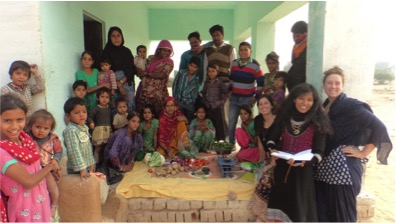
Our formula is very simple: every Monday, in the morning, we scavenge Gajner vegetables stands for the best prices; around 3 p.m. we pack our vegetables and fruits, a bed sheet to display our goods, a scale and off we go. Once in Modia Mansar, we display our things in the front porch of Sadiq’s house with the help of his children and then we wait. Usually it doesn’t take more than 10 minutes for our first customer to arrive. Saira is often present, and usually helps manage all the weighting in a not-so-easy manual scale and understanding the more complicated customers’ requests. All I can say is that so far the initiative has been a great success. We already have requests to bring more products, such as eggs, and a woman from the community has demonstrated interest in taking over the project.


Me selling a bag full of vegetables to one of our regular customers

In addition, last week we almost sold out all the vegetables we brought. Only the cauliflower didn’t find a home, as usual, and to this I must say something about. Our customers are really demanding when it comes to cauliflower. At first, the problem was the stalks. They didn’t want to buy cauliflower because they didn’t want to pay for the stalks, as they don’t eat them. In order to make our customers happy, I started bringing the cauliflower without the stalks. It was not enough. I came to realize that in addition of being stalk-free, the cauliflower needs to be a certain size (not too small but not to big), have the perfect beige color and be just firm enough, to have a chance of conquering a place in their kitchen. In the presence of a non-conformity, even dropping the price from the usual 20 rupees to 5 rupees is not enough to convince the cauliflower experts. 

Carrots are also neglected but surprisingly not for aesthetic reasons. The truth is people don’t know what to do with them. I believe part of the reason for this is that people are not used to having this vegetable around, as it is only available during the winter months. In the beginning of November, we started to hear “carrots are coming”. The possibility of having carrot soup or a simple raw carrot was something that made us all pretty excited, but unfortunately many Indian families don’t share the same enthusiasm, as carrots are not frequently used in a lot of typical dishes. Spinach faces similar popularity issues, which is something that I’ll work my best to change, as spinach is one of the few high sources of iron in a community where anemia is prevalent. On the other hand, green chilies, ginger and bananas sell effortlessly, and radishes are equally appreciated by humans and the goat population, as some of the goats walking around always try to get some when we are not looking.
A goat trying to steal some radishes
The vegetable stand in Modia Mansar is much more than a way to provide the community with a service that was not available before. It’s not only about making things easier. For me as the Health Project Manager in Gajner, it is ultimately about forging new relationships, deepening my understanding of the community’s eating habits and diversifying their vegetable and fruit intake. 

A successful vegetable stand in Modia Mansar with Saira's family and neighbors


Ana Silva - Portugal
Health Care Project Manager, Gajner (Rajasthan)

Wednesday, 12 August 2015

Health Clinic in Rait


After the success of the women’s health clinic in our Naddi centre, made possible by our partnership with Fortis Hospital in Kangra, EduCARE decided to bring a similar clinic to the Rait centre. Rait is one of EduCARE’s newest centres and very little is known about the local women’s current health status. So with preparations being made for the upcoming clinic day, it was the perfect time to investigate what kinds of health concerns local women have, what kinds of health services are available to them and how they go about acquiring health care. We began engaging women in conversations about their health and healthcare practices, and I was struck by how different a Rait woman’s experience with health services was from my own.

Back home, in Australia, I have a very good relationship with my G.P. I see her every six months for a check-up and to discuss my overall well-being; diet, fitness levels, immunity, reproductive and sexual health, mental health and any niggling little ailment that might be bothering me. Waiting times rarely exceed twenty minutes, and we meet in a comfortable, private consultation room. She knows my health history and can conveniently recall the details of past tests or prescriptions, etc., which are all recorded electronically. She carefully explains prescriptions, giving clear instructions on dosages and side-effects. Her manner is warm and patient as she allows me time and space to ask questions or express concerns. She reminds me when my next pap-test is due, and makes sure I’m up-to-day with flu shots. It’s this long-term relationship with my G.P. that provides me with holistic and complete healthcare.

From what the local women of Rait have told me, their experience is very different. Firstly, women don’t attend regular check-ups. Seeking medical services is reserved for the most severe problems or only when ongoing conditions deteriorate to an extent that they can’t be ignored. Most women priorities their domestic responsibilities or their children’s wellbeing over their own health. Going to the Dr for a minor complaint is seen as self-indulgent and a waste of time and money.

There is no personal, on-going relationship with health care providers. In fact, there are no G.P.s. Women receive medicines and advice from local clinics or dispensaries, or visit the local hospital’s out-patient department. Waiting times can take hours, even at private hospitals. Consultations are short and rushed, and only deal with most pressing complaints. Follow-up consultations are rarely performed by the same medical staff, so it’s up to the patient to remember their own medical history and repeat it several times.

For serious or ongoing concerns, women often visit multiple services and receive contradictory advice or duplicate prescriptions. Tests are often recommended, but rarely performed, and if performed but found to be negative, then additional tests are even rarer. Dispensaries often sell only the exact amount of pills that have been prescribed. This means pills are removed from their original packaging and information such as dosage instructions or side effects are only verbally communicated, if at all. Clinics and dispensaries offer no privacy or confidentiality and so health concerns that are considered taboo, such as sexual or reproductive health concerns, are often avoided or ignored. All of these things add to make women feel uncomfortable and inconvenienced when seeking medical services.
Women waiting to be received by the doctor during the health camp  in Rait

It’s no wonder women neglect their health.

EduCARE believes that women have a right to adequate health information, advice and care and that valuing women’s health is one way we can address entrenched gender inequalities in the villages in which we work. This is why our ongoing health projects are so important. EduCARE is able to act as the link between patients and services.

The health clinic held in Rait on the 12 July provided women with a different kind of healthcare experience. They were given a comprehensive check-up performed by two trained nurses, and a free consultations with a multi-specialist Dr in a private consultation room. The very friendly Dr Arka was warm and sincere as she tended to her patients. We scheduled appointments to reduce waiting times and had plenty of friendly faces to make small talk in the waiting room. Only female Fortis and EduCARE staff were present, so that the women felt comfortable and relaxed.

Katherine with the Kangra Hospital staff in one of the consultations
Our plan is to repeat health clinics every three months to ensure the women receive the ongoing healthcare they need. EduCARE provides follow-up support between clinic days too, to see if the women need any help in following the Dr.’s recommendations. Do they need someone to accompany them to get tests done? Did they understand the advice that was given on clinic day? Are they aware of the services their government issued health cards entitle them to? We also intend to design future health projects based on the information we’ve gathered about the women’s health needs. For example a prevenance of kidney stones amongst women who attended the clinics in both Naddi and Rait suggests the need for an awareness campaign about the importance of drinking water.

Health camps are just the beginning, and we have big plans for EduCARE’s health program.


Katherine Woolnough - Australia
Young Women's Association project manager, Rait (HP)

Sunday, 3 May 2015

Naddi Health Camp

Last Sunday, April 26, marked a greatly successful event in Naddi center. Realizing the community’s needs for access to regular health care service, EduCARE India had organized a free health checkup for girls and women in Naddi with the participation of Fortis Hospital in Kangra.

Since the morning of the health camp, every team member was busy with a few last preparations for this big event. ReStore team was making juices to be served to doctors and patients. Another team was in the health clinic making sure everything was in place while others were running around handling logistics. Certainly we all hoped that the health camp would run smoothly.

A team of doctors and nurses from Fortis hospital arrived at around noon. We were honored to welcome Dr.Anu Namgyal, a gynecologist, and Dr.Sumeet Badhwar, a general practitioner, from Fortist Hospital.


In the waiting room
Women waiting to see the docor

The first group of women soon arrived and we all got to work right away. The women first were welcomed to a waiting room where free and health juices were served, their basic information collected, their weight measured, blood pressured and sugar level checked. Each woman then took their number and went to see the doctors.

While Naddi interns continued to assist with the whole operation, three girls from Shenny community also eagerly participated in this event. They were talking to women waiting, collecting information needed, talking to doctors, etc.
Dr.Anu Namgyal


Dr. Parveen Kumar
EduCARE team, Fortis team and Shenny community members
After nearly four hours of the event, fifty plus women had come to the health checkup. We received very positive responses from the communities and from Fortis Hospital. We were all so happy to see the event was a great success and our efforts had finally paid off.

For me, as a cluster coordinator, I could not be happier to see how much the communities were engaged and how much teamwork the Naddi interns showed. Moreover, not only did the health camp provide women with access to quality health care service, but it also raised awareness of health issues among community members.

At the end of the health camp, a young girl from the Shenny community said that she wanted to be a doctor. Dr.Anu Namgyal said: “If only one doctor comes out of this event, it will be already really successful.”

This reminds me of why I find my work so rewarding. It is not just about creating sustainable development within communities but also creating opportunities and exposures for women and young girls.

Hanh Lam, Vietnam
Cluster Coordinator - Dharamsala


Monday, 21 April 2014

Steps towards a sustainable future

Just a short walk away from the main square in the village of Naddi lives a small community that we refer to as the “Shanney community”. It consists of eight families, about 40 people and although they are only a short distance away from the main village they tend to live their daily lives somewhat removed from it. Like every person around the world they have basic needs and wants with regards to their health and sanitation but due to a lack of a sense of empowerment, education and finances they don’t have the sense of responsibility, the knowledge or the organisational skills to implement ideas that will help to give them a better standard of living.

This is where EduCARE India comes into play. An old Chinese proverb springs to mind that might best explain our intentions;

                              Give a man a fish and he will eat for a day, teach him how to fish and he will eat for the rest of his life.

We intend to teach the Shanney community “how to fish”. Our programmes involve sustainable community development that will help empower the community and teach them that they can take responsibility for their lives, health and environment. We want to show them that they are not entirely dependent on the state to organise infrastructure that pertains to their health, safety and sanitation.

On Saturday the twelfth of April 2014, we had an informal meeting led by Mr B (EduCARE India’s Chief Project Director) with seven of our project managers by his side and seventeen members of the Shanney community (each family was represented by at least one person) to discuss what measures we can take together to help them improve their quality of life. Representatives from different generations of life in Shanney were present and they all expressed their intent to continue living there long into the future. For them to stay there in good health habits need to change, education needs to be improved and infrastructural systems need to be developed.

Before we revealed our own agenda with regards to areas that we think they need help with, we wanted to know what issues they felt needed addressing and what it is that they thought they as a community could do to make improvements. One by one they were asked the same question and they all replied with the same answer. That solid waste is a major issue, plastics and paper litter the surrounding area and the only infrastructure that they have is a few bins for paper and plastics which EduCARE had previously placed in their community and have been collecting. Initially these bins raised awareness to the practise of separating waste, but now they are ready for an upgrade.

They all suggested and agreed that they are responsible to do a mass clean up of the surrounding area which we have volunteered to organise for them on the first day of the following month. From this idea a new community based initiative was developed. On the first day of each new month we shall organise a community based activity that directly addresses important issues that the people in Shanney face.

Unfortunately, perhaps due to the fact that waste which litters the valley is so obvious to the eye; this was the only issue that the meetings participants were comfortable enough to mention. This demonstrates either a lack of awareness to the conditions that affect their lives or a lack of confidence to speak up about problems that are not so evident. Either way, it is clear to see that we have a lot of work in front of us.

Following up on the community’s primary concern, is the first item on our agenda; solid waste management. A newly developed solid waste management system has been implemented in the EduCARE staff houses. Although it is not a perfect solution to the waste management problems that people face in rural India, it has been designed in such a way that the foundations of the system should be relatively easy to replicate within the community. Waste can be separated into 4 main categories then brought by volunteering member of the community to our waste storage facility where it is collected and repurposed or sent away for recycling. For example; soft plastics can collected for making Ubuntu-blox (google this if you don’t know this simple but ingenious way of dealing with the plastics problem in the developing world); plastic water bottles are being collected to make a greenhouse; paper can be recycled by the community or turned into burnable briquettes producing energy and lowering the dependency on gas; fabrics can be reused to make clothing for the ReStore (ReStore is an empowerment program which we run where local women make clothes and crafts that they sell in a shop which EduCARE runs)...

These solid waste management initiatives are for us to teach the people from Shanney how to implement and operate, not for us to do everything for them. We help with the initial development of a system, but eventually they will take over. We want them to learn that they control their surrounding environment and that the less waste that they produce the better and that whatever waste is produced can become a useful resource. Very little “rubbish” is actually dirty!

Next up on our agenda is their water supply. Poor infrastructural development has left many leaks along the waters’ pipelines as well as the rampant dumping of waste around the water sources and the leaks have left the water contaminated. Although we are not exactly sure to what extent it is affected, we are certain that water-borne parasites are prevalent, causing many illnesses in the area. A laboratory is being set up for the purpose of testing the water, but this will take some time. In the interim, other solutions must be found. A simple provision would be to boil the water before drinking it and using a water filter, the hard part is getting people into the habit of using these precautions and for them to truly understand why it is they are taking them.

The third issue we addressed is our initiative to raise awareness on health issues. Little education is given with respect to health related practises which we in the developed world take for granted. For example; drinking dirty water or having an indoor fireplace with no ventilation. To counteract this void in learning, we are developing a health centre where the community can learn about the factors that affect their basic health such as; good / bad nutritional practises, basic first aid, causes of respiratory problems, causes of illness such as dirty water, sanitation and hygiene...


There are no local doctors in Naddi and only when someone is very ill do they undertake the forty minute journey down the mountain to the hospital. We hope to be able to arrange having a doctor come to our soon to be developed health centre once a week; to provide basic medical care for relatively easily treated illnesses, which if left ignored might become dangerous.

We then moved on to discuss “the clay oven project”. The houses in the community have open fires in the kitchen, but they do not have any form of chimney to ventilate the smoke. All of EduCARE's staff spend their initial two week induction period staying with certain families in the community which take part in our “homestay” project (similar to a guest house). One of the negative aspects that is always mentioned by the new interns is the problem with smoke inhalation caused by the open fire in the kitchen. We notice this immediately but the families either aren’t aware of the hazard to their health or feel like there is nothing they can do about it. They have learned to live a certain way and for them it is ok, but they seem oblivious to the massively detrimental effects this is having on their health. To combat this, a model for a very cheaply made clay oven and chimney has been developed. Our hope is to eventually have one of these in every house, but it is up to the potential recipients of the oven to help us make them.

There are no ovens in Naddi, hence there is no bakery. The clay oven project also provides an opportunity for business, whereby fresh baked goods can be sold in the Restore shop providing a supplement to a household’s income and fresh bread to a village (this will please many who work at EduCARE).

As an eco-friendly organisation, trees were always going to be mentioned in our meeting. Deforestation is one of the biggest problems that the earth faces. Many of us know that the main effects of this are reductions of global oxygen production and massive losses in wildlife habitats culminating in mass extinctions of species.

These effects are also prominent in Naddi, but there is another pressing issue that the people of Shanney face. The community is built on the steep valley leading down to the river where they experience large snowfalls in the winter and heavy monsoon rains in the summer. The stability of the soil that rests above them is in jeopardy because there are no more trees to keep it in place. The possibility of a landslide will someday become very real. These missing trees should also act as natural groundwater filtering system for the water that flows down to the river which feeds the villages below us. Instead it flows through dumped solid waste, contaminating the water source that supplies neighbouring villages.

We already have projects underway in which we are working with the community and have created a tree nursery. Many of the trees have been planted by the children of Shanney and the life giving favour will eventually be returned when the trees bear fruit for them and their new children whilst keeping the soil above their houses intact.

These ideas are not quick and easy solutions to immediate problems. They require time, patience, persistence and optimism. We want to change the way that people view the world, their place in it and the control they have over it. It is our hope that we can learn from these projects and eventually develop replicable solutions to common but important problems that people face across rural India. When the meeting in Shanney finishes, without anyone mentioning these last points on what it will take to achieve our goals, it feels as if the people of the community understand the problems that lie ahead of them and that they are looking forward to engaging with us as much as we are with them.

Alex Moran, Ireland
SWASH Project Manager
Naddi (Himachal Pradesh)


Monday, 30 September 2013

The Journey of Rubbish…in Naddi

This weeks Shenney Fun Club activity was organised by none other than the waste management heroes themselves – the SWASH team – and as expected environmental education and awareness was on the agenda.

More specifically the activity was focused on the different ways we can dispose of our rubbish and what the environmental consequences of each are.


Hence the first activity consisted of creating a big mind map of The Journey of Rubbish as shown in the photo below.

The use of photos also proved to be an effective tool to the mind map to life for the children, though we had a hard time sticking them to the damp blackboard!

This activity was then followed by a short educational music video in Hindi – An Anthem for a Garbage Free India – that the kids loved.


And of course finally what more could we do than to empty the rubbish bins! In theory it was a brilliant plan, however in practice is proved to be much more difficult!


Because most of the older children were absent the muscle power was to come from the interns as we lugged the blue bins all the way to the other end of Naddi.

Surprisingly this proved to be a hit amongst the children, they loved the excursion, especially rolling the barrels back down the hill!


As usual the activity had its ups and downs but all in all it should be considered a success as most importantly the rubbish made it safely to the bin!

By Veronica Noetzli, October 2013

Saturday, 29 June 2013

Making Healthy Choices... and Fun!

Last week in Naddi, we took over Fun Club (the after school program) in Sheney to teach the kids about what it means to be healthy and making healthy choices. The kids were all enthusiastic as we brainstormed what it meant to be healthy, but they were even more excited when we brainstormed unhealthy things, yelling out their favorite foods - ice cream, lollipops, chocolate! Eventually, we had the kids thinking beyond food and we began to talk about how happiness, work, and friends have to do with being healthy. Next we talked about "choices" and what it means to choose something. With folded paper and color pencils, we drew healthy choices on one side and unhealthy choices on the other - careful to avoid things that we did not have control over, such as the air we breathe or diseases we're born with.

Once the kids were thoroughly antsy, sick of sitting on the ground of the Fun Club room, we herded them outside to play a game about healthy choices. The kids lined up on one side of Sheney, divided into two teams, and we put the brainstorming poster on the other side with a line down the middle, dividing it into a healthy and unhealthy side. I stood in the middle with a stack of homemade cards - healthy or unhealthy choices on each (with an image, an English label, and a Hindi label). The kids had to hop on one foot to me, get a card, hop on the other foot to the poster, and stick the card in the correct column before hopping back to their team and tagging the next person. The relay race began with cheers and yells from both sides. (The kids can always be counted on to get a little competitive!) And as they hopped across the community, women came out of their homes to watch, smiling and laughing as the kids haphazardly jumped from one end to the other. At the end of the race - amid cheering, laughing, and overall confusion about which team actually won - we gathered around the poster to go over the cards. All the kids yelled whether each choice was healthy or unhealthy - vegetables, ice cream, sleep, water, visiting the doctor, visiting the dentist, fighting, going to school, cigarettes, soda, alcohol, many more - and we moved any out-of-place cards into the right column.

As the sun began to set and Fun Club came to a close, I pulled all the kids together outside and we pledged to make at least three healthy choices every day. "What should our healthy choices be today?" I asked. In the middle of the community, we did ten jumping jacks together, shouting the number of each one, choosing exercise for our first choice. Then I handed out lichis, and we stood together, peeling away the rough skin and sucking on the juicy fruit, choosing fruit as a healthy snack for our second choice. "What will be your third?" I asked, and everyone shared what they would do - push-ups, sleep, be nice to their friends, eat dal...

This simple activity may seem unimpressive to an outsider, but it was the first health activity with the kids and we all considered it a great success. Now they are beginning to think about health, what it means to be healthy, and how all the choices they make day-to-day affect their well being. Children are the future of course, and as this generation grows up, we want to ensure that the community will continue to thrive and develop even healthier lifestyles.


Betsy Hinchey
United States of America
Rural HealthCARE Project Manager
March – July 2013

Sunday, 11 November 2012

Better health = Better life

One of the important components of our projects are the health care and wellbeing of marginalised, poor, adolescents and women. Like many other developing countries, India too has several need gaps related to health care education and facilities. As India undergoes a transition from tradition medicine to modern medicine, there is an increasing lack of awareness of health issues and lack of access to health care facilities in many rural areas.

21 year old Jenny Bird and Kathryn Kaintz, both from the USA, and Kirsty Major from UK have spent the last several months initiating various projects in our Dharamashala cluster to address some of these health care issues at the grassroot level. "We have incorporated a few project activities aimed at addressing these need gaps, and to get to know and understand the health needs and concerns of the community better."
Jenny Bird conducting health surveys with some of the community women
Some current and past health care project activities include:
  • Community health care surveys to assess the health care issues and level of health care awareness in the community;
  • Adolescent health care awareness workshops in schools;
  • Nutrition, hygiene and wellbeing workshops during our Girls Club and Young Women Association meetings;
  • Connecting with the local public health care facilities including the traditional Ayurvedic hospitals to try to create good linkages with the rural communities, and; 
  • Community sanitation and waste management education and activities. 
  • Annual medical check up and record-keeping for the marginalised migrant community

Medical health camp with the migrant women

Wednesday, 24 August 2011

Health Day in Adampur: Trash Pickers Visit Local Health Facilities

Hannah Wolkwitz, coordinator of health day, spent weeks organizing transportation, supervision, and free check-ups with local hospitals for the Trash Pickers community in Adampur.  The health day was realized several days before her departure from EduCARE. The Trash Pickers community suffer from constant health problems due to poor sanitation, water, and other conditions in which they live. The goal for the health day was to complete a general physical for the majority of the community, numbering around thirty people.
Interns accompanied three to five individuals from the community to two facilities. EduCARE volunteers were responsible for recording health information and ensuring individuals received free medicine.  The Lion’s Club offered free eye examinations and diabetes tests. The community collected basic eye medication and, for those who needed it, spectacles. The Civil Hospital provided a urine test, weight and height measurements, and blood tests for iron, along with iron supplements.  


Civil Hospital employees checking blood pressure.
An English student and friend of EduCARE, Sukhjinder Singh, extended a helping hand, as usual, by transporting, in multiple shifts, the community to both locations. After initial disorganization and delay at the Lion’s Club during the first shift, interns developed a system to oversee that each person would be attended to. At the Civil Hospital the children bravely bared finger pricks. The community’s dog, Tiger, accompanied them for moral support, at times over-extending that support by lounging in the lobby.
The day required the attention of each member of the EduCARE team. As a much anticipated event and one in planning for awhile, it proved to be quite successful for a community plagued by a plethora of health concerns. The information recorded will be of avail to assist the community in understanding its own health and sanitation issues, as well as to go on record for future interns working to improve the general health of the Trash Pickers. Furthermore, the day spent in two health facilities will hopefully spread awareness among the community that there are local resources available to them that should be utilized.


Krishan receives a free eye examination at the Lion's Club.