Showing posts with label food and nutrition. Show all posts

Tuesday, 12 January 2016

Want subdji?


It all started with a simple request: “Can you show me the vegetables you have in your house?” Meera and Kursida, the two older daughters of Saira and Sadiq – a family we have a chicken coop project with in Modia Mansar- pointed to the phali (rajasthani beans) drying on the floor of their one room house and to three pieces of kakria (an Indian sweet cucumber) laying in a small basket. To me it didn’t seem like a lot of food for a family of 6 (they have two more children) so I asked “Or subdji? (More vegetables?) Aloo (potatoes), gobi (cabbage), tamatar (tomatoes), piaj (onions)?” The girls shook their head no. After some more questions, I came to realize that Modia Mansar only has a small variety shops that sell cookies, chips, and dhal, but no vegetables or fruits. They have to travel all the way to Gajner to get them.

Gajner is located 10 km away from Modia Mansar and although 10 km doesn’t seem that far, unfortunately not everyone owns a car or a bike, and not everyone can afford to use a tuk-tuk on a regular basis. Even if they can afford it, we know by experience that tuk-tuks are not always available, nor its drivers willing to do that specific journey, as there is a highway in between and the roads are in really bad shape. That’s when I realized the limitations this community face in terms of accessibility to food and how it to a certain extent affects their food choices and health. In conversation with one of my fellow co-workers this idea of a pop-up vegetable came up and now we are doing it every week.

Our formula is very simple: every Monday, in the morning, we scavenge Gajner vegetables stands for the best prices; around 3 p.m. we pack our vegetables and fruits, a bed sheet to display our goods, a scale and off we go. Once in Modia Mansar, we display our things in the front porch of Sadiq’s house with the help of his children and then we wait. Usually it doesn’t take more than 10 minutes for our first customer to arrive. Saira is often present, and usually helps manage all the weighting in a not-so-easy manual scale and understanding the more complicated customers’ requests. All I can say is that so far the initiative has been a great success. We already have requests to bring more products, such as eggs, and a woman from the community has demonstrated interest in taking over the project.


Me selling a bag full of vegetables to one of our regular customers

In addition, last week we almost sold out all the vegetables we brought. Only the cauliflower didn’t find a home, as usual, and to this I must say something about. Our customers are really demanding when it comes to cauliflower. At first, the problem was the stalks. They didn’t want to buy cauliflower because they didn’t want to pay for the stalks, as they don’t eat them. In order to make our customers happy, I started bringing the cauliflower without the stalks. It was not enough. I came to realize that in addition of being stalk-free, the cauliflower needs to be a certain size (not too small but not to big), have the perfect beige color and be just firm enough, to have a chance of conquering a place in their kitchen. In the presence of a non-conformity, even dropping the price from the usual 20 rupees to 5 rupees is not enough to convince the cauliflower experts. 

Carrots are also neglected but surprisingly not for aesthetic reasons. The truth is people don’t know what to do with them. I believe part of the reason for this is that people are not used to having this vegetable around, as it is only available during the winter months. In the beginning of November, we started to hear “carrots are coming”. The possibility of having carrot soup or a simple raw carrot was something that made us all pretty excited, but unfortunately many Indian families don’t share the same enthusiasm, as carrots are not frequently used in a lot of typical dishes. Spinach faces similar popularity issues, which is something that I’ll work my best to change, as spinach is one of the few high sources of iron in a community where anemia is prevalent. On the other hand, green chilies, ginger and bananas sell effortlessly, and radishes are equally appreciated by humans and the goat population, as some of the goats walking around always try to get some when we are not looking.
A goat trying to steal some radishes
The vegetable stand in Modia Mansar is much more than a way to provide the community with a service that was not available before. It’s not only about making things easier. For me as the Health Project Manager in Gajner, it is ultimately about forging new relationships, deepening my understanding of the community’s eating habits and diversifying their vegetable and fruit intake. 
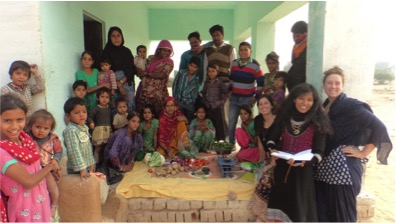
A successful vegetable stand in Modia Mansar with Saira's family and neighbors


Ana Silva - Portugal
Health Care Project Manager, Gajner (Rajasthan)

Monday, 2 November 2015

Chenni grand cook-off


After 2 months of intense nutrition work with the community, the cooking competition in Chenni successfully finished one part of the project, opening the door for more workshops and raising of awareness amongst the girls and women.

Everything started months ago when, after one more dinner with a family, I could not walk home because of all the rice I was fed. I decided that it was time to start a nutrition project. After some planning and discussions with Mr. B, we thought it would be good to first increase our knowledge about community’s food habits and then have an event.

In September I started to hand out one nutrition file per family in Chenni. For 7 days, the girls and women had to write down everything that they ate during the day, indicate in which quantity, if there were salt or spices, and if they thought it was healthy or unhealthy food. As this required a lot of checking up and encouragements, those files were given to 7 families over the month of september. 6 files were completed more or less perfectly – quite a success! In the meantime, I went to have dinner with all the families involved, a good way to spend time with the families, talk about nutrition but also observe the dinner habits.

After that, everything was ready for the big finale, the nutrition event! During one Young Women Association meeting, I asked the women the day they would be available for the event. October being an intense month for wedding, we were able to agree on Tuesday 27th of October and thus squizzed the event between 2 weddings. One problem was left though: how to organise and cater for all the families and the interns ??? The cooking competition was the only way and probably the best way to engage and motivate everyone! The rest was just a matter of organisation. Each family received 2 vegetables to cook and was provided with labour force aka 3 EduCARE interns, hungry and determined to provide the best help to the family!

A week before the event, I started reminding the families about the event, 4 days before the event, I was in Chenni harrassing the families, 3 days before the event, invitations were handed out, 2 days before the event I was in Chenni again (!)… The day before I had to mandate the other interns to do the reminding for fear of being too annoying …

On the D-day, I spend the day preparing the dessert and solving last minute issues with the help of Tomasso, Louise and Johnatan. Baking cookies without oven? Check ! Cutting a mountain of pineapple? Check (thank you Tomasso)! At 4 pm, eveything was ready… Chenni here we come!

After gathering most of the girls, Madhu and I did a little workshop where we were able to provide tips on nutrition and give some feedback from the nutrition files. Progressively, no less than 15 other interns arrived, ready to chop, boil, cook and have fun!

Delicious vegetables dishes made by the Chenni families
5pm ish, the competition started! While everyone was sweating over their dish (figure of speech as the temperature in our mountains has dramatically dropped), Priya, Boby and I were taking pictures. At 7 ish, everyone was enjoying a well deserved meal. 7:45, the judges were gathered, the thali plates were displayed on the judges table. No less than 6 judges – Bindu, Abu, Savita, Priya, Boby and I – had the responsability to decide who should win the first ever cooking competition. More than 25 people were squeezed (we were cold) and were intensely observing the judges nimbling on all the amazing food. 

The judges waiting to taste the food
While everyone was finally allowed to taste each others food, the judges were debating next door on who should win. Despite the difficult task, one team was agreed upon.  After gathering everyone again, Priya announced officially that Sunayna, Kanta, Kuldeep, Anamika, Tulsi and Anesa were the winners. The price – paneer, chocolate and a little cookbook – was given, along with a diploma.

Winner team!
To thank everyone for their participation and as in the end everyone won (yay!), we all gathered around a dessert before shivering our way back home!

Harmonie Bucher - France
Health Coordinator, Naddi (Himachal Pradesh)

Saturday, 29 June 2013

Making Healthy Choices... and Fun!

Last week in Naddi, we took over Fun Club (the after school program) in Sheney to teach the kids about what it means to be healthy and making healthy choices. The kids were all enthusiastic as we brainstormed what it meant to be healthy, but they were even more excited when we brainstormed unhealthy things, yelling out their favorite foods - ice cream, lollipops, chocolate! Eventually, we had the kids thinking beyond food and we began to talk about how happiness, work, and friends have to do with being healthy. Next we talked about "choices" and what it means to choose something. With folded paper and color pencils, we drew healthy choices on one side and unhealthy choices on the other - careful to avoid things that we did not have control over, such as the air we breathe or diseases we're born with.

Once the kids were thoroughly antsy, sick of sitting on the ground of the Fun Club room, we herded them outside to play a game about healthy choices. The kids lined up on one side of Sheney, divided into two teams, and we put the brainstorming poster on the other side with a line down the middle, dividing it into a healthy and unhealthy side. I stood in the middle with a stack of homemade cards - healthy or unhealthy choices on each (with an image, an English label, and a Hindi label). The kids had to hop on one foot to me, get a card, hop on the other foot to the poster, and stick the card in the correct column before hopping back to their team and tagging the next person. The relay race began with cheers and yells from both sides. (The kids can always be counted on to get a little competitive!) And as they hopped across the community, women came out of their homes to watch, smiling and laughing as the kids haphazardly jumped from one end to the other. At the end of the race - amid cheering, laughing, and overall confusion about which team actually won - we gathered around the poster to go over the cards. All the kids yelled whether each choice was healthy or unhealthy - vegetables, ice cream, sleep, water, visiting the doctor, visiting the dentist, fighting, going to school, cigarettes, soda, alcohol, many more - and we moved any out-of-place cards into the right column.

As the sun began to set and Fun Club came to a close, I pulled all the kids together outside and we pledged to make at least three healthy choices every day. "What should our healthy choices be today?" I asked. In the middle of the community, we did ten jumping jacks together, shouting the number of each one, choosing exercise for our first choice. Then I handed out lichis, and we stood together, peeling away the rough skin and sucking on the juicy fruit, choosing fruit as a healthy snack for our second choice. "What will be your third?" I asked, and everyone shared what they would do - push-ups, sleep, be nice to their friends, eat dal...

This simple activity may seem unimpressive to an outsider, but it was the first health activity with the kids and we all considered it a great success. Now they are beginning to think about health, what it means to be healthy, and how all the choices they make day-to-day affect their well being. Children are the future of course, and as this generation grows up, we want to ensure that the community will continue to thrive and develop even healthier lifestyles.


Betsy Hinchey
United States of America
Rural HealthCARE Project Manager
March – July 2013