Showing posts with label Rural health. Show all posts

Sunday, 11 September 2016

Leaving India

Wow. I can’t believe this is the end of my internship. Part of me feels like I’ve been here forever, but at the same time it seems like I just arrived in Delhi yesterday. 

There’s so much I could say in this blog post, but I want to keep it simple and to the point. Expect the unexpected. Unless you’ve been to India, lived in a developing country for an extended period of time, or something similar, then you’re not going to be fully prepared for what you will experience here. Don’t let that scare you though because if you have the right attitude, you will benefit in many ways from this experience. 

Come with your expectations, goals, and inspiration because you’re going to need all of those things. EduCARE will do their best to make this a beneficial and enjoyable time for you, but you can’t forget that you are here to work. I came to India planning to work with alternative energy, but in the end I created a health project and it has a high chance of being successful in all of the centers. 

I loved my experience in India and I say this after I spent days in unbearable heat and a constant state of sweat. You just have to keep a positive mind and know how to re-center yourself when others bring you down. I love this beautiful country no matter its flaws. 

To summarize, I’ll never experience anything like my time in India. It’s as simple as that. Part of me wants to stay here, but the other part of me misses home and can’t wait to see my family.

Traveling around Rajasthan

Little nice neighbour in Gajner

Anna-Leigh Shuping - USA
Alternative Energy Project Manager in Gajner

Saturday, 27 August 2016

My Experience with EduCARE India

My internship at EduCARE has been a great experience for me as an individual and a project manager. EduCARE is a unique organization and it works for the backward areas of India where other people don`t even think to go and work which I think it is a good approach. Its way is unique when they allow young minds to make mistakes and learn and develop innovative ideas.

People in the organization are self -motivated and always come up with some new ideas.It was a great opportunity for me to grow as an individual and question my potential. Overall it was a great experience for me as an intern to complete my journey with the people from other countries. I got the opportunity to enjoy some dishes made by them. I also cooked some Indian dishes which were equally liked by them. To combat the scorching heat, walking by the Harike beach and see the sunset was so relaxing and beautiful.

Walking in the wetlands enjoying the "beach" of Harike

Before joining EduCARE I expected it in a different way but I would say it was not the same. I like the way Mr. B (Projec Director) explained the overall concept of global needs and if we could do a little bit for the mother Earth. I was also swayed by the simplicity of the director. He was so inspiring.There was no feeling of boss and employees at all. 

It was indeed a great experience for me to be a part of EduCARE as an intern and work for Harike's community. In general, the people were not aware of Harike's health care facilities and programs available to them, and there was no atmosphere of education. The lack of interest and support was very harmful for their wellbeing. 

The need and importance of health was a strange topic to them. My first objective was to make them realize why they need to be healthy. I conducted a survey about the quality of the drinking water and water-borne diseases. People were really cooperative so I conducted workshops at school to make children aware of health related issues. During the rainy season, with the help of CHC staff I could check the quality of drinking water of the area concerned. 

I think because of the initiative of EduCARE India I was able to disseminate useful knowledge and information about health and its related issues. 


Working with Harike's children in the ASP project


Mandeep Johal - India
Rural Health Care Project Manager in Harike

Saturday, 20 August 2016

Want to be more flexible? COME TO INDIA!

Living 6 magnificent months in India, as an intern in Educare, has been such a great, incredible experience. I learnt so many things, met so many amazing, awesome people and lived so many experiences that I cannot list them in one single page, but that I'm sure they will stay in my mind and heart for all my (long, so long,) life.

However, I believe the most important thing I learnt in India and in Educare is the flexibility. I always thought I was a very flexible person, able to deal with any kind of unforeseen events, to find a way to sort it out even if everything could seem a huge issue.

Because I had never been to India before January 2016.

All my ability and skills have been tested, again and again, during my whole indian adventure: every time (that probably means almost every day) I thought I was about to go too far and overcome my limits, and probably kill someone.

But what am I talking about?

-Flexibility, when you plan a meeting with someone from the community, you go to his/her house, and she/he is not there because "random excuse/things to do" or, on the opposite, you just go to check if they are okay, and they offer you the longest chai-time ever, asking you everything about your family, country, studies, and why we "Angresi" are so weird, and, last but not least, taking a picture


Dr. Pinkie, such a precious, friendly resource in Rait! (but sooo curious about our lifestyle...)


-Flexibility, when you schedule your trip all around India, and you don't have so much time, and the train is cancelled/delayed, or your bus runs so fast that you reach the destination 3 hours before the scheduled time, but it's 4 AM and all you can do is sitting outside with your friends, blankets, and see the sunrise; 

-Flexibility when you are waiting for someone and after 3 hours they come as nothing is wrong, because "this is indian time", even if you have loads of things and duties to do 

- Flexibility is when you go meeting your friend, the Ayurveda doctor of the village, for a project, she invites you to her house for a chai, and finally on the way to go she asks you to stay overnight and have fun together at the yoga school where she teaches; 

- Flexibility is when you schedule such an important skype meeting/interview/call with your family, and a powercut comes for 10 hours; 

- Flexibility is when you plan to cook for the doctors arrived for visiting the women of the community for the Free Health Camp Day, and you run out of gaz, and the place where you can buy a new one is far away and impossible to reach in time; so all you can do is going and praying a Dhaba to cook for 15 people to take away, 

- Flexibility is when you plan your weekly schedule with meetings, research, staff to do...and there is a Dam, a wedding, a birthday party and we are all invited for the next 3 hours, eating the best thing you will have in your week, meeting incredible people to whom you can show your (poor) hindi; 

- Flexibility is everywhere and anytime, from your breakfast time with no power and no gaz, to your evening, when you want to take a shower because outside is 40 degrees and there is no water left in the tank. 

But flexibility, for me, can be summed up in one of the last moments I lived in Rait with our landlord, Uncle: it was 11 AM or so and as I was about to leave Educare, I was full of things to do, manual to complete, event reports to edit...It had been a rainy week too, meaning lots of powercuts; but suddenly Uncle arrives.  He literally ordered me to take a knife and follow him in the garden, because we had a lot of "saag" (for me, simple weed and leaves with no interest). 

He showed me how to cut it (hey man, it's not the first time I do it!), he showed me how his vegetables are green and big (yes, I can see them every day) and then he told me he will teach me how to cook the famous "saag". 

WHAAAAAAT??!!!! 

Cooking, right now, only understanding half of the words he says and with all the things I have to do?!? 

No possibility of explaining him about my schedule, so...let's go for it!


We cut onions, garlic and tomatoes (of our garden!!;), he came in the kitchen and showed me hot to cook these dark green leaves I would have never eaten (common', this is like salad!you don't need to cook it!): finally we spent nearly one hour together, without almost saying a word, or at least until I saw him putting a full spoon of chilly, and after that obliging me to try the sabzi: NAHI-JI!!!ME HACHA NAHI (or however you write it)

I tried my best hindi to let him understand I don't like such a spicy food, but, as you can imagine, my hindi skills are soooo undeveloped, that I was forced to try it...

OH MY GOD!!!SUCH A GOOD SABZI!!Probably one of the best I ever made (with some help). Uncle smiled (I promise, I probably saw him doing it only twice in 6 months) and seemed very proud of himself teaching how to cook to this white (unable) girl.

Flexibility is one of the most important teaching and gift that India and EduCARE gave me: I must add, of course, all the people I met there, from my house-mates, now part of my global family, to the little children in the After School Program or Girls Club, passing through all the shopkeepers and doctors who helped us.

They completed and supported me in such an incredible adventure!


Federica Villa - Italy
Health Project Manager and Coordinator in Rait

Wednesday, 25 May 2016

Something Special

There is something about Gajner. That’s what everyone says. And when they say that I don’t think they mean the beautiful Gajner Palace or the lake. Nor the mesmerizing sunsets and the amazing desert landscape. In my case, now that I am leaving after 6 months, I came to narrow it to three things: the people, the animals and the pani puri. I will start with the last.

Pani Puri
I truly believe Gajner has the best panni puri in the world. The only panni that not only tastes amazingly good but doesn’t give you diarrhea (at least not to me). And the special one, as I like to call it, the one without the water you get in the end, tastes like India to me. Sweet, sour, spicy and interesting enough to keep me coming back for more.

The man that creates the magic!

Animals
Delhi. Delhi was our house puppy we rescued from the streets, who sadly is no longer with us. He destroyed my favorite pair of gloves and pretty much every shoes I owned. I used to call him “Terrorista”. Manoj says he had an education. Indeed, he had an education, but he was a rebel at heart. 


Delhi's bright and dark side


Mico and Vather, our two beloved pet geckoes. Recently, they have been occupied doingsome horizontal (vertical?) dancing. Actually, I noticed a little bump in Vader’s belly which leads me to believe that the gecko family might be increasing anytime soon. When you don’t have television, this is the best you get. 

Lady, the nicest and smartest dog in Gajner. In fact, the only dog that acts like a dog around here. She wails her tail when she sees you, jumps at you asking for affection, and follows you around. She recently dig a hole just outside of our house where she retires during sleep. Summer doesn’t spare anyone and even the dogs can’t handle the suffocating heat during the night. 

The Cat who comes to our house at night when everyone is asleep to steal our food. He has literally the weirdest taste when it comes to food, and he eats anything from dog food, bread, and eggs, to toilet paper, tampons and sanitary pads. Disgusting I know, but true. Our cat is also a very needy cat and tries to cuddle with people if given the chance. He has found his way into our rooms a few times, and once Orane (an amazing French intern) woke up with him on top of her in bed.

Finally, the moody cows in front of Mr. Bero Singh vegetable shop. For future interns, especially female interns, keep your eyes wide open and prepare to run (and scream!) when crossing through this (dangerous) area, because these cows might attack you for no particular reason. It has happened in the past and it may happen again.

People
Our community has the kindest and friendliest people I met in my life. Living in a place where people actually remember your name and care enough to reach out to say Namaste whenever they see you gives you an immense joy and a true sense of belonging.

Ankita, is one of the many kids in town who runs to you whenever they spot you on the street. For six months our interactions have been always the same. She asks me my name, I reply and then we engage in fist punch with a boom in the end.

Then, there are all the shopkeepers in the main street who, in the beginning, looked at me with curiosity but, whom with time, I became very good friends with. Not surprisingly, my Hindihas evolved from knowing only casual greetings to knowing back and forth the Hindi words for all the vegetables and fruits and many other foods. And then there is the constant invitations for chai, and all the people that ask you to come to their house for dinner, try to teach how to make chapatti for the hundredth time, and reject your weird shaped chapatti as its form would alter the taste.

Vimla, who the moment you say you have to leave her house, gets you more food so you have stay a little longer. And Sorav, her son, who is one of the smartest kids I have ever met, and who at 13 is already thinking about university and studying abroad. Sorav, who is Hindu but spends almost two hours looking for eggs with you (when many others cringe even to the sound of the word) when you decide at the last moment you want to make a cake for dinner.

Me and the kids

Manoj, who not only helps you immensely with all of your projects, but also tries to teach you Hindi, cooks the best Indian food you will ever taste, and invites you to come to his house and celebrate Holi and Diwali with his family.

And Shushuma and her family,Anjuman and Mubarak Je, Dappu, Durga, Pria, Shreea, Kumkum, the Gajner team (you guys rock!), and all of these others amazing people who I would write things about if I had the space, but I am almost on 900 words now and this is obviously getting way to long.

The funny part about leaving is you are not gone yet and you are already thinking when you are coming back. I guess there is really something special about this place. 

So instead of saying goodbye I say phir milinge Gajner, phir milinge India!!

View of Gajner from our roof


Ana Silva - Portugal 

Rural Healthcare Project Manager in Gajner

Tuesday, 12 January 2016

Want subdji?


It all started with a simple request: “Can you show me the vegetables you have in your house?” Meera and Kursida, the two older daughters of Saira and Sadiq – a family we have a chicken coop project with in Modia Mansar- pointed to the phali (rajasthani beans) drying on the floor of their one room house and to three pieces of kakria (an Indian sweet cucumber) laying in a small basket. To me it didn’t seem like a lot of food for a family of 6 (they have two more children) so I asked “Or subdji? (More vegetables?) Aloo (potatoes), gobi (cabbage), tamatar (tomatoes), piaj (onions)?” The girls shook their head no. After some more questions, I came to realize that Modia Mansar only has a small variety shops that sell cookies, chips, and dhal, but no vegetables or fruits. They have to travel all the way to Gajner to get them.

Gajner is located 10 km away from Modia Mansar and although 10 km doesn’t seem that far, unfortunately not everyone owns a car or a bike, and not everyone can afford to use a tuk-tuk on a regular basis. Even if they can afford it, we know by experience that tuk-tuks are not always available, nor its drivers willing to do that specific journey, as there is a highway in between and the roads are in really bad shape. That’s when I realized the limitations this community face in terms of accessibility to food and how it to a certain extent affects their food choices and health. In conversation with one of my fellow co-workers this idea of a pop-up vegetable came up and now we are doing it every week.

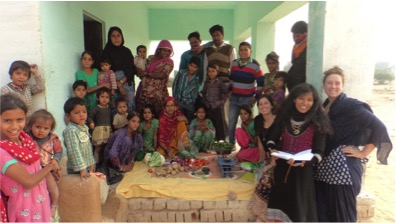
Our formula is very simple: every Monday, in the morning, we scavenge Gajner vegetables stands for the best prices; around 3 p.m. we pack our vegetables and fruits, a bed sheet to display our goods, a scale and off we go. Once in Modia Mansar, we display our things in the front porch of Sadiq’s house with the help of his children and then we wait. Usually it doesn’t take more than 10 minutes for our first customer to arrive. Saira is often present, and usually helps manage all the weighting in a not-so-easy manual scale and understanding the more complicated customers’ requests. All I can say is that so far the initiative has been a great success. We already have requests to bring more products, such as eggs, and a woman from the community has demonstrated interest in taking over the project.


Me selling a bag full of vegetables to one of our regular customers

In addition, last week we almost sold out all the vegetables we brought. Only the cauliflower didn’t find a home, as usual, and to this I must say something about. Our customers are really demanding when it comes to cauliflower. At first, the problem was the stalks. They didn’t want to buy cauliflower because they didn’t want to pay for the stalks, as they don’t eat them. In order to make our customers happy, I started bringing the cauliflower without the stalks. It was not enough. I came to realize that in addition of being stalk-free, the cauliflower needs to be a certain size (not too small but not to big), have the perfect beige color and be just firm enough, to have a chance of conquering a place in their kitchen. In the presence of a non-conformity, even dropping the price from the usual 20 rupees to 5 rupees is not enough to convince the cauliflower experts. 

Carrots are also neglected but surprisingly not for aesthetic reasons. The truth is people don’t know what to do with them. I believe part of the reason for this is that people are not used to having this vegetable around, as it is only available during the winter months. In the beginning of November, we started to hear “carrots are coming”. The possibility of having carrot soup or a simple raw carrot was something that made us all pretty excited, but unfortunately many Indian families don’t share the same enthusiasm, as carrots are not frequently used in a lot of typical dishes. Spinach faces similar popularity issues, which is something that I’ll work my best to change, as spinach is one of the few high sources of iron in a community where anemia is prevalent. On the other hand, green chilies, ginger and bananas sell effortlessly, and radishes are equally appreciated by humans and the goat population, as some of the goats walking around always try to get some when we are not looking.
A goat trying to steal some radishes
The vegetable stand in Modia Mansar is much more than a way to provide the community with a service that was not available before. It’s not only about making things easier. For me as the Health Project Manager in Gajner, it is ultimately about forging new relationships, deepening my understanding of the community’s eating habits and diversifying their vegetable and fruit intake. 

A successful vegetable stand in Modia Mansar with Saira's family and neighbors


Ana Silva - Portugal
Health Care Project Manager, Gajner (Rajasthan)

Wednesday, 9 December 2015

Air pollution & health in the Paro migrant camp

Last week Rajvir, a five year old boy at the Paro migrant camp, fell sick with a chest infection. After an overnight trip to the government hospital in Hoshiarpur and a course of antibiotics, he’s now much better and well on the way to recovery. However, it highlighted to all of us one particular health risk that the migrants in the camp, together with many other families in India, face daily: indoor air pollution from burning wood and plastic.

Worldwide, over 4 million people die each year from illnesses attributable to household air pollution. India has one of the highest death rates, standing at 400 per million population. Burning wood, which is common across much of India for cooking, releases carbon monoxide and particles from incomplete combustion, which have harmful health effects. At the Paro migrant camp, they also burn soft plastic as tinder, releasing additional harmful chemicals. Although there are outside stoves, most of the cooking in the camp is done inside the tents, where there is little or no ventilation, increasing exposure to toxic chemicals.

As would be expected, most diseases from household air pollution are respiratory illnesses, such as acute pneumonia in children, lung cancer, and chronic obstructive pulmonary disease. However, burning wood in the home doesn’t only affect the lungs. People exposed to indoor air pollution are also at greater risk of heart problems and stroke later in life.

So what can we do at Educare to minimise the health risk to the migrants of burning fuel? One of the top priorities is education. To this end, we are working to incorporate educational activities about indoor air pollution into the after school programme. A longer term goal is to find an alternative energy source for cooking, and to work with the community to find ways of increasing ventilation within the tents.

There are also health measures that can be taken. Childhood vaccines can protect against pneumonia; better nutrition boosts the immune system to fight off infectious disease; and screening for cancer and tuberculosis catches disease at an early, treatable stage before the condition becomes too serious. Hence through a collaborative approach between health, SWASH and alternative energy, we can reduce the risk of illness from household air pollution in the Paro migrant camp.

Burning wood as fuel is a major cause of household air pollution. Although the migrants at the Paro camp have outdoor stoves, they often cook inside with poor ventilation, which can have serious health consequences.

Siobhan Botwright - UK
Health Coordinator, Paro (Punjab)

Sunday, 11 November 2012

Better health = Better life

One of the important components of our projects are the health care and wellbeing of marginalised, poor, adolescents and women. Like many other developing countries, India too has several need gaps related to health care education and facilities. As India undergoes a transition from tradition medicine to modern medicine, there is an increasing lack of awareness of health issues and lack of access to health care facilities in many rural areas.

21 year old Jenny Bird and Kathryn Kaintz, both from the USA, and Kirsty Major from UK have spent the last several months initiating various projects in our Dharamashala cluster to address some of these health care issues at the grassroot level. "We have incorporated a few project activities aimed at addressing these need gaps, and to get to know and understand the health needs and concerns of the community better."
Jenny Bird conducting health surveys with some of the community women
Some current and past health care project activities include:
  • Community health care surveys to assess the health care issues and level of health care awareness in the community;
  • Adolescent health care awareness workshops in schools;
  • Nutrition, hygiene and wellbeing workshops during our Girls Club and Young Women Association meetings;
  • Connecting with the local public health care facilities including the traditional Ayurvedic hospitals to try to create good linkages with the rural communities, and; 
  • Community sanitation and waste management education and activities. 
  • Annual medical check up and record-keeping for the marginalised migrant community

Medical health camp with the migrant women