Showing posts with label Women's Empowerment. Show all posts

Wednesday, 21 September 2016

Six months with EduCARE India

Living and working in India for six months did a lot for me. I learned to appreciate the things that seems so common, like access to electricity and clean water. I met the most amazing and inspiring people, and was overwhelmed by the Indian hospitality and generosity. India also turned me into this crazy stealing-toilet-paper-from-hotels-woman, so I would not have to blow my nose again with a newspaper in a country where tissues are scarce. It often pushed me to my limits, with a hole in the ground as a toilet, or people looking over the walls when you already have limited private space. India drove me nuts sometimes, but mostly gave me memories that will last a lifetime. 

I was part of the team that started up the new centre in Rangmahal. Since the villagers had not seen any foreigners in sixty years, I often felt like I was living in a zoo. More often than not at least twenty people would watch me eat, dance, even work. But as they got more used to us, this curiosity turned into a genuine interest in us as persons. Over time, people addressed me as sister or daughter instead of foreigner. Even though the communication was like those of cavemen, I could feel I was building strong relationships with people in the community. 


Slowly we started setting up projects. I saw the girls growing more confident and developing their personalities. Also they learned to appreciate each other more, and even new friendships developed amongst them. This was a beautiful thing to experience. We were also able to spread more awareness about topics like menstruation, stereotypes and domestic violence via workshops at the school. Topics that were taboos at first, now became subjects that were openly discussed amongst the students.


Despite these amazing experiences, there are also still some things I question about the organization. The organization is very dynamic, with interns coming and going every few months. For me it is hard to understand how a organization as dynamic as this one can create a sustainable change. I think the organization would be more effective with a solid team of employees, supported by a team of interns that bring new innovative ideas. Furthermore, I believe it would benefit the organization to have more Hindi speakers. The language barrier makes it often hard to give your projects a push, and you have to work around this. However, this is not possible for everything, which leaves you being stuck at a certain level.


Working for EduCARE was a great personal experience. I feel that in this half year, I gained five years of life experience. I got the opportunity to develop deep relationships with Indian families and experience the diversity of India by travelling to different districts. I definitely fell in love with this amazing, complex country and will have to kick off from all the chai. 

Lovely India, thank you for everything!


Iris Workum - The Netherlands
                                   Women's Empowerment Project Manager and Coordinatorin RangMahal

Sunday, 18 September 2016

What did I learn in India?

As Marcel Proust said:

«Le véritable voyage de découverte ne consiste pas à chercher de nouveaux paysages, mais à avoir de nouveaux yeux» // «The real voyage of discovery consists not in seeking new landscapes but in having new eyes» 

- My look upon the world has changed, regarding : 

How I perceive the inequalities (poor/rich differences, people living in the street, gender inequalities especially regarding girls that are forbidden to pursue their education after a certain age, arranged mariage…)

How I perceive India, and the culture : I didn’t have that many expectations, I maybe was
beautifying the Indian culture and that issues that they had…

I realised the importance of education, regarding women's empowerment and the destiny of these women.

- My look upon myself has changed :

I’ve realized, (even though I was kind of aware of it) that I would like to be a teacher and that education is something really important to succeed in life and to gain more self confidence, self esteem and self accomplishment.

Talking about the people I have met, how they have changed my perceptio and my way to look at things.

For having lived in India for almost three months now, I can assert that my view on wealth and gender inequalities that are deeply rooted into the Indian culture have changed. Inequalities, especially regarding inequalities of income and opportunity, have always been topics that have upset me. I knew before coming to India that it would be hard for me to see certain things as children pulling on my clothes and begging for money and disabled people sitting on the street. And, indeed, on the first weeks, it was. I was aware of the caste system as well and I felt really bad when thinking about it.


I also knew that coming to India I will witness  gender-based and unequal rules, such as our way of dressing. I was aware that I would work with some Indian girls that start skipping school after primary or middle school in order to do household chores, that I would meet married women, young and old, who have not chosen their husband and I felt quite challenged about it.

Then I came to Harike. I have met the women and children at the temple community  with whom we are working with and the girls from the migrant community. I have encountered a lot of people in the streets, on public transport, in shops, at school, at the temple, at their homes, as well as interns from India and abroad with whom I had great conversations. Observing and witnessing these people’s lives and talking with them gives a different approach to how I consider inequalities, which is a different perception than when I was watching dramatic documentaries or reading sad testimonies regarding « these poor and unlucky Indian people ».

The first time I stepped in the migrant community, I felt pretty shocked and upset by all these houses made out of sheets of metal, straw, and wood. The children, beaming with joy, quickly ran to me, and the girls smiled so much as they welcomed me, that I progressively forgot how poor they are compared to how rich their hearts are.  In my eyes, they progressively have become strong and deserving girls that aspire to be teachers or beauty parlour women that are eager to learn and get over gender inequalities.

Over the Girls Clubs meetings, I got to know the girls better along with their aspirations and goals in life, especially concerning Jyoty and Kyran, the two most engaged girls and sisters.


In the temple community, I am working with Neetu, 14, who is attending the Girls Club and Babu, 20, who is a woman engaged with us to make products and attend English lessons. Although she is very young, Neetu is not allowed by her family to go to school. She stays at home to do household chores. Babu, one year younger than me, has a baby and can barely read or write. However, they are both really eager to learn and be engaged with us. Even though I feel lucky to go to university and to be able to earn my own money afterwards, I do not feel I am anybody to judge their lives. They are surrounded by their families and seem to be happy in this way. They will definitely continue to be engageg in English classes and Girls Club though, because education is the key that leads to self-accomplishment and self-esteem and that could empower them.  bMy previous angry and rebellious feeling toward these unfair situations is in a way fading away as I accept the reality as it is.


Furthermore, sharing opinions, ideas, and facts, about the Indian culture and mindset with some Indian people, has progressively changed the way I consider inequalities in India.

My pitiful view progressively broke down and became a realistic opinion. No one is totally a victim, no one is completly guilty, and everyone is just trying to survive and to be happy. As an EduCARE intern, I can try to bring these people some new perspectives, and attempt to rebalance these inequalities. That is the least I can do.


Delphine Lavernhe - France
ASP and Girls Club Project Manager in Harike

Saturday, 16 July 2016

Women of Gajner

The first thing that strikes you when you come to a rural village in India is the people. People that look so different, that dress so different and whose habits are so far from yours. But then, you get to meet these people, to talk with these people in your broken Hindi and share moments with them. And you understand just how similar you actually are. And it is beautiful. 

As fervent believers of cross-cultural exchange and mutual learning, we wanted to know more about the stories of the people who constitute Gajner. Its people, its traditions, its soul. We wanted to give them a platform to share their stories and inspire each other the way they inspired us. So, we decided to create a project named Humans of Gajner. Similarlyto the famous Facebook page “Humans of New York”, we wanted to capture the soul of Gajner through pictures and stories of its people. 

We started to think about the stories we would like to showcase and really define the aim of this project. There, we realized that, from our personal point of view, the stories who needed to be told the most were the women’s. In Gajner, men are everywhere outside, they can talk, they can decide and they can share. The women, who are often kept in their houses, can be undermined and forgotten when you walk through the streets of Gajner. But, as you are welcomed inside their homes and their intimacy, you realize just how big a role they play in their household and therefore in the community. All the women and girls we met here, whatever their religion or age, have taught us something and have a unique role in making Gajner what it is. 

So there, Humans of Gajner became Women of Gajner (at least for now). We decided to start with the women of the community we know. The stories and pictures will be showcased in a safe, women-only space that we want them to make their own: our Vikas Center ECRC. As our center’s Girls Club is held there, these stories can inspire young girls and women to be proud of who they are and find their path to happiness and accomplishment in a society dominated by men. Also, as more women come into the ECRC, this will hopefully create links between them as it is a platform for them to share and discuss. 

We planned very carefully our schedule and stories/pictures to take. But, as everything as India, it did not go according to our plan. The first obstacle was how to explain these notions, very common in our Western world, in simple and down-to-earth words so that the women can understand. For this, we were lucky to have in our team Meera, our favorite Indian brilliant doctor intern. She perfectly understood where we wanted to go with this project and adapted it to words and notions that the women here will respond to. Also, she is our translator for our encounters with the women and our project greatly benefits from the relationship she easily establishes with the women.

We chose women that Educare has established relationships with. Obviously, we wanted every single woman and girl to tell us their story as there is so much to learn from them, but we needed to choose. We wanted women that are emancipated and have found a way to be powerful in the community, to be role models for younger girls. But, we also wanted to showcase women who may seem like regular “underpowered” housewives. Indeed, many girls will unavoidably get married and have to stay in their houses, and many will be restricted in their lives by their in-laws, so we wanted to give them examples for hope. To show them, at a very young age, that society will not get to decide how strong and powerful they are. That, even from home, they are central to their family life and that they are not weaker than men. That, whatever society tells them, they matter, deserve respect and can achieve great things. 

The second obstacle we faced is the paternalist family rules. Many women/girls needed the authorization from the men in their family. This was really tough because 2 key women we wanted to interview and photograph were not able to participate in this project. The most frustrating for us was to see how enthusiastic they were when we presented the project. And then, just because their husband/father did not want to have their picture in the ECRC, we could not showcase the great role they play in their family and community. And still, there is nothing you can do as you have to respect their authority. However, we expect that in the future, when the men will see that the picture will be seen by women only and how careful we will be with it, they will be less skeptical and hopefully there will be less restrictions from this. Also, a part from their authorization, we also needed to handle their presence during our interviews with the women. For one of our stories for example, the man was the one speaking the whole time, even if we were directing our questions to the woman. So again, you cannot say anything, smile and think how you can still make the woman the center of the story. 

This project has been full of ups and downs; coping with people’s personal schedules, running after women to take their picture when they are available, having men telling us that we cannot tell their wife or daughter’s stories even if the woman seemed very enthusiastic, the cultural and language barrier… But we can definitely say that every single step, obstacle, encounter has been worth it. The road to the 4 final stories we have has been bumpy and tough but it has given us so much more than we expected. These 4 stories, written solely from what they told us, give a glimpse of these women’s pride and individuality. 

In the future, we wish to continue with this project as it is a great platform for exchanging but also deeply understanding these women, their vision and their role. We don’t know the whole of Gajner, and are actually very far from it, so this project aims to discover even more these beautiful and strong women. And for us, this project represents exactly our role within the community: build platforms for the community to express their potential and take leadership on their own and village’s path.


Women of Gajner Making of


Costanza Burstin - Women's Empowerment Project Manager and CC in Gajner
Debora Cortez-Miranda - SWASH Project Coordinator, P. Manager and CC in Gajner
Meera Suresh - Rural Health Care Project Manager in Gajner

Wednesday, 6 July 2016

The girls of Gajner and their path.

When I first arrived in Gajner, I was deeply fascinated by the number of beautiful and interesting girls in this rural Rajasthani village. From the very beginning, my aim was to get to know them to understand a part of their world. I wanted to interact with them to comprehend their interests and dreams to explore their role within the community. 

After I have lived with these girls and women for 6 months and sharing countless chats, dances, chais and dinners, I began to learn some small but significant aspects of their lives. What intrigues me most about their roles are the distinct steps they tend to follow at defining junctures of their lives. Their religion, castes and social status are generally irrelevant in determining whether or not they pass through these stages. Whereas timing and methods may vary, the path remains more or less the same and is characterised by 3 phases:

1 Carefree schoolgirl

2 Responsible young woman at marriageable age

3 Respected wife and mother

In line with my observations, the first phase is the period that occurs from childhood until adolescent, which is attained between 12-15 years. In this period of their lives, little girls go to school and roam freely around the village by bicycle, crossing main roads and visiting the bazaar. They are not required to adhere to a specific dress code and permitted to play outdoors, interacting with other girls (and occasionally with boys) from other neighbourhoods and communities. 

Girls at the end of the school day in Gajner


Girls celebrating Holi with the interns in Gajner

The onset of the second stage comes with puberty when girls start to be viewed as potential brides, generally between the ages 15-18. In this stage, their freedom is slowly reduced. Their access to the outdoors decreases and they are no longer allowed to pass through the main streets of the village, other than to go to school or attend tuition classes. Simultaneously, their role within the house increases and they are required to manage housework and contribute to household tasks. Assuming a modest and responsible attitude within the public sphere is essential in preparation for marriage. Their attire in this phase is restricted to wearing tradition Punjabi suits and they are expected to behave appropriately in the public eye.

Young girls carrying wood to their homes

The third stage comes when a girl is arranged to be married to a suitable partner, usually between 18-20 years of age. In this stage, the young women leave their family home in order to move into that of their husband’s as the new daughter-in-law of the family. Their role in the public sphere undergoes another change. They wear saris and anklets to distinguish them as married women. They learn to respect the rules of their new home and family and assume a domestic role as wives and soon to be mothers. 


Mothers and daughters in Gajner village

To conclude, my observations have led me to identify these stages in the lives of these women who continuously occupy various roles in the community. At first, a young bride entering a new family may find that her agency is limited and her freedoms are curtailed but as time passes and she progresses further into this stage it must be noted that her importance and self-confidence increase. As they become mothers, they assume higher position of control within the house and gain an important role not only in daily decision-making processes but also in the children’s education and the transmission of values. 


Costanza Burstin - Italy
Women's Empowerment Project Manager and Centre Coordinator in Gajner 


Saturday, 25 June 2016

8 things I’ve learnt during my EduCARE Internship

1. How to live sustainably 

Living in an Indian village and trying to set an example for the village, I discovered how unsustainably I – someone who claims to care about the environment and climate change – had been living. Since being here I’ve learnt to go without toilet paper, blow my nose with my hands and a bit of water, conserve and re-use water, cut down plastic bags and unnecessary waste and to switch my light off when it’s not in use (something my dad will be cheering about).

2. How to become a cooking extraordinaire 

I still live at home so I have come to rely on heavily on my mum’s cooking. Even when I tried to cook it would end up tasting horrible, but living in a house full of piggy’s for four months I’ve been forced to learn not only to cook but how to get inventive with what we have available. Now I can cook everything from cauliflower and bean tacos, pasta with cashew nut cheese, chapatti pizza and of course the standard mixed vegetables and rice.

Best cauliflower bean tacos of all Harike

3. How to look at the bigger picture 

When you work with a grassroots level NGO like EduCARE you learn to think about the bigger picture and how your actions now will affect and help the organisation in the long term. When I first started I was concerned mostly with my own project and thinking about the “HARIKE VIKAS CENTRE” was secondary. After four months here and many meetings I’ve come to realise they are one and the same. When implementing your project you have to always ask the question “How will this help us develop a sustainable VIKAS centre in the future? What will we get out of this interaction/project?” 

4. How to reach new levels of patience I didn’t realise were possible 

I am someone who starts furiously pacing when my bus to uni is two minutes late, writing an angry complaint email to Sydney buses in my head, when the bus arrives. So for me, India was tough. I’ve had to get used to the girls in my Girls’ Club taking 45 minutes to get ready every week despite us being there at the same time every week. I’ve had to sit on a delayed train for over 17 hours in 40-degree heat while my chances of seeing the Taj Mahal slipped through my fingers. I’ve had to deal with no sim card or internet for a week as I began a descent into madness. Now I know patience is a virtue that I should practice more often. 

5. How to sleep on public transport 

I’ve learnt how to sleep without a pillow on a moving train. I’ve learnt how to sleep on a public bus with plastic seats that don’t move. I’ve learnt how to sleep sharing a bed on an overnight train and I’ve learnt to sleep on the floor of a moving train. 

The very first time I discovered what it was like to sleep on an Indian overnight train

6. How to break stereotypes and trust people

When I first told people I was coming to work in India everyone had the same response:

BE CAREFUL

And that’s good advice, wherever you travel in the world, especially alone. India is rated “exercise a high degree of caution” by the Australian travel website and it is possible to follow this advice while still opening yourself up to trust the people of India. There were times in my internship I decided to go with my gut feeling and put my trust in people. Whether it was the deputy stationmaster at Firozpur station, the guy in the seat opposite me on the train or the many MANY people who gave me directions and help throughout India these people always showed me what you can miss out on if you judge the whole country by what you’ve been told or think you know. Basically I’ve learnt to break down your own stereotypes of a country and open yourself up to new experiences. You’ll be surprised how many great stories you get!

7. How to understand my own privilege

I’ve always known I was privileged to be born in Australia, privileged to be able to follow my dreams and be who I want without fear but here in India I began to understand it a bit better. All the girls I’ve met have BIG dreams for the future, just like me, but unlike me most acknowledge they will probably end up getting an arranged marriage and working as a housewife to fulfill their parents wishes. Most of these girls are probably smarter and stronger than me, but they are held back by a society that celebrates the birth of boys while terminating the pregnancies of girls. By a society that accepts a level of violence against women as the women’s problem. The only difference between me achieving my dreams, and them theirs, is the fact that I was lucky enough to be born in Australia.

8. How beautiful India is 

From the shining golden temple of Amritsar that offers free meals and shelter to any person regardless of religion, race, gender or creed to the symbol of love that is the Taj Mahal. From the snow capped hills of the Himalayas in Manali to the green, calm waters of the Ganges in Rishikesh. From perfectly planned Chandigarh to the crazy, backstreets of Old Delhi. India is a diverse, colorful and beautiful country and over the past four months I have been lucky enough to experience it.

A typical tourist snap in front of the Taj at around 6AM

So there you have it, I’m leaving EduCARE a million times wiser and full of memories to last me forever. 

I’m going to miss playing with these loud, excitable and funny children

I wanted to finish this blog post (mostly because I promised them I would) with a special shout out to the Harike Dream Team who have become my friends, family and partners in weirdness over the past four months. From our deep chats on natural selection and the evolution of the tailbone or climate change that often devolve into animals having sex (and watching the geckos on the wall mate), shaving buffaloes in chest hair, buying an actual fish for a birthday (and then gutting, cooking and eating it) and quizzes to see which Harry Potter house we would be in, it has been the best four months I could ask for. I’ll never forget you guys or the infamous scandal of all India at the Taj Mahal.


Ariadne Sofianidis - Australia
Women's Empowerment Project Manager in Harike 

Tuesday, 7 June 2016

One of the highlights of my internship in India was visiting Amritsar.

We got up at 3 AM on Wednesday to get to Dharamsala to get our bus at 5 AM. It’s about a 6 hour ride but on a government bus, which means its literally like rows of benches and super crowded. Amritsar itself is just a typical busy, dirty, dusty and underwhelming Indian city but it’s also home to the Golden Temple, the holiest site in Sikhism, the religion of most Punjabis. The Golden Temple is AMAZING and so beautiful, its like stepping into another world when you get inside the complex. You approach the complex and everything becomes marble and immaculately clean (weird) and you have to check your shoes and socks (they aren’t allowed inside the complex even inside a bag) and cover your head (men too) and then you walk through this shallow pool of water to wash your feet and then into the temple complex.

It’s full of people 24 hours a day but it’s also so peaceful and quiet, except the hushed sounds of lots of silent people milling around and praying and the gurus inside the temple singing/chanting prayers over this loudspeaker. I spent hours just sitting on the marble on the edge of the water (which is holy water and the men bathe in it in their underwear and the women can too but they have to go in this covered section). Then you can get into the line to go into the temple itself and you get inside and it’s so crazy and ornate (also warm, I cannot even imagine what it’s like in there in the summer) and when you get out of the temple they spoon a scoop of this stuff that looks kind of like dark brown oatmeal into your hand and it tastes like sugary whole wheat flour mush and you’re supposed to eat it and then rub the oil from it on your face. 

We stayed there for free, they have what are called “niwas” which are giant hostels essentially that are free for Golden Temple visitors. You just walk into this giant courtyard just next to the temple complex and if you’re foreign this really nice Sikh guy comes over and brings you to the “foreigners room” which is basically a small section of the niwas that is a bit more private. There’s one big room with a bunch of cots and then four or five smaller rooms off it that each have three cots in them, we stayed in one of the smaller rooms (challenging to get four people onto three cots). There’s a bathroom with a tap and sink and bucket to shower in the big room but then for the toilets you go out into the courtyard and there two-story toilet “halls” with the most toilet stalls I have ever seen in one place. The whole place is full of giant rooms with cots and there are so many people that at night the whole courtyard is full of people just sleeping on blankets on the ground

The most amazing part of all of this is the Langar (which just means food in Punjabi) hall. You enter through the temple complex and you walk through another foot pool and then you walk up and a guy hands you a plate and then another guy hands you a spoon and then another one a bowl and then you shuffle into this enormous room with really long thin mats lined up in rows and you sit down on the mat and then these guys come around with baskets of fresh chapati, buckets of dal (lentils) and subjee (Indian mixed vegetables) sometimes rice and then either something similar to what they give you when you leave the temple or like a sweet rice pudding type thing. It’s totally free, and you just eat as much as you want and then take the plate down and hand it to someone and they pass it along this assembly line to like 100 people who are doing dishes. And next to that there are 100 people cooking in these absolutely enormous vats. Apparently something like 40,000 pilgrims eat there a day. I loved it, the food was incredible - I ate every meal there.

The whole temple, niwas, langar experience was absolutely incredible, I loved it so much.

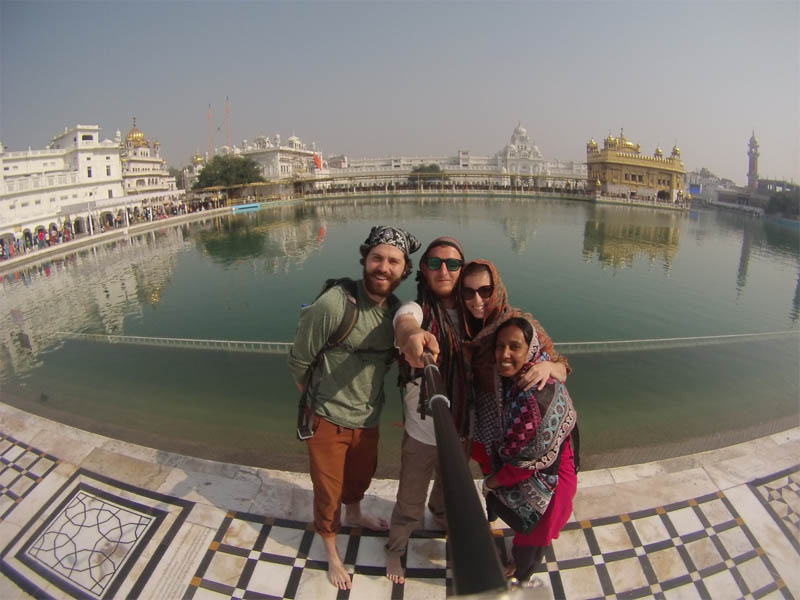
Part of Naddi's team in the Golden Temple


Kyla Korvne - USA
Women's empowerment Project Manager/ Centre Coordinator in Naddi

Wednesday, 1 June 2016

Why India?

The question I get asked the most about my decision to come and live and work in a rural Indian village is:

“WHY INDIA?”

Because the families you meet are the most welcoming and loving.

Working with Educare has given me a unique opportunity to meet different families, with two things in common: their ability to feed you until you are literally bursting out of your Punjabi suit and their obsession with selfies and photo-shoots. My favourite story is with a family in Makhu whose daughter, Komal, does girls club. They invited Jessica, Sacha and myself over for her father, Malkit's birthday where we were hand fed cake into our mouths and on our faces, danced until we could no more and posed for a series of photos involving swords. The hospitality and love of this family is shown across so many families I've met who have treated me as their own.

Me having a sword fight with an Indian father in Makhu

Why India?

Because everyone I meet while travelling is so helpful.

I’m someone who has managed to miss an international flight from Belgium to Australia, an overnight bus from Goa and has gotten on the wrong train (more than once) back home in Sydney so when I was travelling alone in India for the first time I was a little nervous. I got the bus from Harike to Firozpur, managed to buy my return ticket from Haridwar with no issues and I was feeling pretty confident as I walked into the station thirty minutes before my train. I went to look at the board that lists the train numbers only to find my number wasn’t there. 04934. I ripped open my printed ticket sure that I had gotten the date or the station wrong. 
No, everything was correct. 
My stomach in knots I walked to the stationmaster’s office to ask. I was offered water while Raj Kumar (the station master) called a million people, shaking his head, the worst thoughts running through my head. Finally he looked up, “You want chai?”, I nodded my head thinking oh no this can only be bad news…. Sure enough, he began to tell me the train was delayed…by FOUR hours. They didn’t know the platform yet. I drank chai and chatted with them until they had to leave. They introduced me to the deputy stationmaster who was going to come and get me when the train arrived (he did, despite my many visions of him forgetting and me sleeping in Firozpur station for the night) and opened a private meeting room for me to wait alone. 
I'm happy to say I ended up safely in Haridwar. 
Although I had another incident on the way back which involved an Indian man walking me to my seat, putting my bed up and making sure the ticket guy knew I was there.

Why India?

Because people you are wary of end up being nicer than anyone in your home country.

Coming back from Pushkar we forgot to buy our tickets and we ended up in GENERAL CLASS (cue scary music) – we decided to try our luck finding spare sleeperseats. 
Luck was not on our side.
Resigned to our fate of having to sleep on the floor of the train right outside the bathroom we began to get comfy. About an hour in, some Indian men who had been drinking and staring came over and offered us two of their beds. We initially refused but they insisted. This kind gesture meant that three Punjabi men (who as anyone who has been to Punjab knows, are not exactly small) had to share ONE bed. When they left the train before us, they explained to the new people the situation and astoundingly they also let us stay. To this day I am still shocked because if this had been Australia, we would've been laughed at and left exactly where we were. 

Alex and Armando sleeping very comfortably on the floor of the train

Why India? 

Because each hotel owner has their own story. 

I find the people who run hotels some of the most interesting people, they always have stories to tell about India and other travellers. From Abu in Jaisalmer with his pearls of wisdom such as “Life is Mamma Mia, Life is Hello, Hello is Life” to the owner of a cottage in Old Manali who told us about his work as a peacekeeper for a few months every year in east India and about a book he was writing called “Travel Ugly” with destinations such as the village of living bridges or the place where birds commit suicide. There was also the owner of a hotel in Haridwar who told us stories of the ”Goa fashion style” and Russians drunk on vodka getting into fights on the beach.

Why India?

Because despite the 50 degree heat, the power cuts, the slow internet, train delays, the stares, the dirt and the diarrhea, the people with their big hearts and open arms make it all worth it. 

I think I'll end this blog with a quote from Shantaram that has stuck with me ever since I read it, and sort of inspired this blog:

“India is the heart. It's the heart that keeps us together. There's no place with people like my people, Lin. There's no heart like the Indian heart”

Being welcomed and loved by my girls in Girls' Club

Ariadne Sofianidis - Australia 
Women's Empowerment Project Manager in Harike

Saturday, 7 May 2016

So I have now been living in Rangmahal for just over a month.

At first, there was a lot of adjustment as it is a totally different environment to what I am used to! I am from cloudy, grey, drizzly, fast-paced London and this is a world away from that! It is insanely hot, slow and lazy, the sun is always blaring and there is sand EVERYWHERE. I am sure when I arrive back home in London, I will open my backpack and sand is just going to pour endlessly out of it!

One thing that was a challenge at first was the toilet situation. At home I am used to pristine clean toilet bowls, sinks with luxurious soaps, a bathtub and an overhead shower (I am drooling at the thought of this kind of shower now!) In the village, the typical toilet is one that looks like this:

Our gorgeus toilet in the first house

As you can see, this is simply just a hole in the ground with two bricks either side. There was no door… only a wall that around the toilet, which came up to my elbow, so I was always nervous that someone would peek over the wall and see me squatting. I had several comical experiences as I do my business, coughing constantly as though I have been smoking for the last century to make people aware of my presence, awkwardly walking in on Dada Ji then running away and hiding in embarrassment, and also having a dog jump over the wall like HELLOOOOO. Toilet trips were interesting to say the least!

This set up made me wonder how hard it must be to be a woman in this village, particularly when on their period; it certainly would not be comfortable and if I was a woman here, I would be worried that someone would look over and see me, particularly as menstruation here is seen as disgusting and a taboo.

Here we also shower with bucket and water. As I have been to the Philippines several times, I am very used to it and rather enjoy this way of bathing. However, what I am not used to, is a cow eating its breakfast and defecating outside the shower room, and an old woman peeking into the shower as I pour sand water over myself. I had to laugh so many times when things like this happened! People here are extremely curious, particularly to the way that us foreigners do things!

Another difficulty I had at first was hand washing my clothes. It was definitely a struggle at first, especially with half the village coming to watch the foreigner wash their clothes like a local and laugh at how ridiculous and confused I look. Now, I can definitely say I am a pro hand washer!I had to fill up my bucket with a manual water pump (producing a concoction that is 90% sand and 10% water) and then attempt to wash my clothes by hand sitting in the typical squat position, which is waaaayyyyyy harder that it looks I honestly still do not know how people manage to sit like that for so long.

Actually, most women here experience severe pain in their legs, backs and arms from doing chores such as washing and cooking in this position. Even though they experience such pain, they seldom complain and simply carry on. At home, doing chores can require very little to no effort! It is even so simple for me that if I so wish, I can go to a laundrette or order a takeaway ….so I do nothing at all!

Whenever I was invited to peoples’ house for food, I would always be offered a master class in chapatti making. At first, my chapattis all looked like one of the teletubbies, but hey, as they say, practice makes perfect and I can make the roundest chapattis in the village(with the aid of a bowl to cut it out).

Food has been difficult for us; there are no grocery shops in the village and there are about 12 shops that sell roughly the same thing: biscuits and potato chips. To get food we have to travel to Suratgarh, the nearest city which is 7km away, but this requires potentially waiting for the hourly ‘regular’ bus for 3 hours. The result: a diet consisting of mostly daal, daal and more daal. I do not think I can look at another lentil again after this! However, the food we have made, and have been offered has been absolutely delicious! We have even managed to make hummus desert style which entails mashing the chickpeas for an hour with a dodgy fork.…so worth it and so good!

A huge problem we have been facing as of late is the lack of electricity and water. As it is harvesting season, the whole village has decided to turn off the electricity from 9am – 7pm. This has made living in 41 degree heat extremely difficult without the help of our electric fans! One weekend consisted of Iris and I lying in our beds the whole day just saying“ugh”….”its so hot” …”omg don’t you think its hot?!”…”I’m dying!” … “bring me cookies!”


Holi with the beautfiul girls in the village

On top of this, we cannot use our electric pump to fill up our water tank. We have experienced a few times with no water in our tank, so had to buy a whole pack of 10 one litre bottles to go about our day. ON TOP OF THIS, another village has been controlling the water supply and this is cut off for most of the day until 9pm when we can finally fill the tank. We hope to find a solution to this, particularly when it comes to May and, we have been repeatedly warned, it gets excruciatingly hot with temperatures apparently reaching50 degrees…yay!

Yes, it has been difficult at times, but also has been incredible. I have learned so much from the people here, with their warmth, kindness and openness. The village is BEAUTIFUL. We can walk up a large hill, which everyone calls the mound, and watch the sunset over the lush green farms and the sandy plains around us, or play “Kabadi”, a wrestling game, with the children. I have already been invited to, not one, but three weddings! And have indulged in the delicious food there, and joined in the dancing. I experienced Holi with the girls and ladies of the village, again, dancing and indulging in delicious food and tons of chai.

View from the mound

Living here has made me realise how fortunate I am at home with my plethora of CHOICES. I can choose to eat anything I so desire. I can choose to use the washing machine and laze about watching television as it washes. I can choose to leave my house with the light on in my room, if I so wished, for the whole day and not even think of having no electricity at the end of the day. I can choose to have a hot shower for 30 minutes without thinking about water running out.

It has all been a huge learning experience for me. I feel that I will be a gazillion times more patient; there is a lot to learn from the optimistic and laid-back attitude of the people in the village. I am enjoying this simple way of living, and I have even more appreciation for the comforts and the ease of doing everyday chores at home.

Ta for now!


Danielle Outen - United Kingdom
Microfinance / Women's empowerment Project Manager
Centre Administration Coordinator in Rang Mahal

Saturday, 9 April 2016

The Missing Girls of India

India is a wonderful country. The culture is diverse, the food wonderful, and the people amazingly kind. However, India also faces a lot of problems, and the more research you do, the more complex the problem seems. According to Indian law, your husband cannot rape you. Although it its prohibited by law to marry before the age of eighteen, girls get married when they are fourteen years old, and pregnancy will follow soon after. Furthermore, because of selective abortion and malnutrition, India is now missing millions of girls. In a lot of areas a women is still perceived as almost worthless.

How this affects me? Actually, it makes me pretty sad. A foetus that does not even has the chance to be born because of her sex, a women being immolated because of a dowry, these are things that should not be happening. No one deserves to be killed because of something random like gender. And still, it happens daily.

However, it also reminds me every day why I am here, why I am doing this job. Every month, I see how young girls are getting married, and are not always ready for it. A week ago, I was in Gajner for a coordinators retreat. While talking with the nineteen-year old Pooja, the niece of our hosting family, she was telling us that she will marry in a year. Right now, her mother is looking for her future husband. This will be someone of the same caste as Pooja’s. Pooja answered with a firm “No.” when we asked her if she was excited to marry soon. Pooja does not want to leave her family yet, and you could see in her eyes that the thought of it made her upset.

Sharing moments with girls in Rang Mahal 
In the centre I’m working it, RangMahal, some girls even get married when they are fourteen. Most of the girls are from the most marginalized community in the village, the Naat community. The people within this caste almost all have not received education, are illiterate, and live from begging. Although I have not researched this yet, I would not be surprised if these girls don’t know how sex works. How to have safe sex, how birth prevention works, or how to say no to sex and realize that you are the boss of your own body. ‘Sixteen and pregnant’ could scout a lot of girls here.

However, there are also girls that cannot wait to be married. For example, a couple of days I was watching a cricket game on the television with a family living in RangMahal. All of a sudden, a girl pops up on the screen, holding a huge sign that says “I’m finally eighteen, marry me!”

But no matter how you look at it, a thing is clear: marriage is really important. After this, the main task for women is to get children –preferably boys– and take care of the household. Energic, enthusiastic girls slowly transform into shy women, hidden behind a sari.

Fortunately, I see examples within this village of women that have empowered themselves. Nila runs her own shop at the back of her house. She sells fabrics in all colours you can think of, and if you give her your measurements, she will make a perfectly suiting kurta for you. It is clear she is also highly respected by the men, and I rarely see her faced covered by her sari. Or Rika and her friends that run twice every day, and are involved in competition in- and outside Rajasthan. Although this may seems like something small, compared to other women in India this is already a huge accomplishment.

Celebrating Holi with the girls in Rang Mahal
What also fascinates me, is how I as a western women can enjoy privileges regarding my behaviour towards men. I am allowed to shake hands with men, or join parts of the wedding that are normally only allow male participation. Why can Indian women not do this, what makes me different from them?

In the upcoming months, I hope to create some foundations to make women aware of the rights they have. That they have the right to say what they like and dislike, to become more independent, have a bigger saying in their lives. Shortly, to become leaders of their own life.

Iris Workum - The Netherlands
Project Manager Women's Empowerment and Health

Friday, 18 March 2016

THE 5 STAGES OF BOOKING A TRAIN IN INDIA

Let me preface this by saying that I am an experienced traveler, especially in the developing world, and yet even I face these 5 stages almost every time I try to book a train. These are really only applicable to when you are booking a ticket that is available, because when you’re booking yourself straight to the waitlist, you generally skip these stages and go straight to defeat and angst, where you remain until the moment your status is changed to confirmed. 

NB: If you don’t have an Indian credit card or bank account, the only website you can book trains on is ClearTrip. In order to do so, you still have to have an account with IRCTC, the Indian rail company. In order to make an account, you need an Indian phone number. So if you have to book before you get to India, which most interns do since we need to get from Delhi to induction somehow, ClearTrip helpfully lets you use a dummy number and then you can email IRCTC to get your mobile one-time-password via email and make your account. 

Excitement. In which you’ve spent days, possibly weeks, planning and dreaming about your next Indian adventure, even if it’s just a weekend. You’ve spent hours on TripAdvisor.in and other blogs, figuring out the best and cheapest way to get where you want to go, where to stay there and what to see. All that remains between you and discovery is time and your train tickets. 

Denial/table flipping. In which one of two things happens. Either A, you reach the page where you put in all the information like passport numbers and then click “book” and it tells you that it cannot get current train information from IRCTC, please check back later and you have the sudden and overwhelming urge to flip the table you are sitting at, after lifting up your computer and chai, of course. And with every time this little red error message pops up when you click “book”, you fall deeper into this state of denial and disbelief until you abandon hope, fall back into your indoor-use plastic lawn chair and wave the proverbial white flag. 
Alternatively, you encounter situation B, in which IRCTC asks you a security question that you never made because you were never able to actually get into your account on the IRCTC website because you couldn’t receive the mobile code needed to make your real password because you made the account with a fake phone number, and you can’t change that fake number because in order to change your number you need to get into your account which you need a mobile code to do. So you find yourself being asked your pet’s name when in fact you don’t have a pet. So you send lots of emails and call numbers that either don’t exist or don’t have any humans on the other line until you give up and just make a new account using your real Indian phone number. 
At this point you start the whole process all over again and soon find yourself on the page where you are about to be finished, all you need to do is put in your IRCTC password and enter the “captcha”. It all seems so simple. You’ve made it, finally. So you enter the password and captcha and it tells you that your credentials are incorrect, or that the captcha was incorrect. So you try again, and again, until finally you lean back and close your eyes in quiet defeat. 

Quiet defeat. In which you sit staring at your computer, wondering why, why do bad things happen to good people? Why is this so hard? Why is it so hard to book a train in this country that the simple idea of doing so is used to cut diamonds? Your musings about this question quickly spiral into an existential crisis and you find yourself staring off into the middle distance wondering “why do you exist, IRCTC and ClearTrip, respectively, and why am I here, trying futilely to use you to accomplish what one might otherwise and naively presume a simple task? What is life, little box on the white screen asking me for a password that even Shiva does not and cannot hope to know? And most importantly, what reckless fool invented captcha?

Renewed hope. In which you’ve had some chai and moral support and are ready to try again, bolstered by the promise of another adventure awaiting you once you complete this process and the pressure of the fact that you likely have people relying on you to book their tickets as well. 

High blood pressure. In which you have your train booked and yet you feel no joy or satisfaction looking at the email from ClearTrip, the confirmation from IRCTC and the multitude of indecipherable text messages you receive from ClearTrip, IRCTC, perhaps your mobile provider, the train conductor, the Prime Minister of India and the ghost of Mahatma Gandhi. You instead feel the desire to drink 7-10 cups of chai and the need for some sort of sedative. Not for another 12 hours or so will you return to the pre-booking process euphoria and excitement of knowing you will soon be in another unique and colorful city seeing and doing and tasting and hearing things you will never forget and perhaps having your snacks stolen out of your unexpecting hands by a monkey or being offered a ride on a camel-drawn cart by some kind and curious locals who will likely want to take a selfie with you. And then it will all be worth it.

Naddi interns and myself at the Golden Temple in Amritsar, the previous weekend destination.

A staircase in Rishikesh, my most recent destination in my explore-north-India-in-my-weekends project 


PS: Ironically neither of these places were reached by train, but we've been booking extensively for upcoming trips - just trying to find our way :)


Kyla Korvne
Women's Empowerment Project Manager in Naddi

Saturday, 12 March 2016

Opening up a Girls Club in Harike!


What to say about my first few months here in Harike? 

When I first came to Harike, I thought my project was off to a slow start. The center was just opening and the three musketeers—Maria, Tommaso and I—along with our beloved Ethan, the center manager at the time, were in charge of establishing the centre within this new village. This meant that a great amount of time was to be spent engaging people, creating relationships and establishing trust with key individuals, while doing our best to always make a good impression. There was one thing we had not quite anticipated, however, and that was the extent of the language barrier in this village. Oh and being the only white people in the village, thus making us the object of constant scrutiny. 

Now, we all knew that community engagement was to be a part of the initial stages of our projects. I, for one, could not develop or implement my project without this crucial first step. Therefore, our first month consisted of what I felt was a series of failed attempts at verbally interacting with community members; we did not speak Punjabi and they did not speak English. Other than reading out a long list of Punjabi vegetables names just to get a laugh out of a group of school girls, there wasn’t much more I could say, and vice versa. How were we supposed to develop, let alone implement our respective projects?!

Then one day, it happened. As we were preparing to host quarterlies, Mr B took us on a visit to a neighbouring village called Makhu and introduced me to a timid, but very lovely girl—Harjwinder. We could not do much more than exchange smiles, head nods or hand gestures, and a few dance moves (my “go-to” place when we are so verbally limited). I, then, asked if she was interested in having English lessons and soon after, I had a list of names, ages and phone numbers of girls who were excited to learn English with me. I opened up a Girls’ Club only two weeks into the internship. This was going to be my baby, the center of my attention for the next months! Needless to say, I was equally excited. 

Playing Musical Chairs with our Girls’ Club in Makhu
In the meantime, as a center, we formed ties with a school that was happy to have us deliver sessions on various topics. I learned that the school had no Sex Ed programme and the kids were not taught about crucial life changes such as puberty. I saw this as a perfect opportunity to teach young girls about menstruation and give them the necessary knowledge and tools to cope with this new and natural process. As expected, the girls were shy but—thankfully—also very curious. To my surprise, the teacher that was translating for me said she had also learned some things. This was incredibly rewarding and I would do it a hundred times over. 

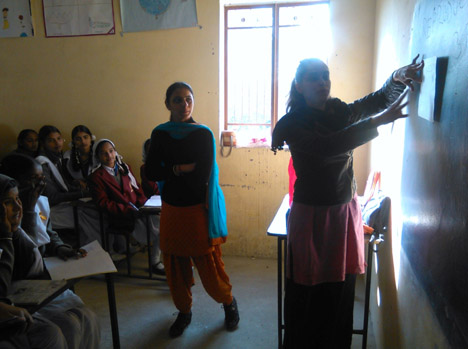
My first session on Puberty and Menstruation at Shri Guru Hargobind School. The students were aged between 13 and 16 and very keen on learning about this topic.  

Some time before the holidays, some changes happened and we received, Sabina—also a Women’s Empowerment project manager—who was transferring from Paro to Harike. We were now two interns working on Women’s Empowerment projects at the center and I knew we’d make a great team. Only two weeks after the holidays, things happened, again, so suddenly and in the span of a week, three Girls’ Clubs were up and running in three different communities—one in Makhu and two in Harike. 

Sabina and I with school staff, principal and some students after our session Puberty in Menstruation at Secondary Government School Harike Pattan


To this day, I am amazed at how this country works. It is so easy to get discouraged and be tempted to give up based on the impression that everything feels like a struggle. All you need is to have all the elements perfectly aligned for things to happen. And they do (happen). In other words, be patient…but stay focused and continue to work hard. Things will happen when you least expect it.

One of our most recent Girls’ Clubs—they are the most enthusiastic girls you will meet in Harike!  


Jessica Cialdella
Women’s Empowerment Project Manager, Harike (Punjab)