Showing posts with label Alternative Energy. Show all posts

Sunday, 24 June 2018

Developing micro-scale concentrator photovoltaics


Developing micro-scale concentrator photovoltaics
Concentration Factor
Renewable Energy

After completing my master’s degree in mechanical engineering in the UK, I came to intern at Naddi as part of the EduCARE team. I planned to only spend a month and a half interning, so I came with preconceived ideas of what I wanted to build and the components required. Hence, I set forth on designing a micro scale concentrator photovoltaic system (CPV), this technology generates electricity from sun light and uses lenses and curved mirrors to focus sunlight onto a solar panel. CPV technology has been used to improve the power output of a solar panel by 350 times, however on the budget and time constraints my aim was to double the power output.

Within the first couple of days in Naddi, I discovered that solar power was currently being used by the majority of the street lights in Himachal Pradesh (HP). Every solar street light used a 40W solar panels and 40Ah battery, this ensured the lowest possible probability of loss of power supply and did not require to be connected to grid power. This was important in HP, as the street lights prevented accidents, so reliable constant lighting was key, and they were often deployed in remote locations. However, the cost of the solar lights, limited their deployment to more highly populated areas. I believed that a micro scale CPV system would be very applicable to these solar street lights, as it could reduce the cost of each light and improve its reliability.

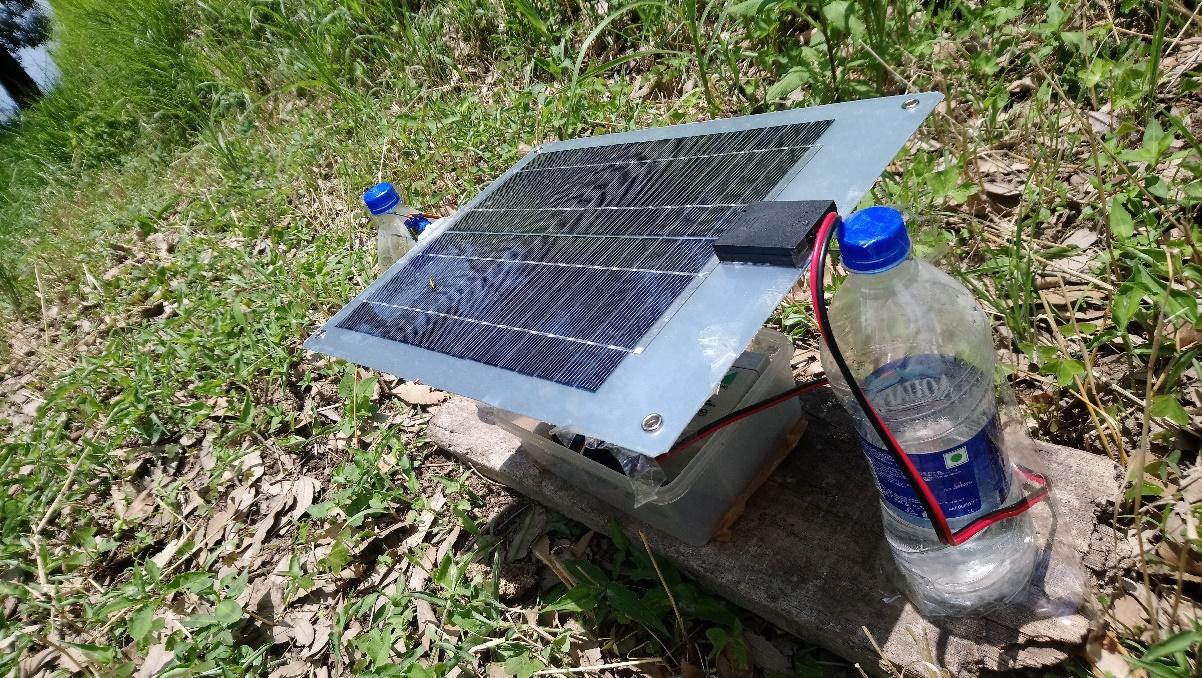
I set about designing a CPV system, using the components I had brought with me, including a solar panel, solar charge controller, battery, Arduino and lenses. Surprisingly, the majority of the solar panel components were available in HP, however I was glad that I came prepared. The first step was to configure a solar panel set up, to test my components. Once that was completed, I designed a solar tracker, which rotated the solar panel to face the sun, so that lens remained focused on the solar panel. This was the most difficult part of the project, as it required me to design a frame for the panel to rotate about. Luxuries that I was used to, such as 3d printers and laser cutting was unavailable. Hence, I was forced to be more creative, I used recycled materials to design the frame including plastic bottles and scrap wood, making the design more environmentally friendly and cost effective. In the future of my project, I would aim to design a lens mounting system and make the product more robust.

The freedom of the project and the self-motivation has really helped me to enjoy my time here. I have had so much fun hanging out with the other interns, my favourite experience was going paragliding with them, in the quaint mountain village of Bir. This was a once in a life time opportunity and I am glad I took it.

Jack Parker (UK)
Project Manager, Micro-scale Concentrator Photovoltaics
Project Manager, Renewable Energy
Naddi
EduCARE India 

Sunday, 11 September 2016

Leaving India

Wow. I can’t believe this is the end of my internship. Part of me feels like I’ve been here forever, but at the same time it seems like I just arrived in Delhi yesterday. 

There’s so much I could say in this blog post, but I want to keep it simple and to the point. Expect the unexpected. Unless you’ve been to India, lived in a developing country for an extended period of time, or something similar, then you’re not going to be fully prepared for what you will experience here. Don’t let that scare you though because if you have the right attitude, you will benefit in many ways from this experience. 

Come with your expectations, goals, and inspiration because you’re going to need all of those things. EduCARE will do their best to make this a beneficial and enjoyable time for you, but you can’t forget that you are here to work. I came to India planning to work with alternative energy, but in the end I created a health project and it has a high chance of being successful in all of the centers. 

I loved my experience in India and I say this after I spent days in unbearable heat and a constant state of sweat. You just have to keep a positive mind and know how to re-center yourself when others bring you down. I love this beautiful country no matter its flaws. 

To summarize, I’ll never experience anything like my time in India. It’s as simple as that. Part of me wants to stay here, but the other part of me misses home and can’t wait to see my family.

Traveling around Rajasthan

Little nice neighbour in Gajner

Anna-Leigh Shuping - USA
Alternative Energy Project Manager in Gajner

Tuesday, 19 July 2016

Photovoltaic Solar Panel System Project

With EduCARE, some interns already did few projects in alternative energy to have a way to produce clean energy, and without harmful effect on the environment and the people, like biogas station, solar heating water system, windmill system... Studying electrical engineering in France, I wanted to provide to Educare a new way to produce energy (and especially electricity), that Educare still didn’t have implemented. So I it’s all naturally that I proposed a small PV solar panel project, to provide electricity to the Naddi ReStore.

Why in ReStore?

The ReStore in Naddi had no way to have electricity power, and therefore, no way to have light during the night, or to run electrical cooking device. With the PV solar panel system, ReStore is now fully electrical autonomous, and able to run cooking device such as blender and so facilitated the work of the girls, to charge small device such as Smartphone or small speaker, and so make the job for girl more comfortable, and to run an LED light and so open lately in the day or also during the night. For the future we are also thinking to provide a free internet Wi-Fi to ReStore customer to attract more people. 

PV solar panel installed on the roof of the ReStore


For whom this project is it for?

One of the main goals of this project is to make the job more pleasant and more comfortable for the girls. But with this project, my objective was also to show and present this mean of electricity production to the people and the community, create an interest in people for solar electricity production. The last goal of this project is to provide a base of documentation for other intern who would do this type of project in other center for future project, and therefore not have to have strong knowledge in electricity to install a PV solar panel system. 

But how does it work?

About the technical part, the system is very simple, the solar panel transforms the solar energy in an electric energy, and the energy is store in a battery. To control the flux of energy between the PV solar panel and the battery we use a small controller/regulator. And then we can directly use the energy thought the battery to run light and small device, or use an inverter to use bigger device (220V).


Synoptic of PV solar panel system


Thomas Lecomte - France
Alternative Energy Project Manager in Naddi 

Tuesday, 1 March 2016

Hard Questions

Alright, I’ll say it. I don’t know what I’m doing here.

Don’t get me wrong…I love EduCARE. I love the interns (my family-away-from-family), the community, the organisation. I love the opportunity we are given here, the chance to explore whatever draws our interest. I love the crazy Indian traffic, the wandering cows, and (somehow) even the bucket showers. What I love just a little bit less is all the damn thinking required!

With the COM Team and Project Director hanging around Gajner, we have had a (large!) number of meetings and discussions. For me, the common theme behind all of these discussions: asking hard questions.

Why are you here? What are you hoping to accomplish? Should we even be here in the first place? What is your personal/centre/organisational/community vision? How does your project contribute to these visions?Why, why, why?! All of these bloody questions really made me stop and think…

Back home, with the fast pace of life, competing deadlines and priorities, I found it very easy to get sucked into it all. At times I felt as though I was following a script; progressing through life’s checkpoints without much critical thought.Highschool grad? – Check. University? – Check. ‘Real’ job?... Marriage?... House?...

Here at EduCARE, that script is removed. The structure I was used to, relied on (?), is nowhere to be seen. What is left in that space? What exists without that structure? After four months of work here and a lot of learning, my short answer would be: a lot of hard questions, as well as personal opportunity and growth.

Following our discussions with COM, the centre has started thinking about what all of these questions mean for us. Specifically, what is our vision for the centre? Although at first glance answering this question may seem easy, we have learned that it is much more difficult to express when you start putting your mind into it.


Gajner crew thinking hard...

Our centre visioning process has only just begun, but so far it has brought out some interesting insights. At the end of our first meeting, there may have even been some mediocre-enthusiastic applause (thanks for the prompting Shama!). Our hope is that by exploring these tough questions, we can bring all of our projects and personal directions together to push the centre work forward.

With all of this blabbering about hard questions and the future, what about the present?As cliché as it may sound, I will say this: always take the time to stop, think, and truly take in the moment. As easy as it can be to forget, we here in EduCARE are living a one-in-a-million experience. We are young people given big responsibility, are part something bigger than ourselves, where our only real limitation is our own creativity and imagination. Never lose sight of this, and enjoy every moment of your internship - the good and the bad.

So where does this leave me? What am I doing here in EduCARE India? Although I haven’t quite found the answer, I’ve asked the question - I think that is a good start.


P.S. For those who were wondering, question mark count: 15


Tom Zadorsky - Canada
Alternative Energy Coordinator - Gajner (Rajasthan)

Sunday, 16 August 2015

The real price of the windmill blades


Hi dear reader, I’m gonna tell you an incredible story of this incredible India.

I went there, arrived the 1st of April in Dharamsala, 22 years old young French engineer called Rémi, totally unexperimented about developing countries and strong of three years of managing in a famous brand French company. In my mind, I would have been easy.

Huh yeah, actually, no.

The first night, I was really wondering what the hell I’m doing here? I was supposed to manage a renewable energy project there, but there were no hierarchical structure, no boss, no managers and I didn’t have a clue about the opportunities of renewable energy.

And now, dear reader, three months passed away so fast, like a lightning.

It has been the strongest professional experience of my young carrier. After a short period of induction, I totally dove in Indian culture. I was really like a fish in the sea, grow a moustache, bring a Shiva’s necklace all the time and transform to a real Indian guy –Namasté Namasté ! -.

I’ve decided to build a small wind mill for household. The goal was to provide electricity to a standard house. I designed it, calculated all the stuffs (wind resource, wind strength, rotation speed, blades shape, alternator rewinding, etc.), planning and budget. All was perfect.

Huh yeah, actually, no.

In India, dear reader, nothing comes as you planned. When it came to the building steps, I had to travel thousands of kilometers. I went to Gaggal, Horshiapur, Chandigarh, Bikaner, Jaisalmer, Delhi, Rajkot, Amehdabad, and so on. I met people, professionals of small wind mill, professionals of huge wind mill, mechanics, electricians, ”Jugaad” (handymen), CEO's and technicians. My design wasn’t perfect at all dude!

One thing you have to keep in mind, dear reader, is that working in India needs flexibility.

To get the blades, I went to Rajkot. 24 hours of travel to meet a guy, who was supposed to help me (maybe? First we go, and then we will see! – Indian style). Hopefully it was successful, I learned a lot and got blades, perfect blades, and WAHOU I was so glad!! So then, 24 hours of travel to go back to Bikaner by train, no seat, a night train incredibly crowded, 6 hours of standing in the corridor facing the smelly toilets. Man, this is the real price of the wind mill blades.

This is just an example, but managing a project in India looks like that. T.I.I: This Is India, and it’s wonderful.

Now, the wind mill is fully assembled, with electric parts, mechanic parts, pole, blades, transmission chain, etc. It will be installed in Khuri Village, near Jaisalmer in Rajasthan (an incredibly beautiful city in the middle of the desert, 50°C during summer, easy).

To conclude, I would just say that it was such a rich experience! To manage a renewable energy project in India, dear reader, you don’t need to be an engineer, a manager or whatever, you need to be you, trust yourself and persevere, and everything will be alright.

I’m lucky to had this opportunity to challenge my skills, I’m lucky that EduCARE trust me like that, and I think I wouldn’t have this opportunity in western companies.

Reading this blog will not give you a full description, neither a real picture of this experience; so go there, dear reader, and you will understand, you will learn or unlearn, but you will grow up.

Maja aa gaya !


Rémi Matray - France
Alternative Energy project manager, Jaisalmer

Monday, 27 May 2013

Renewable Energy Workshop for volunteers and interns

Renewable Energy Workshop - Bio-Gas in Himachal - Part 1

As part of the ConservEN program, four of my intern colleagues and I recently participated in a two-day Biogas Workshop aiming to increase basic awareness of biogas plants and their potential as a renewable energy source in Northern India.
On the first day of our workshop, we learned how a biogas plant functions and why it may be a beneficial sustainable energy source for the communities we live in.
A biogas plant produces clean gas through the digestion of cow dung and non-woody biomass waste. The resulting biogas is used as a low-cost fuel for various energy needs. This workshop focused primarily on using biogas for cooking as an alternative to LPG (liquid petroleum gas), a limited environmental resource.
Biogas plant diagram (source: biogas-technology.blogspot.com)
Biogas plants provide an extensive list of benefits. The input, most commonly cow dung mixed with water, has high levels of the greenhouse gas methane. After biogas digestion, however, the biogas plant emits the processed cow dung as waste with significantly lower levels of methane. This “waste” product can be used as a nitrogen rich, odorless organic fertilizer full of beneficial bacteria that’s easily absorbed by plants. Therefore, the biogas plant not only provides a sustainable source of cooking fuel, it also supports rural sanitation, organic plant growth, and greenhouse gas reduction.
The Indian Ministry of New and Renewable Energy provides subsidies for biogas plant construction, reducing the 30,000 rupee cost to roughly 20,000 rupees.
Extensive list of biogas benefits (Source: Indian Ministry of New and Renewable Energy)
On the second day, we visited several working biogas plants in nearby villages. First, we visited the village of Charhi, where the head of the village, Mr. Dadwal, invited us into his home to study his biogas digester. 
Mr. Dadwal’s resilient biogas plant built into the ground.
This biogas plant was built 20 years ago for a cost of approximately five thousand rupees (roughly 100 US dollars), which was quite an important amount at the time. The biogas plant features an aboveground input tank to insert the dung mixture, connected to the underground concrete reservoir where anaerobic process occurs and produces the gas. The waste outlet expels the processed dung as pressure builds. They feed the biogas plant roughly five kg of cow dung each day from their one cow, producing two-three hours of biogas cooking fuel daily. The family uses up to two cylinders of biogas per month due to the reception of many guests, which is linked to the position as head of the village of the father.
The Biogas Workshop participants. From left to right in foreground: Gulshan (cultural liaison officer, far left), interns- Clement, Aureline, Katrina, Mandy and Adrien
The second visit took us to Mr. and Mrs. Shamsher’s home, near the EduCARE intern house in Maiti. Like Mr. Dadwal’s family, this family has an important role in the community as current village committee members.
Mrs. Shamsher kindly demonstrated how to use their 18-year-old biogas plant, a similar model to the plant in Charhi.
She mixed the dung in the inlet reservoir with water.
First, Mrs. Samsher added water to the dung in the inlet reservoir.
Then, she mixed the dung and water together and removed the stone that allows the mixture to enter the reservoir where anaerobic digestion occurs.
On the top of the concrete biogas reservoir, she opened a valve that released the gas into the gas line. Here you can see the gas line carried through the trees to their kitchen.
She also welcomed us into her kitchen where she uses three sources of energy for cooking: wood, biogas and LPG. According to her experience, the biogas flame is slightly weaker compared to the LPG and provides the slower heat best suited for cooking chapatti bread and vegetables. She uses the biogas for 75% of their cooking, up to 2-3 hours per day, with dung supplied from their three cows. One supplemental cylinder of LPG now lasts her 3-4 months. During the winter, she uses the stove more often because of the heat it provides to her home.
Her three energy sources for cooking (biogas, wood stove, and LPG) increases her self-reliance if biogas supply is low.
After visiting these two biogas digesters, we visited Mr. Ramesh’s Nirmayam Trust Organic Farm close to Maiti.
The farm applies organic farming, permaculture, and natural farming principles by growing several kinds of plants in the same area. This creates resistance to pests by increasing biodiversity.
Natural building made of stone and clay plaster with a roof made of slate rock. Although concrete is becoming more popular, this style of natural building is still common in the local villages.
The farm holds up to ten cattle in the barn, but they aren’t currently processing the dung for energy use. This is a good example of the biogas plant potential in the area as biomass/dung is readily available.
Finally, we visited Dr. Anjan Kumar Kalia in Dharamshala at his renewable energy shop and information center. As a retired professor of Palampur Agricultural University, Dr. Kalia is a leading expert in biogas processes in India and has travelled extensively around the world to present his works in several environmental conferences.
Dr. Kalia’s renewable energy center displays and sells a wide array of sustainable energy options.
He provided us with valuable, relevant information from his research on the current biogas use in India.
His statistical highlights focus on the state of Himachal Pradesh, where half of the ConservEN and EduCARE interns currently work:
  • Cattle to human ratio = nearly 1:1
  • Dung from these cows could fuel 319,482 biogas plants
  • 319,482 biogas plants = domestic energy needs of 1.24 million people
  • 45,000 biogas plants currently installed = only 14% of potential
  • Carbon credit can be sold by rural villagers with biogas plants to the International Carbon Market for reducing methane gas production
Dr. Kalia also provided us with advice and guidance on how to fix the issues Adrien encountered with his ambitious homemade biogas plant.
After two days of workshop training, we gained a deeper awareness of biogas production. Most importantly, we began to process and discuss the potential of biogas usage in the communities around our centers in Himachal Pradesh and Punjab.
Next, we plan to develop Adrien’s model of a biogas plant and gather additional knowledge on our communities’ need and interest in relation to biogas use. We’re excited to share our experience and knowledge at our REstore office, to open in the next month or two.

by Adrien Calvez Petit (France) and Katrina Sill (US)

Renewable Energy Workshop - Biomass in Punjab - Part 2

Recently, the interns involved in the Biogas Workshop held in Himachal Pradesh were treated to an extra day of field visits related to renewable energy in Punjab. The biomass plant visit was among the many highlights of this extended workshop.
Located near Nakodar, the Green Planet Energy Ltd Biomass Plant produces 7,000 kilowatts of energy per hour (KWh). Assuming the average house utilizes 3 KWh, this one plant produces enough energy to power 2,333 homes every hour. All of this energy is produced through the burning of biomass (organic) waste that would otherwise be burned in farm fields.
BiomassPlant
Full view of the biomass plant with the boiler on the left
Benefits of the Biomass Plant:
  • Alternative to burning biomass in fields, causing air pollution
  • Saves habitat and ground cover
  • Produces renewable energy – 2 KG biomass = 1 KW energy
  • Gives extra income to farmers – 1 rupee = KG of hay or biomass
Biogas Plant Process:
  1. Farmers sell biomass waste to the plant
  2. Biomass is dried and compacted
  3. Compacted biomass is loaded onto the belt, leading to the furnace (see Photo 2)
  4. Biomass is used as fuel in boiler, reaching temperatures of 700 degrees Celsius
  5. Boiler heats 30 tons of water each hour (of which 2 tons evaporates, 28 tons reused)
  6. The boiling water creates steam
  7. Steam runs the turbine at 7500 revolutions per minute (RPM)
  8. Turbine produces electricity/power by running the generator
Belt
Compacted biomass is loaded onto a belt leading to the boiler
Waste Products/Emissions from Biomass Plant Processes:
Of course, burning the biomass fuel creates waste fumes. The fumes contain particles of carbon monoxide, a poisonous gas for humans to breathe, and carbon dioxide, a greenhouse gas widely considered to be contributing to global warming.
                                                  GroupPhoto
The workshop team in front of the electric static precipitator  (from left to right: Clement, Adrien, Owen, Gulshan, Biomass Plant Engineers, Ariel, Katrina, Mandy, and Sevil)

Tuesday, 19 July 2011

Five interns, two buckets and a pile of gold…brown gold!


On a July weekend the members of the Sotla Interns house were presented with what can only be described as a mountain of a task.  Something that would test their metal, harden their spirits and leave them covered in animal poo.


Modestly equipped with a pair of buckets and spades, the five of us set to work to transport the pile of cow dung the ten meters to the stirring pit, mix it with water, and coax the slurry down into the bio-gas plant.  Why were we doing this?  Locked up in the cow manure is methane gas, which will be piped from the plant to our kitchen, providing a clean and renewable source of energy for us to use for cooking.  

To make our task even more dramatic, methane gas was leaking out of the pile as it was lying there for two days in the open, making it a race against time to get the manure into the hole as soon as possible.  Progress initially was slow and we felt the job would be too time consuming without the help of additional labour, which can be found around Sotla.  Alarmingly no labour could be found as they were all committed to working on the farms, and in an amusing inversion of the principles of ViKAS and SEVA, we found ourselves in a situation where we had money but no labour! (Our principles are labour first, materials second and money last).

There was nothing left to do but begin work and get as much completed as we could.  After four hours of unyielding toil, five manure covered bodies were lying limp on the ground, but the pile was no more.  We had won…It was gone.


Many thanks goes to Tom, Yiwen, Jerah, Martha and Julia.  Your valiant efforts will be etched into the minds of the other team members and local villagers, and you will always be remembered as the strange white people who left their lives of comfort, luxury and privilege, to come to India and play with the cow poo.  

(Courtesy: Renewable Energy Initiative - ViKAS, Bhunga-Dosarka)

Thursday, 9 June 2011

Making a stove, to make a difference!

Finishing touches - smoothing out the stove

One of the problems that the migrant communities face within daily life is the access to combustible material (primarily wood) in order to burn for cooking purposes. In India, you often see communities that heard cattle making patties out of the cow or buffalo dung, which they then dry out to use as fuel. However, with the Trash Picker community in Adampur, they have few assets, and certainly do not have the finances to procure the most cherished of animals, a cow. With limited resources and little availability to cow excrement, we had to come up with a solution to try and make cooking less burdensome.

Here at ViKAS we are pretty resourceful folk, although, it is still crazy to think that you can make a fully working, fuel efficient stove in under two hours out of, well... poo, mainly. Structurally, all you need is two plastic buckets, to form the basic mould of stove around. Then for the material: natural clay (5 buckets per stove) FRESH cow dung (3 buckets) natural sand (1 bucket) and water... Oh, and of course, lots of enthusiastic interns, and some local know-how!

Every stove has to start somewhere...
So, it all sounds simple enough. Here is the procedure:
  1. Set the wider of the plastic buckets on its end, and the narrower bucket perpendicular against it (this will form the negative space where the fuel is inserted and burned).
  2. Combine clay, dung, and sand, and mix it at first with a shovel, then thoroughly by hand until there is an even consistency. Add small amounts of water as needed, to bind. 
  3. Take 'snowballs' of the mixture and throw it against the two-bucket structure in order to expel all the air from the material as you build. 
  4. Hold boards around the area to define the stove's shape as you throw.
  5. 4-6" up, place a stick perpendicular to the upright plastic bucket (this will form the negative space where the smoke will escape from - a chimney).
  6. Continue throwing balls of the mixture, and sculpting with the boards until the stove reaches 8-12" tall.
  7. Place the family cooking pot on top of the upright plastic bucket and continue throwing the mixture around the base of the pot - to form a custom fit of the pot to the stove. 
  8. Smooth out the shape of the stove with boards, and by hand, decorate if you want!
  9. Allow the stove to dry for two weeks with no use whatsoever. Cover well with tarpaulin in order to prevent any moisture getting to the completed stove.
The finished article. Now to let it dry!!
This was the process that we followed for the first of our stoves that we built, which turned out to be a great success. We managed to engage with the local community, as our willingness was met by the whole of the Trash Picker community who came over and offered advice, suggestions and praise! 

Everyone involved - the community loving the new stove
Looking forward, hopefully we can replicate this activity with the marginalized communities that we work with in both Janauri and Dosarka, as well as amongst the Snake Charmer's who are settled in Adampur too. With this project, involvement is key, as the more the community helps, the more they will learn, and the more they will gain a sense of belonging over the end product!

And for us, well, we are just pleased that we can help introduce:
  • A 60-70% reduction in fuel consumption
  • Faster cooking times
  • A reduction in carbon emissions 
  • Fuel cost savings
  • Less time spent collecting wood for fuel
  • Forest tree conservation
On the weekend the members of the Sotla Interns house were presented with what can only be described as a mountain of a task. Something that would test their metal, harden their spirits and leave them covered in animal poo.

Modestly equipped with a pair of buckets and spades, the five of us set to work to transport the pile of cow dung the ten meters to the stirring pit, mix it with water, and coax the slurry down into the bio-gas plant. Why were we doing this? Locked up in the cow manure is methane gas, which will be piped from the plant to our kitchen, providing a clean and renewable source of energy for us to use for cooking.

To make our task even more dramatic, methane gas was leaking out of the pile as it was lying there for two days in the open, making it a race against time to get the manure into the hole as soon as possible. Progress initially was slow and we felt the job would be too time consuming without the help of additional labour, which can be found around Sotla. Alarmingly no labour could be found as they were all committed to working on the farms, and in an amusing inversion of the principles of ViKAS and SEVA, we found ourselves in a situation where we had money but no labour! (Our principles are labour first, materials second and money last).

There was nothing left to do but begin work and get as much completed as we could. After four hours of unyielding toil, five manure covered bodies were lying limp on the ground, but the pile was no more. We had won…It was gone.

Many thanks goes to Tom, Yiwen, Jerah, Martha and Julia. Your valiant efforts will be etched into the minds of the other team members and local villagers, and you will always be remembered as the strange white people who left their lives of comfort, luxury and privilege, to come to India and play with the cow poo.

(Courtesy: Renewable Energy Initiative - ViKAS, Bhunga-Dosarka)