Showing posts with label Punjab. Show all posts

Thursday, 15 December 2016

My first time in a non-Western country - Experience working with EduCARE India

As I climbed onto my first general bus in Delhi, I looked around anxiously as sweat dripped from every inch of my body and the adrenaline of being in the midst of chaos was the only thing keeping me from collapsing of exhaustion. It had been a twenty-three hour journey from San Francisco to Delhi, and I had just spent another eight hours in a bus station waiting for my bus to Dharamsala, where I was headed for induction. Once on the bus, it was another hot and grueling twelve hour trip pressed up against a metal pole and pushed around by an overflowing sea of people, all shouting and staring at me as if I was an alien. It was a rough first few days, but at least I knew from then on things could only get better. And I was right, for the most part.

This was my first time in a non-Western country, so the culture shock I faced was quite taxing. After you get past the intense heat and smells, constant honking, being bombarded by taxi drivers and being scammed out of money, you begin to notice other idiosyncrasies of the Indian culture, some of which I came to love. The sheer amount of people in one place was overwhelming, but the beautiful bright saris, smiling faces and friendly dispositions made being there worth it.

My initial culture shock never completely wore off during my time in India, especially as I kept experiencing new things that made me angry or upset. Starved dogs ran awry in the streets looking bruised and beaten, and it was a defeating feeling to know I couldn't do anything to help them. Cows, who are considered “holy” in India, trudged around in the street and appeared just as sickly. Piles of burning trash blanketed the ground for miles and filled my lungs with dust; and this was just the beginning.

I came into my internship unsure of what to expect— just like everyone, which I soon found out when I arrived. But adjusting to this new world became much easier as I started to meet all the positive and motivated people around me from all over the world. My two and a half month internship took place in Harike, Punjab and in Rait, Himachal Pradesh, so I was lucky to experience two different locations in India— both rural and poverty stricken, but diverse in their own ways.

In Harike, what surprised me the most was the absence of women outside in the village. At least for the short time I was there, I never once saw a woman walking in the street, which I soon learned was deliberate since most women are expected to never leave the house. When I transferred to the Rait center, this issue was not as prevalent and the village seemed slightly more progressive, but inequalities in the community were evident right outside our intern house. On one side of the road was a decently sized home with a family who owned healthy pets and grew their own vegetables in their backyard; across the path, homes were barely held together by metal, straw or wood with no signs of comfort in sight.

Living in a home-stay, working and interacting with the community is much different than traveling around India and seeing their world from the “outside.” Even through our challenges and difficulties, it was invaluable to experience the true Indian culture and spend time with the locals, especially in rural and impoverished areas: the reality that makes up the majority of India.

The most eye-opening part of my project was engaging with the women in the community and listening to their stories and daily struggles. It changed my perspective on everything, and made the things I complain about in my daily life seem pretty laughable. As well as spending time with the women and getting to learn about the Indian health care system firsthand, the best part of this internship were my peer interns who played such a big role in my life at the center. I learned so much from all of them, and they still serve as my reminders of all the good people in this world. My internship with EduCARE India was foremost a learning experience and is one which I will never regret going through. Although my disappointment at the end was that I did not accomplish what I wanted, I know now that I gained a sense of knowledge I couldn’t have elsewhere, especially back in the states. My time here has also solidified my thoughts about pursuing a job as a travel nurse. For me to be able to provide a ray of light for people surviving in desperate conditions, even for a moment, is what I hope to do someday.

While there were parts of India that I saw as a complete mess, I came to learn that much of it was a kind of organized chaos; one that worked for people, and my initial shock turned into more of a sense of wonderment by the end of my stay. It may be different than the standards I have at home, but that does not always mean it’s wrong— just different. Some of my favorite moments in India were seeing children’s faces beaming with joy and curiosity, and experiencing the sincere kindness of families who would offer us food or chai even if they barely had enough for themselves. Some of the happiest people I met were some of the least materially well-off.

Stepping out of my comfort zone opened my world, and the people I met showed me that life is not about living in luxury. Life is about being happy.

Namaste!

Sarah Cole - USA
Health Project Manager in Rait

Monday, 17 October 2016

Work for living and enjoying life

Here we are, close to the end of this internship. It is hard to describe in words what it means to leave a place that has given me so much and has made more clear who I am and where I want to go. Many people intentionally come to India to discover their inner self in the land of diversity and contrasts. They train through yoga and meditation in order to find their path in life. Me, I came to India primarily for my CV and a genuine work interest. It turns out, it did not solely made me grow professionally, but personally also and I would say most importantly. 

I must admit the first weeks in this foreign place had not been easy. Leaving behind familiar faces and places for the unknown and not knowing how long you will be away kept me awake at night. The pressure of a remunerated job, a life stability and eventually the generation of a family are social expectations that all societies put on us. And I am not getting any younger through the years flying by…The social pressure trap had caught me unexpectedly! 

NGO work, particularly at these levels and settings, are not regarded as serious positions most of the time. Many people I know would tell me ‘You have satisfied a desire, you visited an exotic country, worked/volunteered a little, but now it is time to get back on track and work seriously’. It is indeed the truth that the developmental sector has much to offer, but in term of salary lags still behind other fields. However, and personally in my case, it was not at all what people say or perceive of it.

In these past 6/7 months I have worked more than 8 hours per day on average, I have undertaken many different roles, learnt a lot (more that I could possible expect and wish for) and stressed out much (as in all jobs, regardless of the field). I still vividly remember the major power crisis of Gajner, one day before the Coordinator Retreat, when most of the computers fried due to a power surge. Or the rushes at 7 in the morning to welcome the new interns, in the rain and still wearing a pijama. I have put 100% of my effort and at times more in the job and I do not see it as less valuable of any other position.

In fact, the minimal supervision from the beginning and the flexibility of working in a diverse setting where rules are alien to you, could be considered a hurdle as much challenging as any possible corporate responsibility.

Perhaps in this typology of work we do not see immediate results. Perhaps the systems we put in place are to be altered constantly as they are to be adapted to ever-shifting conditions. Perhaps the failures and setbacks are more often than successes. However, this does not diminish the importance of the job and the dedication that each person, be a volunteer, intern or employee put into place.


Let us do what we like to do and enjoy life and work in the meantime. Nowadays we are totally losing sight of it. WE MUST WORK FOR LIVING AND NOT LIVING FOR WORK!

EduCARE India, as well as India, has gifted me with an invaluable opportunity that will always remain in my heart (and my CV). Who knows what the future holds? I will not say ‘Goodbye’, better a ‘PhirMilenge’!


Martina Fraternali - Italy 
Education, Training and Development Coordinator

Sunday, 2 October 2016

My time in Punjab

Prior to my arrival in Delhi, I hadn’t done too much reading about what it was life to spend a significant amount of time anywhere in India, especially Punjab. I had gone over EduCare’s pre-arrival instructions and manuals, but wanted to surprise myself in terms of what the experience would be like, and what I would ultimately receive from the time I would spend here. Now, as my internship is coming to an end here in Harike, I can look back on the experience and reflect on what I accomplished, what I was unable to accomplish, and ultimately how I view the experience as a whole. 

As I sit here typing, I am realizing that it is difficult to put an experience like this into words because living here is all about the smells, sights, and interactions with locals, travelers, and animals; all of which have been so distinctly different from anything I had experienced before. Every intern comes to EduCare with different expectations and ultimately is greeted by a different experience as a result, but I do believe that the internship is what you make of it. For me, the experience became all about the local Harike community members with whom the team engaged on a daily basis for their projects, Hindi lessons at the government school, etc. Finding ways to reciprocate the kindness that was shown to us in the face of strong language barriers and cultural differences was difficult, yet the openness and willingness to allow us into their daily lives and routines was heart-warming as well as astounding. 


I was fortunate enough to work with a team of thoughtful, intelligent, and hard-working individuals at the Harike center, who adopted a more team-centered approach to the projects instead of the traditional division of roles based on personal goals, which allowed for the successful facilitation of projects such as a the reusable scrap-fabric bags project, which combined aspects of microfinance, SWASH, and women’s empowerment. 

For me, this project became the center of my attention while at the center, and allowed SWASH, microfinance, and women’s empowerment interns to meet and interact with a number of families in the community in a combined fashion that helped cement working and trusting relationships between the center and the community in ways I had not thought possible during my first month in Harike. That is not to say that the project did not face adversity, as the comings and goings of interns, coupled with the difficulties involving communication that often ended in smiles, shoulder shrugs, and awkward laughter undoubtedly tested our team. What living in Harike allowed me to do was take me out of my comfort zone and force me to act on tasks I might not have previously acted upon had I stayed in the states, such as waking up in the morning and walking to a local family’s house, not knowing if they actually wanted me within the presence of their home, while understanding that I would be unable to speak with them about such an issue as my Punjabi language capabilities were nonexistent. 


These barriers pushed me to become a problem-solver, organizing Hindi lessons with the Hindi teacher at the public school in order to help the team potentially communicate at a basic level, and thereby strengthening ties with the local schools where the team would present workshops on various topics, including waste management and domestic violence. 

10 days from leaving India and I can now communicate semi-effectively with community members in Hindi (although many only speak Punjabi), something I never would have expected to be able to do before arriving in this country. What I will miss most, in addition to all the Paneers and fried street food of course, will not only be individuals, both in the organization and in the community, but the daily lessons I received on cultures that at first seemed so foreign to me, but now have become reminders of how fortunate I have been to experience life in the state of Punjab. 

Moreover, what the experience has also given me is the knowledge that issues such as widespread trash littering the streets and waterways, and domestic violence in the home may be more apparent in this country, but that does not mean they do not exist in the places I come from. In this regard it falls on me to take responsibility for my waste management and my actions towards other human beings and the natural environment, because although my country may be better at disguising the presence of these problems, they ultimately still exist. Working in India has simply reminded me of this, and my responsibilities as a global citizen of this planet, not just one or two countries. 

So for this experience, I am thankful.


Justin Cole - USA 
                                                                                         Microfinance Project Manager in Harike 

Tuesday, 27 September 2016

My stay in India

My name is Jeanne, I am 19 years old and I study Agriculture in an engineering school in France. I arrived in India the 1st of June after the longest flight ever. I met Gautier at the airport in Delhi, he is also French and in Harike as the SWASH manager. I am on the organic farming project.

My first impression after my first step in India was: the heat. The exit of the airport was an oven and it was only the beginning of our travel, we had to go to our hotel with all our luggage, what a good start! We were assaulted by the taxi drivers, the auto rickshaw drivers, the hotel managers and many other people that wanted to sell us something. After an hour or an hour and a half of metro, walk and getting lost many times we finally reached our hotel. There another nightmare was starting, understanding the formalities of the hotel and trying to not be over charged, even if both Gautier and I were not really fluent in English. We can say that it was an interesting exchange!

Despite all that I began to like Delhi, all the different smells, the trash, there you can smell  incense and at the same time the smell of the street food. Here and there, there are street dogs, cows, squirrels, pigeons or even a zebu pulling a cart. But the most significant maybe, are the people. So many people who are doing so many different things, food street vendor everywhere (momos freely, corn, samosas, ice-cream, juice...), barber, street ironing service, ear cleaner, trash picker, beggar child, woman, old person no one is spared to this condition, and this day and night. One other thing that you have to get used to as a foreigner is people staring at you as if you had a problem on your face! As well as sometimes people just do a little walk with you to ask you where do you come from? What are you doing in India? Did you see the Taj ? Or you have to go there it is beautiful and then go back among the crowd. For me that is Delhi and I love it.

Playing cards in the train!
  
The next days, I discovered Harike, a “village”! 8ooo inhabitants, many shops, dhabas, chemists, tailors, boat makers, 4 different schools, at least 4 Sikh temples, one Hindu temple, one post office (never open), many fruits and vegetables stalls and even more. I was very surprised to see that. It was not really what I had imagined. I had the same impression when I discovered the intern’s house, I was expecting more privacy, more comfort, more everything but I finally like this place. After a week or two you feel at home and find your own way to live here. Then it was time to meet the communities and our neighbors, the first contact was strange and I didn’t feel comfortable to be welcomed like we were. But now it has become normal to have chai or cold coffee everywhere, even at the fixed price store they give you a soda. The Punjabis are very friendly and welcoming when you take a step toward them to try to discover them. I am learning a lot about the religion, the way of living, their point of view about their country, about ours (Punjabi are completely crazy about Canada and Australia!), the food, the history of the country and many other things.

Before I left for India every one told me, “You will come back changed!” I don’t know if it is true but the only thing that I know is that I will come back with a nose full of smells, eyes full of colors, ears full of horns and Punjabi music and finally a head full of memories. 


Jeanne Tardieau - France
Organic Farming Project Manager in Harike


Sunday, 18 September 2016

What did I learn in India?

As Marcel Proust said:

«Le véritable voyage de découverte ne consiste pas à chercher de nouveaux paysages, mais à avoir de nouveaux yeux» // «The real voyage of discovery consists not in seeking new landscapes but in having new eyes» 

- My look upon the world has changed, regarding : 

How I perceive the inequalities (poor/rich differences, people living in the street, gender inequalities especially regarding girls that are forbidden to pursue their education after a certain age, arranged mariage…)

How I perceive India, and the culture : I didn’t have that many expectations, I maybe was
beautifying the Indian culture and that issues that they had…

I realised the importance of education, regarding women's empowerment and the destiny of these women.

- My look upon myself has changed :

I’ve realized, (even though I was kind of aware of it) that I would like to be a teacher and that education is something really important to succeed in life and to gain more self confidence, self esteem and self accomplishment.

Talking about the people I have met, how they have changed my perceptio and my way to look at things.

For having lived in India for almost three months now, I can assert that my view on wealth and gender inequalities that are deeply rooted into the Indian culture have changed. Inequalities, especially regarding inequalities of income and opportunity, have always been topics that have upset me. I knew before coming to India that it would be hard for me to see certain things as children pulling on my clothes and begging for money and disabled people sitting on the street. And, indeed, on the first weeks, it was. I was aware of the caste system as well and I felt really bad when thinking about it.


I also knew that coming to India I will witness  gender-based and unequal rules, such as our way of dressing. I was aware that I would work with some Indian girls that start skipping school after primary or middle school in order to do household chores, that I would meet married women, young and old, who have not chosen their husband and I felt quite challenged about it.

Then I came to Harike. I have met the women and children at the temple community  with whom we are working with and the girls from the migrant community. I have encountered a lot of people in the streets, on public transport, in shops, at school, at the temple, at their homes, as well as interns from India and abroad with whom I had great conversations. Observing and witnessing these people’s lives and talking with them gives a different approach to how I consider inequalities, which is a different perception than when I was watching dramatic documentaries or reading sad testimonies regarding « these poor and unlucky Indian people ».

The first time I stepped in the migrant community, I felt pretty shocked and upset by all these houses made out of sheets of metal, straw, and wood. The children, beaming with joy, quickly ran to me, and the girls smiled so much as they welcomed me, that I progressively forgot how poor they are compared to how rich their hearts are.  In my eyes, they progressively have become strong and deserving girls that aspire to be teachers or beauty parlour women that are eager to learn and get over gender inequalities.

Over the Girls Clubs meetings, I got to know the girls better along with their aspirations and goals in life, especially concerning Jyoty and Kyran, the two most engaged girls and sisters.


In the temple community, I am working with Neetu, 14, who is attending the Girls Club and Babu, 20, who is a woman engaged with us to make products and attend English lessons. Although she is very young, Neetu is not allowed by her family to go to school. She stays at home to do household chores. Babu, one year younger than me, has a baby and can barely read or write. However, they are both really eager to learn and be engaged with us. Even though I feel lucky to go to university and to be able to earn my own money afterwards, I do not feel I am anybody to judge their lives. They are surrounded by their families and seem to be happy in this way. They will definitely continue to be engageg in English classes and Girls Club though, because education is the key that leads to self-accomplishment and self-esteem and that could empower them.  bMy previous angry and rebellious feeling toward these unfair situations is in a way fading away as I accept the reality as it is.


Furthermore, sharing opinions, ideas, and facts, about the Indian culture and mindset with some Indian people, has progressively changed the way I consider inequalities in India.

My pitiful view progressively broke down and became a realistic opinion. No one is totally a victim, no one is completly guilty, and everyone is just trying to survive and to be happy. As an EduCARE intern, I can try to bring these people some new perspectives, and attempt to rebalance these inequalities. That is the least I can do.


Delphine Lavernhe - France
ASP and Girls Club Project Manager in Harike

Monday, 1 August 2016

Three months in India

Who am I ?

I am a french student in engineering school where I am studying environmental sciences.

Why did I choose India ?

I had to do an internship in a foreign country. I wanted to find a country completly different from France, with an other culture, an other language and other life conditions. That’s why I chose India, the second most populous country in the world, the 7th largest country in the world.

My arrival in India 

I started my trip with the capital, New Delhi , because I arrived at New Delhi airport from France. The first thing and the most difficult one when I came out of the airport was the heat (47°C). Then, the second thing was the most suprising one : the taximen. About 10 taximen came after me saying that the metro was broken. I stayed 3 days in Delhi where I could visit several temples, discover the old Delhi with its little streets, the diveristy of food and the amazing traffic.

Street of my hotel
Visit of the Lotus Temple in Delhi


My arrival in the centre

My center is located in Harike, Punjab. When I arrived, I discovered that Harike was a little village and was completly different than New Delhi. Indeed, the landscape is not the same, Harike is situated in the countryside and surrounded by wetlands. I also discovered the house of interns and I was pleasantly surprised because the centre was spacious and the rooms were nice.

The Harike centre

Harike, view from a roof


What are my projects ?

I am SWASH project manager and the field which interested me in particular is the waste
management. Moreover, the main problem in Harike about the waste is the soft plastics issue. Indeed, there are trashpickers who pick up all the trash (plastic bottles, glass, metal…) in the street except soft plastics. That’s why, we can find in the street a lot of soft plastics (in particular plastic bags).

Soft plastics area in Harike

Thus, the main goal of my different projects is to reduce the use of soft plastics or to reuse them.

The first project is the creation of cushion in soft plastics.
We implemented this project only in the intern house for the moment. Indeed, we collect our soft plastics (plastic bags, food packages…), then we wash them and we use them to cram the cushions (the cushions are made by tailors).

Washing of the waste
One cushion filled up with soft plastics
The second project is the reusable bags project.
To reuse soft plastics is a good idea but it would be better if we manage to stop the use of soft plastics and in particular plastic bags. Thus, this project is to make cloth bags to replace the plastic ones.
First, we picked up fabric scraps for free thanks to different tailors. Then, we found some women in the community who agreed to make bags with these fabric scraps. In exchange, we gave english courses to women who want it. For the ones who did not want English lessons (and made most of the bags), no compensation was asked as they said they were happy to sew the bags.
Thus, we managed to create 34 bags for the moment. The challenge now is to make sure that the community will use and reuse these bags.
Should we sell these bags ? Should we give these bags ? Should we work directly with the shopkeepers ?

Some of the reusable bags

Paralelly to these projects, I try to find some creations to do with plastics and I managed to make two things :

Pompoms in plastic bags

Bloom in plastic bottles (7 bottles)

Holidays and weekends

Some pictures of our weekends and visits 

Golden Temple, Amritsar

The Indo-Pakistani border

The wetland, Harike

Taj-Mahal, Agra

Gauthier Guerrar - France
SWASH Project Manager in Harike


Tuesday, 12 July 2016

Experiencing India

They say that anything is possible in India, and most of the people that spend some time here would agree with that. Some days you will ride on top of a bus to your destination or you just go out to buy some milk and before you know you are in someone’s house with a big family eating dinner together. You can definitely say that life in India is not boring, anything could happen here at any time. But life is not always easy, there is a lot poverty, heat, immense crowds and a lot of pollution. With pollution I am not just talking about the dirt in the street, but as well the air or dust your breath and the noise pollution, which can drive you crazy when you just need some peace of mind. For most people it will be surprising that my country is denser populated than India, well it is for me too! Here there are people, people really everywhere, the trains, buses and even Harike! , it does not know what quite means. One day I was just sitting down at one of the fields at the back of our house looking for some peace and I saw a man walking to me from hundreds of meter away, he came gave me a nod with his head, squats and kept staring at me. At these moments you just have to let go, and enjoy your peace… together.

Some serious amount of people during the Holi festival

A thing what you learn here, well you have to learn, is to lower some of your senses or use them in a different way, as soon as you arrive in Dehli, you will be stunned by what is going on, the smells, the noises, the colours and all the things that are happening around you. I am also speaking about all the holiness and beliefs they exist here, you can find a God on every street corner and rituals happen daily. At first it is hard to adapt, it took me two weeks to finally say: I feel relaxed in India. But when you do and you learned to have some patience, you can notice some order into this chaos. 

A thing you can really notice in India is the dramatic change undergoing, it is developing fast. People with create and innovative ideas put a lot of things into action, sometimes for the greater good sometimes for the own good. People build everywhere, a lot of people are well connected to the whole world with their smartphones. On top of that, this country is filled with young people and children, who will soon make India a different place. But a thing you cannot escape from is the poverty, the slums, the homeless and the beggars, which some of them are not even 3 years old, this can be a difficult thing to deal with. Soon you realise how lucky you are, with food, shelter and the clothes that you wear. 

Educational workshops to the new generations in Harike's schools

I remember the moment I wanted to do something about the inequality in this world, I just came back from Nepal, had travelled through the mountains and stayed with the locals, who lived the simplest lives.They were the most warm-hearted people you can find, from there I landed in Dubai, a city build in the dessert, wasting all its energy on the biggest indoor ski-slope in the world and everything is golden and about spending money, it was a shock. I decided that day, I have to do something about this, and I am glad for this moment, otherwise I would not have chosen this path in life and have lived this experience in India.

Despite the almost daily power cuts, the dirt, the noise and the heat, you can find the most generous, kind and warm people here, and people who have almost nothing to give, they are willing to share their last piece of bread with you. You can make friends here without being able to understand each other, the Temple’s welcome you to eat and sleep for free. The easy and simple life that some people have and are so satisfied with. There is just a lot of wisdom were I think that ‘the west’ can definitely learn from.


Living in India has been some experience, also the house in Harike where we lived so closely together, I had no idea if I could do that before I left my home. This was completely new to me, but it was a wonderful experience, I came across awesome people, made new friendship and had awesome food and the best discussions about life. I am very thankful for the great people I lived my experience with.

So yes, this place, is an incredible and magical country, I think people share with me that you just sometimes hate this place and the next moment it is the best country that ever existed. Life here is something you will only experience here, in this beautiful and crazy country. Sometimes you will be so caught up in the moments you live here that you will start wondering and asking yourself how is life back home? But then again, when you will get home will you be able to put this experience into words? 

I often wonder about this, but I think this is an experience you just have to live, and if you do, you would have grown a lot.


Joris Slotboom - The Netherlands
SWASH Project Manager and Centre Coordinator in Harike

Saturday, 25 June 2016

8 things I’ve learnt during my EduCARE Internship

1. How to live sustainably 

Living in an Indian village and trying to set an example for the village, I discovered how unsustainably I – someone who claims to care about the environment and climate change – had been living. Since being here I’ve learnt to go without toilet paper, blow my nose with my hands and a bit of water, conserve and re-use water, cut down plastic bags and unnecessary waste and to switch my light off when it’s not in use (something my dad will be cheering about).

2. How to become a cooking extraordinaire 

I still live at home so I have come to rely on heavily on my mum’s cooking. Even when I tried to cook it would end up tasting horrible, but living in a house full of piggy’s for four months I’ve been forced to learn not only to cook but how to get inventive with what we have available. Now I can cook everything from cauliflower and bean tacos, pasta with cashew nut cheese, chapatti pizza and of course the standard mixed vegetables and rice.

Best cauliflower bean tacos of all Harike

3. How to look at the bigger picture 

When you work with a grassroots level NGO like EduCARE you learn to think about the bigger picture and how your actions now will affect and help the organisation in the long term. When I first started I was concerned mostly with my own project and thinking about the “HARIKE VIKAS CENTRE” was secondary. After four months here and many meetings I’ve come to realise they are one and the same. When implementing your project you have to always ask the question “How will this help us develop a sustainable VIKAS centre in the future? What will we get out of this interaction/project?” 

4. How to reach new levels of patience I didn’t realise were possible 

I am someone who starts furiously pacing when my bus to uni is two minutes late, writing an angry complaint email to Sydney buses in my head, when the bus arrives. So for me, India was tough. I’ve had to get used to the girls in my Girls’ Club taking 45 minutes to get ready every week despite us being there at the same time every week. I’ve had to sit on a delayed train for over 17 hours in 40-degree heat while my chances of seeing the Taj Mahal slipped through my fingers. I’ve had to deal with no sim card or internet for a week as I began a descent into madness. Now I know patience is a virtue that I should practice more often. 

5. How to sleep on public transport 

I’ve learnt how to sleep without a pillow on a moving train. I’ve learnt how to sleep on a public bus with plastic seats that don’t move. I’ve learnt how to sleep sharing a bed on an overnight train and I’ve learnt to sleep on the floor of a moving train. 

The very first time I discovered what it was like to sleep on an Indian overnight train

6. How to break stereotypes and trust people

When I first told people I was coming to work in India everyone had the same response:

BE CAREFUL

And that’s good advice, wherever you travel in the world, especially alone. India is rated “exercise a high degree of caution” by the Australian travel website and it is possible to follow this advice while still opening yourself up to trust the people of India. There were times in my internship I decided to go with my gut feeling and put my trust in people. Whether it was the deputy stationmaster at Firozpur station, the guy in the seat opposite me on the train or the many MANY people who gave me directions and help throughout India these people always showed me what you can miss out on if you judge the whole country by what you’ve been told or think you know. Basically I’ve learnt to break down your own stereotypes of a country and open yourself up to new experiences. You’ll be surprised how many great stories you get!

7. How to understand my own privilege

I’ve always known I was privileged to be born in Australia, privileged to be able to follow my dreams and be who I want without fear but here in India I began to understand it a bit better. All the girls I’ve met have BIG dreams for the future, just like me, but unlike me most acknowledge they will probably end up getting an arranged marriage and working as a housewife to fulfill their parents wishes. Most of these girls are probably smarter and stronger than me, but they are held back by a society that celebrates the birth of boys while terminating the pregnancies of girls. By a society that accepts a level of violence against women as the women’s problem. The only difference between me achieving my dreams, and them theirs, is the fact that I was lucky enough to be born in Australia.

8. How beautiful India is 

From the shining golden temple of Amritsar that offers free meals and shelter to any person regardless of religion, race, gender or creed to the symbol of love that is the Taj Mahal. From the snow capped hills of the Himalayas in Manali to the green, calm waters of the Ganges in Rishikesh. From perfectly planned Chandigarh to the crazy, backstreets of Old Delhi. India is a diverse, colorful and beautiful country and over the past four months I have been lucky enough to experience it.

A typical tourist snap in front of the Taj at around 6AM

So there you have it, I’m leaving EduCARE a million times wiser and full of memories to last me forever. 

I’m going to miss playing with these loud, excitable and funny children

I wanted to finish this blog post (mostly because I promised them I would) with a special shout out to the Harike Dream Team who have become my friends, family and partners in weirdness over the past four months. From our deep chats on natural selection and the evolution of the tailbone or climate change that often devolve into animals having sex (and watching the geckos on the wall mate), shaving buffaloes in chest hair, buying an actual fish for a birthday (and then gutting, cooking and eating it) and quizzes to see which Harry Potter house we would be in, it has been the best four months I could ask for. I’ll never forget you guys or the infamous scandal of all India at the Taj Mahal.


Ariadne Sofianidis - Australia
Women's Empowerment Project Manager in Harike 

Tuesday, 7 June 2016

One of the highlights of my internship in India was visiting Amritsar.

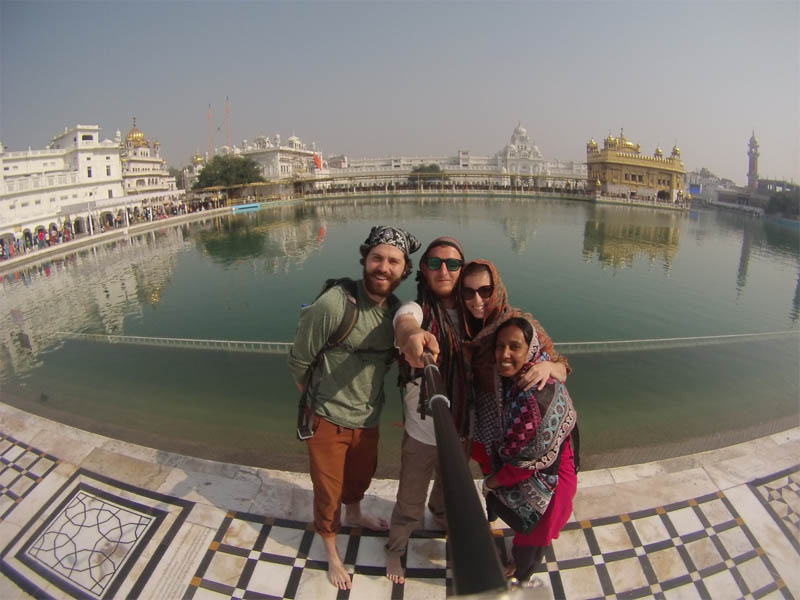
We got up at 3 AM on Wednesday to get to Dharamsala to get our bus at 5 AM. It’s about a 6 hour ride but on a government bus, which means its literally like rows of benches and super crowded. Amritsar itself is just a typical busy, dirty, dusty and underwhelming Indian city but it’s also home to the Golden Temple, the holiest site in Sikhism, the religion of most Punjabis. The Golden Temple is AMAZING and so beautiful, its like stepping into another world when you get inside the complex. You approach the complex and everything becomes marble and immaculately clean (weird) and you have to check your shoes and socks (they aren’t allowed inside the complex even inside a bag) and cover your head (men too) and then you walk through this shallow pool of water to wash your feet and then into the temple complex.

It’s full of people 24 hours a day but it’s also so peaceful and quiet, except the hushed sounds of lots of silent people milling around and praying and the gurus inside the temple singing/chanting prayers over this loudspeaker. I spent hours just sitting on the marble on the edge of the water (which is holy water and the men bathe in it in their underwear and the women can too but they have to go in this covered section). Then you can get into the line to go into the temple itself and you get inside and it’s so crazy and ornate (also warm, I cannot even imagine what it’s like in there in the summer) and when you get out of the temple they spoon a scoop of this stuff that looks kind of like dark brown oatmeal into your hand and it tastes like sugary whole wheat flour mush and you’re supposed to eat it and then rub the oil from it on your face. 

We stayed there for free, they have what are called “niwas” which are giant hostels essentially that are free for Golden Temple visitors. You just walk into this giant courtyard just next to the temple complex and if you’re foreign this really nice Sikh guy comes over and brings you to the “foreigners room” which is basically a small section of the niwas that is a bit more private. There’s one big room with a bunch of cots and then four or five smaller rooms off it that each have three cots in them, we stayed in one of the smaller rooms (challenging to get four people onto three cots). There’s a bathroom with a tap and sink and bucket to shower in the big room but then for the toilets you go out into the courtyard and there two-story toilet “halls” with the most toilet stalls I have ever seen in one place. The whole place is full of giant rooms with cots and there are so many people that at night the whole courtyard is full of people just sleeping on blankets on the ground

The most amazing part of all of this is the Langar (which just means food in Punjabi) hall. You enter through the temple complex and you walk through another foot pool and then you walk up and a guy hands you a plate and then another guy hands you a spoon and then another one a bowl and then you shuffle into this enormous room with really long thin mats lined up in rows and you sit down on the mat and then these guys come around with baskets of fresh chapati, buckets of dal (lentils) and subjee (Indian mixed vegetables) sometimes rice and then either something similar to what they give you when you leave the temple or like a sweet rice pudding type thing. It’s totally free, and you just eat as much as you want and then take the plate down and hand it to someone and they pass it along this assembly line to like 100 people who are doing dishes. And next to that there are 100 people cooking in these absolutely enormous vats. Apparently something like 40,000 pilgrims eat there a day. I loved it, the food was incredible - I ate every meal there.

The whole temple, niwas, langar experience was absolutely incredible, I loved it so much.

Part of Naddi's team in the Golden Temple


Kyla Korvne - USA
Women's empowerment Project Manager/ Centre Coordinator in Naddi

Saturday, 4 June 2016

Living on the Road

One random day meanwhile I was working in Greece I decided that I wanted to move to another place and do something else. Once I made the decision one thing linked to another and after a series of lucky has by unsuspected events I ended up in India doing an internship with EduCARE India. 

Before coming I was a bit sceptic of what I will find in this country, in the organization, the people around me...when I arrived to Delhi that feeling was fading out slowly (I felt super confident after ruining a taxi driver scam) and during my Induction it went away definitely. 

Soon I learnt that my internship will be characterized by one thing, I will “live on the road”. As my internship is as Communications coordinator and during 2016 the COM Team (Collaborative Operations Management Team) will be travelling between the centres to be more helpful and support better the teams. I loved the idea from the very first moment and since then I have been discovering EduCARE India centres and India at the same time.

My first home in India was Gajner (Rajasthan) and it will always be a place I will remember with special affection. I loved how I felt part of the community really soon, how every child will greet me with a big smile, how beautiful were the sunsets at the lake, the amazing dinners that the interns prepared, all the chais and kachoris I had at Manoj’s shop (one of the places I miss the most!) and the weekend trips we did always preceded and followed by some hours in Bikaner, I city I got to know well (partly because of my multiple visits to the FRRO office) and I like for some inexplicable reason. Whoever has been in Bikaner knows that is a crazy and noisy city, but when you get to know it becomes...let’s say familiar.

ASP in Modiya Mansar (Gajner)

Lovely dinners in the intern's house rooftop

Peacocks acting as my morning alarms in Gajner

But the time to moved came and with a lot of sadness but some excitement for keep discovering India and EduCARE I left Gajner behind and I spent two weeks in Harike’s centre. During the train trip I already noticed how different everything will be from my previous life in India, the desert was not there anymore instead I will find green plains, the wetlands and humidity, a lot of humidity! Even the people were different Punjabis were undoubtedly taller and bigger than my previous Rajasthani neighbours. 

I still remember vively the buffalos and their crazy eyes, the Sikhs’ culture all around, my first noodle burger and how surprised I felt at first by Harike. I was used to my calm village life in Gajner where not many (or none) shops or food options are available and suddenly I found myself in a little town where they even had fabric shops and my beloved paranthas (a dish that if you didn’t try yet, believe me you are missing something!) I definitely took advantage of all the options that were around me, noodles, noodles burgers, paranthas, real ice creams, lassis, Chocos, milkshakes by Armand and more! I was awakening the food monster I have inside every single day.  

View behind the intern's house at sunset

In the temple community, one of the places where the interns in Harike work

Nevertheless soon it was time to keep moving.

After a long night driving where I found myself stuck in the back of a car surrounded by backpacks, household stuff and the belongings of my team members, we finally arrived to Naddi, Himachal Pradesh. It was six in the morning and it was so cold compare to my previous locations!! My body had a complete shock but even though I was shivering and I had a big lack of sleep, I could not believe how beautiful everything was around me, the mountains, the clean air and the view itself. As soon as I step out of the car and I got my first chai things started fitted in. 

Stunning view from Naddi

These four months have been a great learning experience so far and one thing I have learnt is that when you “live on the road” your house is your backpack and that means going through many housing situations. I loved the place I stayed in Gajner it was calm, fresh, I had shelves and we got a fridge just a week after I arrive (cheers for that!). Harike was good, I liked the open spaces, the big table, the size of the rooms and the pressure of the water was great compare to Gajner! Naddi was a bit rough in the beginning (even though the fridge came after only four days!) but once we started to clean, built shelves everywhere (thanks to Faik and Emma, they literally changed our lives!) and taking advantage of the balcony to enjoy the view, it became slowly slowly my third home in India (still having freezing showers though) 

Building shelves with Atul's help

Of course this incessant movement has sad sides, when you know all the shopkeepers, your neighbours, how the buses and trains work, who has the best paneer in town, who sells the best lassi and people treats you as part of the family, as part of the community you live in you have to move and start from scratch. But it has a lot of good things also, I got to know all the centres and all the interns (I am really happy about that, many beautiful and inspiring personalities in EduCARE!) I have experimented and lived in three different Indian states that couldn’t be more different from each other and the most important thing is that everywhere I felt at home.

Another lesson I am learning is about me, I considered myself a really easy going and flexible person before coming to India, but now I definitely can say that I am both even more (mostly like everybody in EduCARE, we left behind almost all our comforts and food pleasures, believe me) I can sleep on the floor of a train station without blinking (or literally sleep anywhere), I can cook tasty dinners with three ingredients, survive to power cuts or water cuts that last two days and I proved myself that I can survived without cheese! Everything takes longer here and everything can go wrong but once you accepted it life can be surprisingly good. I can also say that this way of moving around is making me realize how little I need to live and how many useless stuff we use that just take space and money away (cliché alert!). 

Getting to know all the communities and living among them, sharing time with all the teams and participating in some of the women’s empowerment projects I also find myself even more convinced about my ideals and principles regarding feminism, environment, education, gender issues and inequalities among people. I discovered really soon how unsustainable I was and how little I thought of the consequences of some of my daily habits. Before coming to India I also considered myself a feminist but now after seeing how Indian women feel and struggle daily and how many times I had to control and repress myself for not reacting against certain behaviours towards them, I can say that I am a convinced feminist seeking for equality among all human beings with a renewed motivation. 

I find myself sometimes thinking how lucky I am that I got to live this experience and how much I have learnt so far, I already see how I am changing and how much India, EduCARE India and its interns have opened my eyes and showed me how much still needs to be done. 

India can be too much sometimes, some days are a bit overwhelming but if you have the right attitude in the end everything works out and something good can always came up, all depends in how you face the situations!

I am looking forward to seeing what more India has to teach me! 

Enjoying Himachal Pradesh sceneries.


Mercedes Milán - Spain
Communications Coordinator in EduCARE India