Showing posts with label Janauri. Show all posts

Friday, 30 October 2015

Colourful and exciting India


If there is one thing to know about India, it’s that they love a good festival and celebrating in style. Luckily, we got to experience every first hand and on a quite a personal level. We started small and by the second day, it turned into one of the most intriguing events in my life so far…

We spent the first night (Saturday), at a small celebration in Janauri, there was some delicious free food, a makeshift temple near the bus stand, and some lovely traditional Punjabi music. It was a nice and low-key event to transition us into what was in store for us Sunday.

Earlier in the week, the councilor from a nearby (and much bigger) town came to invite us to his festival in Hariana. We happily accepted and went over in the afternoon for some more food and music. I think we underestimated our invitation but quite quickly it was brought to out attention we were “esteemed guests” and presented with a picture of some Hindu Gods, which we are planning to hang in the office. 

Aurelien, Amelie, Madeline and Breanne
Immediately after that, everyone around us was preparing for the parade-men in costumes, drum players, cars with stereo systems surrounded us. Much to our surprise, Amelie and myself were asked to ride camels in the parade and wave to the crowds. There were firecrackers and elephants in front of us and the whole experience was loud, colourful and incredibly and uniquely, India. Three hours later we were finally off on camels and own our way home to get back to work until the Kabaddi games on Friday.

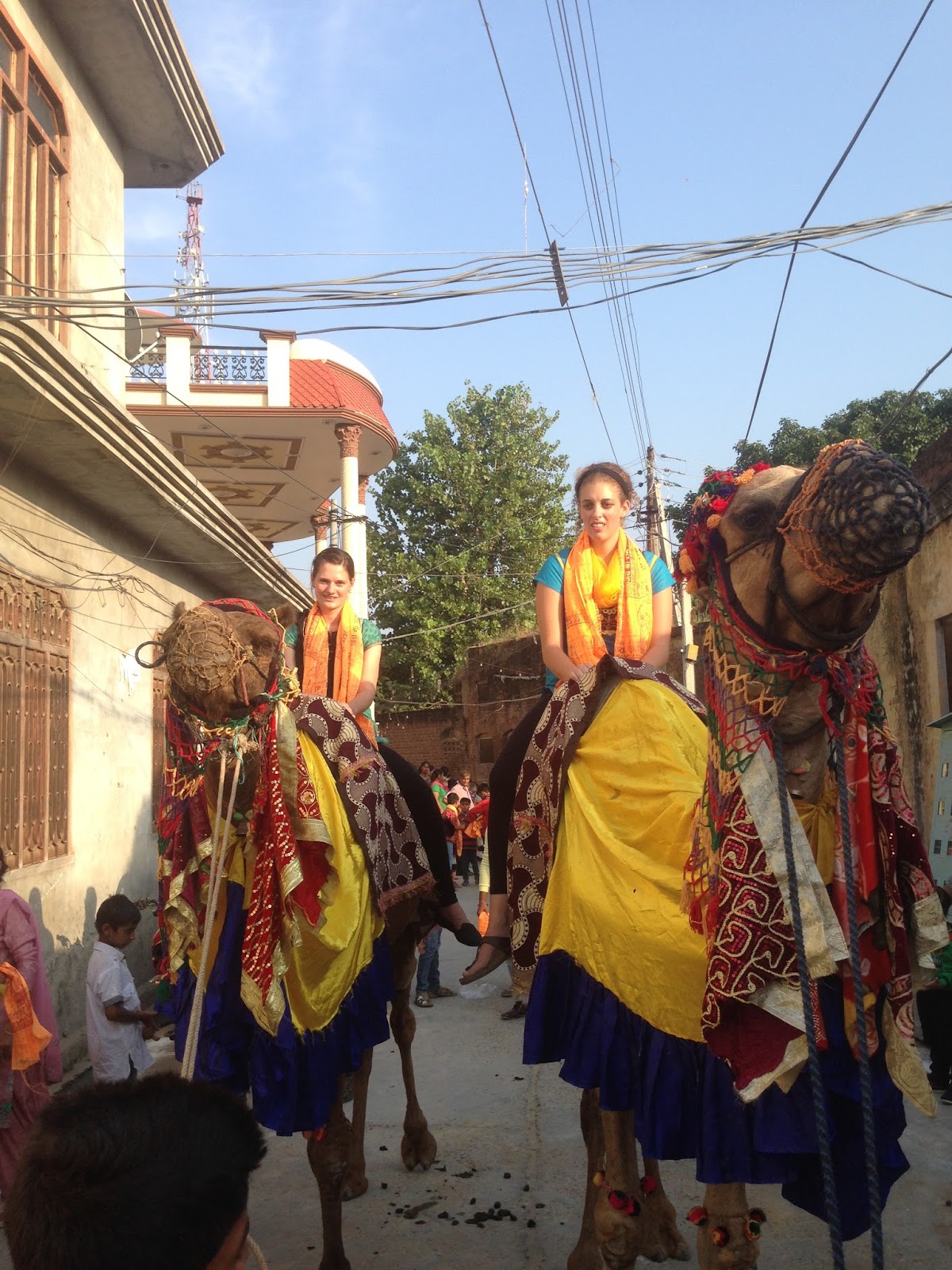
Amelie and Breanne riding camels in the streets of Hariana
The Councilor invited us to come to Hariana again to see a Kabaddi Game with him on 23rd of this month. Once we reached, he got us seats on the stage next to the other counselors from where we had a good view on the Kabaddi field. For most of us it was the first Kabaddi game so it was really interesting to see it live and from a stage as VIP guests. But what was even more interesting was the show inbetween the Kabaddi games. Once, three men tried to fit in a ring that, to us, already seemed too small for two men, and another time they let five men aged over 60 try to catch a chicken. As interesting it was to see all these bizarre shows and talents unfold in front of us, you can’t help fell uncomfortable as you realize these old men are chasing a chicken for a money prize and are quite poor members of the community. To everyone on the stage with us, they roared with laughter as the men tried and failed to catch the bird, falling face first in the sand along the way. It was a good example of the cultural shocks we sometime face in India and how we have to learn to adapt to the situation without being offensive. While watching the game, the counselor introduced us multiple times to the crowd and we got served several snacks throughout the afternoon. And again, we got a painting and orange scarves as a gift for the guests of honour, which will keep reminding us of this interesting part of Indian culture we could experience that day.

Kabaddi game in Hariana


 Amelie and Breanne - Germany/Canada
Microfinance Project Managers, Paro (Punjab)

Wednesday, 16 September 2015

"Garmi, garmi". Dealing with the heat in Punjab


Before I arrived in India at the beginning of June 2015, the news at home was displaying stories on a near daily basis about the insane heat waves across India. The south was experiencing temperatures nearing 50’C, Delhi was a toasty 44’C (112’F for my fellow Americans), countless photos of people guzzling water crossed my BBC news app. My friends and family loved to alert me of these temperatures, but I assured them I wasn’t going to places mentioned in the news, and thus should be ‘chill’. I was right….sort of.

While Punjab was never mentioned in the history-making heat wave, that did not mean the Punjabis were relaxing in balmier weather. Much of my experience with Educare, and thus living in rural India, has centered on the unrelenting heat. I believe on one of my first days I (naively) asked if the house I would be living in would have hot water. The answer, technically, was no. However when your black water tank sits on the roof baking in 40’ your water really will be hot, whether you like it or not. Living in Janauri I quickly had to be accustomed to stepping out of a shower and not being able to differentiate between what were water droplets from my freshly washed hair, or new beads of sweat already starting to do away with my recent cleaning. It’s a never-ending, and sometimes futile, battle.

You learn to embrace this heat though. Everyone’s affected by it and brings you all together at a basic human level. One of the first Hindi/Punjabi words I learned was garmi (hot), and it is the perfect way to break the silence when meeting people. If one is ever at a loss for their Hindi (which happens in every conversation I’ve entered in India), they simply feign an exhausted face, fan themselves with their hand and mumble “garmi, garmi, garmi”. It is a perfect way to connect with whoever is in the room, and most likely they will respond with the same motion, and you both will chuckle.

I won’t lie, aside from vanity reasons; this heat is difficult to work with. Children that should normally be running and screaming with excitement lay exhausted in the shade. Getting “rambunctious kids” excited for after school activities is often one of our biggest challenges in Punjab. Community engagement is difficult when the majority of people in the villages are sitting inside with their fans on. But we make it work.

I don’t mean to whine about the heat because in fact, life thrives here. Everyone still adds just as many hot spices to their daal (well, maybe not every intern), everyone still drinks their daily hot chai, and we still manage to play games of tag in the migrant camp that leave us dripping in that Punjabi sweat. If anything, the heat just adds a little more flavor to the experience! But that doesn’t mean I’m not excited for that autumn chill!

Madeline lighting up fireworks on the 4th of July


Madeline Zdeblick - US
Paro center manager and microfinance project manager, Paro (Punjab)

Sunday, 28 June 2015

Water: a major concern in Punjab

To describe life in Punjab some subjects are inevitable. The heat, the Punjabi music in the buses, the food … And so is the water.

Indeed water shortages in households are common and so are diseases or health problems that can be easily related to water (stomach pain, diarrhea, etc). Since March, the two of us work on water sanitation in rural Punjab in the Hoshiarpur district. We focused on the water supply and the drinking water quality as well as on a rain-water harvesting system for the Janauri intern house. Our project was divided in several parts, online researches, on the field research, a survey in our work communities, and an educational part. We wanted here to share our experiment regarding the survey. Indeed, we had to find ways to communicate and do our survey in Hindi/Punjabi because only a small number of the 23 participants spoke English. As many of you know, Hindi is a very different language than French or English. With internet we were able to translate the main words we needed to be understood. We believe that the success of our survey lies in the fact that we had a real connection, a very good relationship with the people we were interviewing (as many kids as adults, as many women men). They were happy to help us and very excited to participate which was motivating and comforting when the language barrier started being an issue. What we learned during this survey is that there is a strong link between the type of water you get access to (tap water, boiled water or filtered water) and the health symptoms you can present (stomach pain, diarrhea). We are also conscious about the limitations of our work. Indeed it would have been statistically better if we could have had more participants. Besides, we learnt that none of the men we interviewed showed health symptoms while 70% of the women admitted having at least one of the symptoms. This result would certainly have been different if one of us as been a man as well… But you know, TII (this is India).

filling in the survey with Manon in the Mansa Devi Community.
The Janauri Dam, the irrigation water system would be an interesting thing to investigate in the future.

To conclude, we strongly believe that Water Sanitation is a major concern in every cluster of EduCARE and in Punjab we hope that next interns (maybe you) would be interested in focusing on testing the drinking water, filtering the grey waters, etc.

Claire Rais Assa & Manon Egnell - France
Water Sanitation Project Manager, Janauri, Punjab

Wednesday, 5 December 2012

Education will lead to empowerment of Migrants community in Janauri village

Education will lead to empowerment of Migrants community in Janauri village

On the outskirts of Janauri village lies a small migrant camp that has all to often been overlooked by the Indian society. The cast system does not only limit access to basic provisions but also stifles children’s opportunities to dream to strive for a better way of life. Many children here are unable to comprehend that they can improve their lives, as they do not know any different. Through education the prejudice from society can be challenged, and the children can attempt to break free from the societal pre-determinations of how they should live their lives.

Learning English improves the children's self esteem

Education can lead to empowerment. This is our firm belief at EduCARE India and can be seen on the ground in Janauri. Currently the 4 interns as part of EduCARE India's international internship programme undertaking their volunteer work in India providing basic English and Math’s classes which Erica Vass from US and local beneficiary group believes will “serve them well into their adult lives”. These skills taught to the children will aid them in basic money management and also allow them the opportunity to compete for more jobs in the future. The classes currently are running twice a week and according to Erica are “of the utmost importance in terms of promoting empowerment for these children.”


The children are highly attentive during lessons and always enthusiastic. Currently the children receive 2 after-school English lessons a week, however this number may improve due to the demand for learning. The children’s willingness to learn in the migrant camp is staggering. Despite having significant other concerns such as access to basic amenities they are still determined to learn and we are therefore determined to teach.

Learning through games

Education therefore is being used as a tool of empowerment that can result in long-term tangible benefits for the migrant children in Janauri. Sydney J. Harris stated that the whole purpose of education was to turn mirrors into windows and this can be seen through the work in Janauri. Rather than the migrant children assessing their limitations and believing they cannot improve their lifestyles, education shows them what they can achieve.

Thursday, 15 March 2012

Hello everyone!!
My name is Ryusuke, from Japan.
I`m one of the interns at EduCARE India and also
REstore manager in Janauri.


This time I`d like to introduce my project.
On March 9th, I held an event at migrant`s community Paro.

In Janauri and Paro, some migrants from Rajasthan live there and make communities. They pick some garbage up and sell for living. Migrant`s children also have to work because their income is very low. So our center is facilitating a MCE program. MCE stands for Marginalised Community Empowerment. In that program, we try to teach the children about nutrition, hygiene, English, Punjabi, and so on.

Through my internship, I found they have really dangerous problem. I found this burned toothpaste-tube in their community. They seem to burn these tubes, plastic-bags, and plastic-tray, and they breathe these smoke. That`s very dangerous for their health. So, I thought I have to teach them what is good or bad for burning. Moreover, I want them to use candles as cleaner energy.


This time, we went to their community and asked them some quiz questions: what is good or bad for burning. Besides, I told a story, showing their children some pictures. This story is about a boy`s life. The message is “always try to do your best” and “You can change your life for yourself”.
At first, only a few people took part in my program, but many people got interested in my project gradually. Children could easily understand the story due to local people`s help with translation.

After telling the story, we talked with the community`s leader about education. Through this conversation, we found that Punjab state government tries to provide all children with some opportunities to education for free.

Moreover, one of the adults in that community seems to be interested in getting those chances. So, there are some gaps between them. However, if we can remove these gaps, we will be able to help migrant`s children go to school.

But, I was so sad when I asked the kids whether you`re interested in school or not, their answers ware “No”. Through this moment, I really thought talking with local people is really important to do some activities.

Next, I asked them some quiz questions about what is good or bad for burning. 3 children and many adults took part in this program.
At first, they answer paper is bad for burning because it is really dirty and plastic-bag is good for burning. But when I finished asking all the questions, they can answer accurately.


When I show them candles, one of the adults told us they tried to buy candles before and they really want to know how to make candles. So, we made candles with migrant`s children and adults at REstore on March 12th.
Hello everyone!
My name is Ryusuke, from Japan. I`m one of the interns at EduCARE India and also
REstore manager in Janauri.REstore is information center about environmental awareness
and also selling eco-friendly products like organic soap, vinegar, and baking soda.


This time I`d like to introduce my project.


On February 24th, I held an event at REstore. In it, I made a presentation about 3R, Reduce, Reuse, and Recycle. Moreover, as one of the examples of recycle, I made recycle-candles through used-candles.

Through this event, I`d like to enlighten local people about environmental awareness and also like them to get interested in recycle through making candles.


In this event, I asked a shopkeeper (He is really helpful!!) to help me with translation. So, I could communicate with local people.In Janauri, most of the people can speak only Hindi and Punjabi, so language- barrier is always big problem for us every time we do some activities with locals.

Totally, 9 people came to my event, so I`m not satisfied with the number of participants. I`d like to hold an event with more and more people, so I have to consider solution like how to advertise.

In a few days, I was involved in After School Program, and I played football with children. After that, one of the children who took participate in my event pointed at the garbage in the puddle and said to me “Ryusuke, Pollution!! Pollution!!”

Moreover, I saw one of the participants who helps me with translation talked with others about recycle without my help.I was really happy to hear that. I want to hold another event soon, and at the event I also want to do my best.

Thank you for reading my blog!!!

Ryusuke
REstore Manager Janauri

Monday, 13 June 2011

Building recycling storage

Project blueprint - recycling facility
As always, we have been busy plotting and planning something new! This time it is back to Janauri. Manuel has been meticulously labouring over these drawings, which are the blueprints for a new bamboo framed Waste Separation, Storage and Recycling Facility (WSSRF). It is being built for (and largely by) the migrant community in Paro, a neighbouring village of Janauri. We thought that we would leave the construction side of things to the locals who have the best knowledge on building these type of huts.

Plan for the interior shelving of the facility
The purpose of this new WSSRF unit is so that when the monsoon rains come, the trash can be kept dry and retain its value, as such things like wet cardboard do not sell. In addition it will keep the migrant community clean, tidy and organised. Operations have got under way with the build. Last week all the interns ventured across to Janauri and spent a hard days work stripping all the bamboo from knots. Most of our blisters have just about healed, and now it's time to erect the structure!

More to follow. Check back next week for the finished article.

Tuesday, 31 May 2011

Trash talking with the Local Schools

School kids learn about the importance of a clean environment
In order to make the S.W.A.S.H. project in Janauri sustainable we need to change peoples behaviours. This happens through making waste disposal easy and practical. In our case, we firstly introduced the recycling bags scheme within the village, and then followed this up with projects, such as restoring the public restroom and undertaking groundworks in the water gutter area. Much to our delight, all of these S.W.A.S.H. efforts have drawn increasing interest and cooperation from within the local community.

Changing age-old habits is not going to happen in the short-term. We recognise that we won't be pulling up any trees overnight, but with the success of these projects, coupled with a great visual presence in the village, this may take a while, but we will change peoples attitudes over time!

With the idea of 'legacy' in mind, for the long-term success of this effort, the S.W.A.S.H. team decided to sensitize the minds of the future decision makers - the children of Janauri. We are currently working with four schools, three in Janauri - the Girls Middle School, the Mixed Middle School and the Modern Public School - and one in Paro (neighbouring village) - the SDM School. The general idea is to give presentations and workshops at these schools, to raise awareness, so students learn about local and global environmental problems. With a problem, there needs to be an remedy, so we discuss and propose solutions with the children and teachers too. Together we work to identify how the locals can strive towards achieving the goal of a clean environment to live within!

There have been presentations in three of the schools with the Modern Public School already scheduled for July. In the future we are looking forward to create one presentation/workshop per month and present them at the schools, one school a week. This series of events will start in July as the kids are on holiday throughout June.

The plinth - just before the Janauri team address their masses!!
The children have been enjoying our presentations and showed great interest. With games like the 'trash game', where the children have to guess what kind of waste is shown to them, and the 'good/bad plays', where we act out different good and bad habits concerning waste. We are trying to make learning about the environment as fun and exciting as possible. It is a serious health issue, which is sometimes difficult to raise the children's interest towards the topic. However, by making the presentations interactive and exciting, we seem to be capturing their attention!

We have to keep our presentations very basic and simple so the translation into Hindi/Punjabi is easier for the teachers. Having experienced good translation so far and having increased the general knowledge of the students about environment, we will try to go into more detail and address more complicated topics in the future. So far so good!! :)

Tuesday, 17 May 2011

Going with the flow

The disgusting state of the muddy hole/run-off water
As part of our ongoing S.W.A.S.H. project in Januari, this Wednesday, those interns who were not away on a the bio-dynamic farming course (more to come on the blog soon), gathered to take on the so-called water gutter problem that is being faced by the village. 

The problem: The used run-off water that is guttered along the side of the street (mainly from the kitchens and showers of peoples homes) had become stuck in front of the Boy's Middle School, due to a muddy hole that had formed in the street. This, combined with trash flushed in by the rain, coupled with the extreme heat, had led to this disgusting patch that the school kids had to confront on a daily basis - both aurally and visually.

Additionally, this area had become a more problematic issue for the whole village at large. Not only had the area become aesthetically unappealing, but now the stagnant water that had formed was slowly seeping into the ground, which is one of main causes of the bad ground water quality, the water that people drink and use to irrigate their farmland - a real issue for concern!

Appoline and Annette picking up the trash
What happened: The days work started with the ladies bravely taking on the dirty job of cleaning out the water gutter, and ridding it of all the trash that had been thrown carelessly into the area. Meanwhile, simultaneously, the men dug out the canal on the other side of the road, to make it ready for the plumbing of the pipe under the road that had become blocked over the years with trash and sludge. 

There was plenty of support from the locals
Right from the start the interns experienced a lot of community support, which was fantastic for us! To see that the community were interested and willing to help was really nice. We had up to four community members helping at one time - support that was very welcome on such a hot day!!

The all-important plumbing - with bamboo!
After the plumbing was done, we needed to rebuild the original canal in the water gutter section of the project and then level the rest of the hole. After moderate success using the leveler (a cricket pitch roller), it was clear, that the leveling could not be finished, as the ground was still too wet under the layer of dry mud and sand that all the interns had dug up. This particular part of the project, the leveling, will be continued during the next week by the S.W.A.S.H. team members in Janauri, as the land will dry out and become more stable.

Leveling out the area with sand, mud, and feet!
Yet, having everybody thinking that the work was done, the project manager for the day, Manuel, happened to have his heart set on the idea of moving the extremely heavy concrete pipes. His desire, to use them to protect the new canal we had dug-out from preventing trash from gathering their again. 

Despite the fact we were all tired, after another hour of hard and sweaty work, the first part of the canal was successfully covered by one of the big concrete pipes - a great success. Covering the canal properly will now prevent the water from future blockages due to trash, mud and plants that had previously caused flow issues.

The new canal, a job well done!!
Pipe down - the new drainage system in place
From the side of the S.W.A.S.H. project team in Janauri it has to said: Thanks for the great support from the interns in Adampur and Dosarka for helping out with what was a very hard, very hot and dirty days work.

Sunday, 17 April 2011

S.W.A.S.H.

Poor water quality in Janauri
Plastic bags, wrappers, cans, batteries, coke bottles. One would hope you would find these items stashed away in a green recycle bin on a street corner. But in Punjab, and the village of Janauri specifically, this is sadly not the case. Batteries lie in river basins, plastic bags clog gutters, and broken glass litters cricket playing fields. Even worse, some of these items are even set ablaze as a means of the eradicating waste, polluting the surrounding air, water, and soil. It is a short-term solution with drastic costs. 

This is why the S.W.A.S.H. project (Sanitation of Water, Air, and Soil for Healthy Villages) was founded in Janauri. The S.W.A.S.H. project is addressing waste disposal challenges at the village level to tackle issues such as toxins in the air, water, and soil from burning waste, poor/undrinkable water quality, and general mismanagement of waste. Janauri is a particularly important location as much of the polluted water that passes through the village continues westward into the irrigational system of the lowland farming districts.

Problem and solution (waste in the background, bag in the foreground)
Thus far, S.W.A.S.H. has implemented a recyclable waste management system to discourage the community from burning their waste and littering water basins. Currently, twelve bags are located in central Janauri, including near shop fronts, high pedestrian traffic areas, and in two schools. The community has shown much support for this initiative, including some members already taking the initiative to assemble more recycling bags to meet the current demand. S.W.A.S.H. is also committed to using nearly all re-usable materials for the assembly of recycle bags. This includes old cement bags serving as recycle bags, and everything from plastic lining to old electrical wires as rope.


Community support
The recycling initiative in Janauri experienced initial success and is currently at a consistent level of waste disposal and collection. In the next month, S.W.A.S.H. is planning to expand the recycling program to the temple district of Janauri. It has been our constant goal to see that our motto, “Clean Janauri, Beautiful Janauri”, is being realized through the empowerment of the community.

Thursday, 7 April 2011

Toil-ets in Janauri

Cleaned out, new roof, banked entrance - Great job
Before (above) and after
The SWASH (Sanitation of Water, Air, Soil for Healthy Villages) project in the village of Janauri has taken on a new initiative to clean and restore the public restroom near the village bus stand. The restroom has been out of use for several years because of previous monsoon rains that flooded the floor, leaving a 40cm layer of mud behind. 

Currently, due to a great effort from EduCARE interns Bryan and Manuel, the mud has been removed, a temporary roof installed, and a barrier constructed in front of the entrance to prevent further flooding. 


Bryan and Manuel - proud of their brickwork
SWASH is in the process of installing brick steps, a new roof, laying down grass, organizing the plumbing, and making the final touches in cleaning the facilities. The initiative has experienced much support from the Janauri community, and has helped to bring closer ties between ViKAS interns and the community.