
The first month in Harike has passed, and
it has gone very fast. Many things have happened, and the team has been working
hard to establish strong connections with the local communities. After the end
of quarterlies, the team began strategizing on the future of the centre and
planned the centre's activities for the following year. After some house
decoration activities (led by our former centre manager Ethan), the real work
began.
 |
| First Saturday Meeting complete |
Until now, we established two weekly ASP’s
with two different local communities. The wonderful Jessica, our Women’s empowerment project manager, has initiated a Girls’ Club with the Makhu girls and has received a very
positive response. Our Eco-building project manager, Maria, has been
working hard at establishing relations with local women who will host the eco
home stays in the future, as well as worked on the plan for eco-buildings in all
of EduCARE’s centres. While our new centre manager Tommaso, in between cooking
delicious meals for all the interns, has begun his business plan for Harike’s
ReSTORE. In addition, we also began giving workshops to a local school on a
range of subjects including SWASH, girls’ health, disaster management and
environmental awareness. Maria and Jessica gave the first two workshops and
received very positive feedback from both the children and the teachers. These
workshops will be given twice a month for the next year and are aimed at
raising awareness amongst local children about important issues.
 |
| Harike team members standing next to their caricature |
With respect to the forestry project, Harike
has a lot of potential particularly due to its proximity to Harike’s Wetland,
a protected area which includes a bird sanctuary home to hundreds of birds
migrating from places as far as Siberia. The forestry team, composed of Sydney and
I, had a pretty successful month in terms of establishing contacts and planning
future projects. During this month, we have managed to meet and interview a number
of officers from Punjab’s Forest Department in both Harike and Firozpur, as well as visited
Makhu’s tree nursery to learn about the local flora and fauna. After some
brainstorming sessions and lengthy discussions with Mr B, we came up with a
number of projects to implement in the future. These include:
· Establishing a tree nursery at
the local Sikh temple, planting bamboos and a number of other local trees, with
the aim of engaging the local community in taking care of the trees and create, in this way, a social forestry project.
· Work with some of the women
from Makhu village to create organic vegetable gardens for self-consumption.
· · Establish an
income-diversification project aimed at the two local communities we work with in
Harike. As these communities’ incomes rely on extraction of resources from the
wetland (for example by fishing and cutting wood for fuel and fodder), our aim
will be to create a number of organic vegetable gardens for the families to use
for self-consumption. This will allow the families to reduce their expenditure
on food, improve their levels of nutrition, as well as promote more sustainable
agricultural practices.
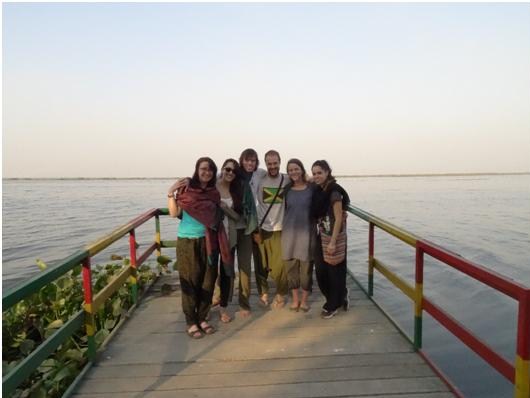 |
| Harike team at Quarterlies |
For the moment, these are the forestry
project priorities and steps have been taken to ensure we’re on the right
track to achieve these in the next year. In addition to the main project,
Sydney and I also created a new garden for the interns’ house which will be
used to grow organic vegetables, as well as mosquito-repellent plants (which
are very much needed for the summer months here).
All in all, our first month here went very
fast, between some planning and strategizing, drinking many, many chais, film
nights, perfecting our parantha recipe, running away from frisky buffalos, playing
cricket with the children and experiencing our first Punjabi wedding, we have
learnt a lot but still have a lot to achieve.
 |
| Our first Punjabi wedding |
Alessandra
Sciarra- Italy
Forestry
and Organic Farming Project Manager, Harike (Punjab)


