Thursday, 12 November 2015

EduCARE India - the good, the bad, and the disgusting

Seven months ago I remember saying to a fellow intern, “wow, time is going by so slow,” and he responded, “wait until you start working.” He was right. The past few months in Educare have flown by and it has been an amazing experience.

For someone like myself who didn’t join Educare as an internship requirement for university, my reasons for coming to India were a little different. I wanted to leave the regular 9 to 5 job in the States to go abroad to experience life like I never imagined, I wanted to utilize the skills that I have in an NGO helping a local community, and I wanted to learn more about life! I ended up learning so much and about everything – not only about Indian culture and life in India, but about cultures all around the world from my fellow interns, about the concept of objective selfishness and more about myself. As cheesy as it sounds, this experience was life changing.

The most significant change I found in myself is my patience. Patience is a word that was redefined for me while working in Educare and living in India. Internet is slow, ordering food at a restaurant normally can take over an hour, plans change last minute, everyone is late, the bus schedule in Maiti is random, the FRRO change their requirements on the spot, there are power outages constantly, vegetables have to be bought in the next village, flour- two villages over, the new intern you’ve been waiting for never arrives, COM meeting is in a village two hours commute away, you want something done and the answer you are given is “not possible today, come back tomorrow.” I can stay shockingly calm for much longer now.

Thinking about the past seven months, a few moments stand out as the happiest and there are a few that I would have to claim as my worst moments. All in random order…

Happiest moments:
1. Going on the camel ride in the desert at the Coordinators Retreat in Khuri and playing games in the dunes the next day. Who knew Mathilde and I were evenly matched in strength (we tied in our wrestling match).

2. Creating the superlatives for the June quarterlies and laughing until 2am with Elliott (whitest trash picker alive), Harmonie (swaggalicious swiss), Bruno (wannabe hippie), Whitney (most likely to tell you the office is her house and she almost pooed herself cleaning your mess), Remy (B’s favorite) and Johann (coolest geek).

3. Dancing to “Lean On” on top of Triund with Harmonie, Dani, Shannon, Hellen, and Laura (music video coming soon).

4. Making it to the top of the 5000m pass in Ladakh during my 3 day trek after an interminable trek uphill.

5. Laughing uncontrollably when Pooja, my favorite girl in Girls’ Club, points to the neighborhood dog and says “Lenty is my favorite bitch.”

6. Discussing our dreams and crafting dream catchers in Girls’ Club with the craft supplies my friends in the US sent me.

7. Shamelessly eating countless chapattis for breakfast, lunch and dinner with Margaret in Maiti.

8. Riding with Elliott in the motorbike I bought and I never used again after falling from it at the beginning.

Unhappiest moments:
1. Throwing up off the bus at 4am on the way back from Leh, praying nauseated and in fear that I would shit my pants at any moment (luckily I did not).

2. Spilling liquids from both ends at the same time in Atul’s homestay during June quarterlies with no toilet paper and missing the gender circle. Definitely felt like I hit rock bottom at this point.

3. Getting peed on by a rat in the kitchen TWICE. I almost died I was so disgusted.


With fellow interns at a wedding in Naddi, Himachal Pradesh


Playing Red Rover in the desert during the Coordinator’s Retreat in Khuri, Rajasthan


With the Maiti Girls’ Club in Maiti, Himachal Pradesh


Michelle Fujisaki - USA
HR Coordinator, Maiti, Himachal Pradesh


Monday, 9 November 2015

A Garden for the hungry tummies

I did not have a definite idea as to what I was going to be working on initially when I started my internship at EduCARE. My longtime wish to work on rural development projects like waste management, alternative energy or forestry in my country has brought me here but still not knowing where and what to begin with. To work with the migrants, the needy, the poor or kabadiwalas (trash pickers) as labeled by the society, was the apt platform for me to put in my thoughts and efforts to work on something that would help this migrant community in their everyday lives.
The migrant community of Paro
Since the day I started visiting the migrant camp here in Paro, Punjab, it was quite conspicuous that the community struggles to meet their daily needs. Some days they would not even have enough money to buy their aata or cheeni for their roti and chai for the day because Nanku, the head of the family could not accumulate enough trash to sell or the trash buyer did not show up for the day, or even if he did he was shameless enough to cheat these vulnerable people in their basic mathematics right in front of my eyes. Who is to be blamed? Is it their ignorance, illiteracy and poverty or is it that some people are too heartless to swindle these poor people off their daily bread. Hence, I decided to settle down with a project that would at least be of use in their food supplies: a community garden.
Preparing the plot for the garden
Initially we were planning on making the garden organic but it seemed to be a strenuous task as it would be a lot more time and money consuming to buy the organic seeds which were not available locally, to build a nursery, to shelter it, to get the organic fertilizers and pesticides and also the maintenance. However, after discussions with the community about all the important factors such as their necessity, plot for cultivating, ploughing, fencing, watering, sustainability, etc., we decided to go ahead with the locally available hybrid vegetable seeds. I had no prior experience in gardening so I had to do some basic research online. Also, by discussing with a few people about the soil here and the seasonal crops that can be cultivated during this time of the year, we finalized on eight vegetable seeds which included coriander, spinach, cabbage, peas, cauliflower, carrot, radish and turnip. Thus, with very little knowledge and hoping for the best outcome for the community, we commenced work by marking a plot at the camp with the help of Nanku and Gulshan. Since the community was very excited about it, things started moving pretty fast in the beginning. I would not say that we had to put in excessive effort and time in making this garden, but without Nanku’s involvement from ploughing the soil till sowing the seeds, it would have been arduous. Perhaps the hardest part was to motivate Nanku every day to get work done as he would be tired after his day job or he would be busy with some meeting at the camp.
The main structure of the fence for the garden 
We started by cleaning the plot and as we began the initial ploughing, we had to collect manure (animal waste and compost) to mix it with the soil and then we had to let it set in the following couple of days while we started working on the fence, which was the most labor and time consuming part in this whole project. Aurelien and I had to collect plenty of bamboos from the nearby jungle and carry them on our shoulders back to the camp. Some days it had to be early mornings and some days it had to be late evenings. The bamboos were put together and the fence was made by pushing them deep in to the ground to make it sturdy and also make it dense enough so that the dogs and chickens cannot penetrate. Even at this point, I was skeptical about the outcome of this project; not knowing if we were doing things the right way or how beneficial this whole thing would turn out to be for the community. Nevertheless, we were highly motivated to persevere by the little kids at the camp, who repeatedly questioned us every day when were we going to sow the seeds.  

The bamboos are ready to be placed! 
One of the kids of the camp observing the process
The garden fence, made of bamboo, was quickly finished

After the completion of the fence it was all ready, the soil looked fertile, the fence looked sturdy and the seeds were waiting to be sown. Thus, with a couple of days of re-ploughing to loosen and level the soil and dividing the plot into many sections for different seeds we were all set for sowing. The seeds were scattered considering the three important factors of gardening, the depth of sowing the seeds, spacing between the seeds and watering, all the seeds were sown in the following couple of days. I visited the garden everyday to water the soil and peep over the fence to check if a leaf was showing up from the ground and one evening within the next three or four days there it was, a few cotyledons popping out from the soil. The excitement and happiness running inside me was immense to see something grow from the seeds that were planted with my own hands. 

The first cotyledons in the garden!

I cannot forget to mention that this whole process wouldn’t have been possible to be completed in such a short span of time with no cost involved, without the contribution of all the other interns (Aurelien, Amelie, Madeline and Breanne) who were involved from day one. Now all I can wish for is a fruitful garden to fill the hungry tummies in the community.


Rizwan Ahmed - India
SWASH Project Manager, Paro (Punjab)

Friday, 6 November 2015

Trekking to Triund


I have a tradition of sipping a freshly brewed coffee on the brisk mornings of a hike to take in the sun rising over the beautiful view in front of me. However, after a cold and unexpected trek to Indrahar pass with Mr. B, Rachael, Daikon, Jacob and fellow interns, all I needed to wake and warm me up in the morning was a hot, spicy chai.

It all started with a call from B early on a Thursday morning asking to join him on an overnight trip to Triund, a popular hike among travellers, to survey the trees at different elevations. I had already been to see the unobstructed view of the Dhauladhar mountain range, but going again with B offered a chance to learn more about the flora and government forest management initiatives. So I rounded up a crew- Louise as my forestry team mate as well as Daniela and Kevin and we were off.

We started through the Deodar predominant forest area in Upper Naddi. The morning sun shone through the dark green needles providing us with some serenity before our gruelling trek; it’s no wonder deodar forests are sacred place of meditation in Hinduism.

Ascending from there brought us to a dense Rhododendron forest on either side of the path, which was unchanging for the better half of the trek. Even without their flowers, which bloom in March/April, it made for a pretty sight. This area is also sprinkled with Himalayan Oak trees, which have been severely lopped by the locals. Lopping is the act of cutting off branches of the tree to provide fuel for families and fodder for livestock to the point where the tree’s shape resembles that of a toothpick. Lopping hinders the regeneration of the tree’s population in a region and has adverse effects on the tree’s overall health. Unfortunately, this practice is not uncommon- you would be hard-pressed to find a healthy Oak in the region.
Kevin, Sydney and Daniela on the way to Triund

The foliage gradually became less dense as we neared our destination and the thick Rhododendron forests transitioned into scattered Kriew trees, also known locally as Triund Oak, which are a type of Himalayan Oak. These trees can establish their roots in the steepest and rockiest of slopes. Unlike their sister species, these trees seemed to be in better shape, however they are largely exploited for cattle fodder (local people send their livestock up the mountain for prime grazing during the monsoon season, before winter).

And alas, we reached Triund for a lunch of Thali and a refill of water. Clouds were blocking our promised view of the mountains, but luckily this was not the end of our trip. We were to set up camp for the night in a cave about an hour and a half’s walk from Triund on the base of the mountain. We set out for our last lag of the journey, energy restored and excited to have made it up the toughest bit of the hike- so we thought.
View from Triund

We passed Snow Line café, the last café of the journey, and picked up an omelette dinner that we would save for the cave. The clouds finally broke and we were able to see the peak of the mountains for which we came. Suddenly something sparked in all of us- we needed to get to the top. Although it was a risky decision, each of our worries and queries were rationalized in one way or another and it was set- we were to hike up to the top of the mountain as soon as the sun rose.

Cold from the frigid cave floor, we set the pass the next morning with promising clear skies. Only a 3 hour ascent and we would reach the peak of the monstrous rock! We stopped every couple hundred meters to catch our breath and a glimpse of Naddi from afar. Snacking on whatever food we had in our backpacks and water from the adjacent glacier, we hiked slowly but surely on the faintly marked path.

The dream was dampened once fog surrounded us and the path to the top was no longer visible. It had been three hours since we started for the day; some of us found ourselves questioning our motives, while others were strictly determined to reach the pass. A group huddle resulted in a decision of completing the journey and off we went again without hesitation.

An hour and a half later of a steep, narrow path and we finally reached the peak! Satisfaction overcame us as we high fived and hugged each other with congratulations. The view of Chamba Valley was worth every heavy breath and finally the mystery of what was beyond the towering mountains we see from Naddi had been uncovered. We knew it was our queue to descend when a blizzard obstructed our view and covered the path, adding another degree of difficulty to the trek.


The blizzard, accompanied by thunder and lightning, followed us down the mountain, forcing us to seek refuge under overhanging rocks when it became too dangerous to continue. The sun made a short appearance, just enough to warm us up and gain feeling in our fingers and toes, however it quickly retreated back in to the clouds. With wet equipment and a dwindling food supply, there was no choice but to make it to Snow Line. We trekked through the blizzards for the rest of the day into dusk with the promise of a warm cafe to keep us going.

We reached Snow Line and sat down among other hikers who did not brave the trek we just completed. We recounted all that we had done over our hot Maggi and omelettes: you know you have a good crew when all the stories told are done so with giant smiles. We set up our tents once we could phathom stepping into the snow, ready to start the next day’s descent with a hot chai and our favourite view.
Reaching the top!

Sydney Strelau - Canada
Forestry Coordinator

Wednesday, 4 November 2015

Coordinators Retreat in Rajasthan

The retreats for Coordinators were developed during 2015 as an opportunity for the management team to come together and talk about changes that might have come about in the organisation, what they want to change, issues they face, their job roles, etc. This was the third Coordinators retreat of the year, but it was my first. I had come back to EduCARE after three months in Nepal and decided to take up the role of Centre Manager in a new centre in Punjab called Harike/Makhu. I had worked in EduCARE earlier in the year in Rait as the Project Manager for sustainable living and SWASH. But this time I wanted to get some management skills and try something new. However I didn’t really know much about my role and what I had to do. I am also very young as I turned 18 this year, and I don’t have any past experience or management skills.

I had just come back to India at the beginning of October and went straight to the Coordinators retreat after being back for about a week. I hadn’t yet gone to my centre in Punjab and I was still confused about what I had to do and what my job role was. I had read some documents before coming and had some idea of which ones were my tasks, but I still lacked some knowledge. At the retreat there were Centre Managers, Management team members (HR, Communications, Directors, etc.), Operations Coordinator and the Project Coordinators. At the time, about half the organisation were involved in all the management job roles, so about 20 people joined the retreat!

The retreat went for 4 days and I found it very informative and useful. I got to talk to other Centre Managers and was able to ask them questions about the role and what they thought I needed to do. We had workshops and meetings where all of us would work together to create new systems and plans for the organization, discuss and outline what we need from the organization (facilities, support, etc.) problems we faced (as Centre Manager’s, Project Coordinator’s, etc.).  We made a to do list of all our weekly, monthly, quarterly and yearly tasks so that we could manage our time well and stay on top of everything.  We also had team building activities where we came closer as a group and even went on a camel safari and spent the night in the desert J.  And we did many other amazing workshops and meetings!!


A night in the desert 


I really enjoyed this retreat and everything in it. I learnt so much and met so many new people. I got a better understanding of my job role and everyone else’s job role within the organization. But what I learnt the most is that EduCARE is one big family and we are all here to support each other with our job. I LOVE YOU EDUCARE!!
All the coordinators, enjoying the last minutes of the retreat


Ethan Donovan - Australia
Harike Center Coordinator, Harike (Punjab)

Monday, 2 November 2015

Chenni grand cook-off


After 2 months of intense nutrition work with the community, the cooking competition in Chenni successfully finished one part of the project, opening the door for more workshops and raising of awareness amongst the girls and women.

Everything started months ago when, after one more dinner with a family, I could not walk home because of all the rice I was fed. I decided that it was time to start a nutrition project. After some planning and discussions with Mr. B, we thought it would be good to first increase our knowledge about community’s food habits and then have an event.

In September I started to hand out one nutrition file per family in Chenni. For 7 days, the girls and women had to write down everything that they ate during the day, indicate in which quantity, if there were salt or spices, and if they thought it was healthy or unhealthy food. As this required a lot of checking up and encouragements, those files were given to 7 families over the month of september. 6 files were completed more or less perfectly – quite a success! In the meantime, I went to have dinner with all the families involved, a good way to spend time with the families, talk about nutrition but also observe the dinner habits.

After that, everything was ready for the big finale, the nutrition event! During one Young Women Association meeting, I asked the women the day they would be available for the event. October being an intense month for wedding, we were able to agree on Tuesday 27th of October and thus squizzed the event between 2 weddings. One problem was left though: how to organise and cater for all the families and the interns ??? The cooking competition was the only way and probably the best way to engage and motivate everyone! The rest was just a matter of organisation. Each family received 2 vegetables to cook and was provided with labour force aka 3 EduCARE interns, hungry and determined to provide the best help to the family!

A week before the event, I started reminding the families about the event, 4 days before the event, I was in Chenni harrassing the families, 3 days before the event, invitations were handed out, 2 days before the event I was in Chenni again (!)… The day before I had to mandate the other interns to do the reminding for fear of being too annoying …

On the D-day, I spend the day preparing the dessert and solving last minute issues with the help of Tomasso, Louise and Johnatan. Baking cookies without oven? Check ! Cutting a mountain of pineapple? Check (thank you Tomasso)! At 4 pm, eveything was ready… Chenni here we come!

After gathering most of the girls, Madhu and I did a little workshop where we were able to provide tips on nutrition and give some feedback from the nutrition files. Progressively, no less than 15 other interns arrived, ready to chop, boil, cook and have fun!

Delicious vegetables dishes made by the Chenni families
5pm ish, the competition started! While everyone was sweating over their dish (figure of speech as the temperature in our mountains has dramatically dropped), Priya, Boby and I were taking pictures. At 7 ish, everyone was enjoying a well deserved meal. 7:45, the judges were gathered, the thali plates were displayed on the judges table. No less than 6 judges – Bindu, Abu, Savita, Priya, Boby and I – had the responsability to decide who should win the first ever cooking competition. More than 25 people were squeezed (we were cold) and were intensely observing the judges nimbling on all the amazing food. 

The judges waiting to taste the food
While everyone was finally allowed to taste each others food, the judges were debating next door on who should win. Despite the difficult task, one team was agreed upon.  After gathering everyone again, Priya announced officially that Sunayna, Kanta, Kuldeep, Anamika, Tulsi and Anesa were the winners. The price – paneer, chocolate and a little cookbook – was given, along with a diploma.

Winner team!
To thank everyone for their participation and as in the end everyone won (yay!), we all gathered around a dessert before shivering our way back home!

Harmonie Bucher - France
Health Coordinator, Naddi (Himachal Pradesh)

Friday, 30 October 2015

Colourful and exciting India


If there is one thing to know about India, it’s that they love a good festival and celebrating in style. Luckily, we got to experience every first hand and on a quite a personal level. We started small and by the second day, it turned into one of the most intriguing events in my life so far…

We spent the first night (Saturday), at a small celebration in Janauri, there was some delicious free food, a makeshift temple near the bus stand, and some lovely traditional Punjabi music. It was a nice and low-key event to transition us into what was in store for us Sunday.

Earlier in the week, the councilor from a nearby (and much bigger) town came to invite us to his festival in Hariana. We happily accepted and went over in the afternoon for some more food and music. I think we underestimated our invitation but quite quickly it was brought to out attention we were “esteemed guests” and presented with a picture of some Hindu Gods, which we are planning to hang in the office. 

Aurelien, Amelie, Madeline and Breanne
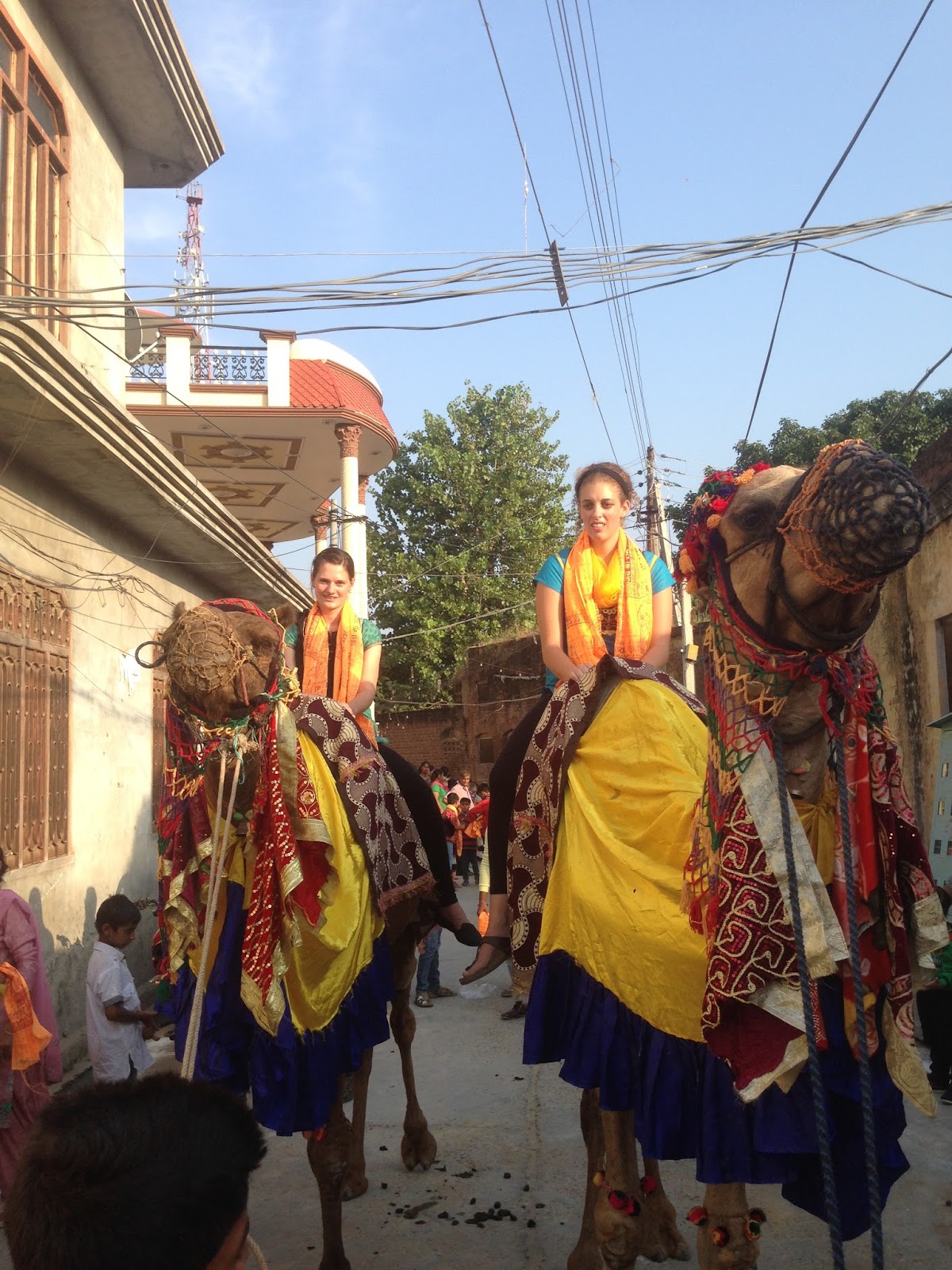
Immediately after that, everyone around us was preparing for the parade-men in costumes, drum players, cars with stereo systems surrounded us. Much to our surprise, Amelie and myself were asked to ride camels in the parade and wave to the crowds. There were firecrackers and elephants in front of us and the whole experience was loud, colourful and incredibly and uniquely, India. Three hours later we were finally off on camels and own our way home to get back to work until the Kabaddi games on Friday.

Amelie and Breanne riding camels in the streets of Hariana
The Councilor invited us to come to Hariana again to see a Kabaddi Game with him on 23rd of this month. Once we reached, he got us seats on the stage next to the other counselors from where we had a good view on the Kabaddi field. For most of us it was the first Kabaddi game so it was really interesting to see it live and from a stage as VIP guests. But what was even more interesting was the show inbetween the Kabaddi games. Once, three men tried to fit in a ring that, to us, already seemed too small for two men, and another time they let five men aged over 60 try to catch a chicken. As interesting it was to see all these bizarre shows and talents unfold in front of us, you can’t help fell uncomfortable as you realize these old men are chasing a chicken for a money prize and are quite poor members of the community. To everyone on the stage with us, they roared with laughter as the men tried and failed to catch the bird, falling face first in the sand along the way. It was a good example of the cultural shocks we sometime face in India and how we have to learn to adapt to the situation without being offensive. While watching the game, the counselor introduced us multiple times to the crowd and we got served several snacks throughout the afternoon. And again, we got a painting and orange scarves as a gift for the guests of honour, which will keep reminding us of this interesting part of Indian culture we could experience that day.

Kabaddi game in Hariana


 Amelie and Breanne - Germany/Canada
Microfinance Project Managers, Paro (Punjab)